
Full-Field Erbium Laser Peel
What MicroLaserPeel Is
MicroLaserPeel is Sciton’s full-field 2940 nm erbium:YAG laser peel, removing a precise, even layer from the entire treated surface at a depth the operator sets (from about 10 microns for a light “weekend peel” up to 50 microns or deeper) to smooth fine lines, rough texture, dullness, and sun-related surface change in one visit. At Aesthetica by Ashley Howarth MD, depth decides who performs it: light peels are done by the physician-led team, while peels of 50 microns or deeper are performed by Dr. Howarth herself, scheduled during laser season, October to April.
MicroLaserPeel is Sciton’s full-field erbium laser peel. It uses the 2940 nm erbium:YAG wavelength, which water in the skin absorbs almost completely, to remove a precise, even layer from the entire treated surface at a depth the operator sets in microns: about 10 microns for the lightest weekend peel, 20 to 30 microns for a light peel, and 50 microns or deeper for a peel that reaches the base of the epidermis. Because the whole surface is treated, not a fraction of it, it is the most direct way to smooth fine lines, rough texture and dullness, and sun-related surface change in one visit. Aesthetica by Ashley Howarth MD, the med spa of Howarth Plastic Surgery in Scottsdale, offers MicroLaserPeel across that whole depth range, and the depth decides who performs it: light peels are performed by the physician-led laser technicians under Dr. Howarth’s protocols, and peels of 50 microns and deeper, or any peel stacked with ProFractional, are performed by Dr. Howarth herself. In Arizona, where the summer UV index regularly reaches 11 or higher, MicroLaserPeel is scheduled during laser season, October to April, on untanned skin.
Sciton introduced MicroLaserPeel as the step between microdermabrasion and full resurfacing, and that remains the best way to understand it. A chemical peel reaches a depth that depends on how the acid reacts with your skin; MicroLaserPeel removes exactly the depth that is set, evenly, in a single scanned pass. A 10 to 30 micron peel stays within the epidermis, which is roughly 50 to 100 microns thick on the face, so the skin re-epithelializes in 2 to 5 days and looks brighter and smoother by the end of the first week. A deeper peel approaches the dermal-epidermal junction, gives more change in fine lines and texture, and heals in 5 to 10 days. Sciton lists 1 to 3 treatments, repeated no sooner than 6 to 8 weeks apart, with improvement continuing for up to 6 months. For skin that needs both surface smoothing and deeper collagen work, the same 2940 nm laser runs ProFractional in the same session, and for etched lines the plan moves to the deeper Contour TRL. Compare Sciton lasers to see where each fits.

Why Patients Ask for MicroLaserPeel
What Patients Who Choose MicroLaserPeel Notice
Most people who ask Aesthetica by Ashley Howarth MD about MicroLaserPeel describe skin that looks tired rather than old: a surface that has lost its smoothness after years of Arizona sun and dry air, fine lines that makeup settles into, and a dullness no facial fixes for more than a few days. The common findings are these.
- Fine crosshatched lines on the cheeks and under the eyes
- A rough, sandpaper surface that catches on makeup
- Dullness that no exfoliating product corrects for long
- Mottled, uneven tone from years of sun
- Small superficial scars and enlarged pores
- Skin that looks better the day after a peel, then slides back
These are surface problems, and a full-field erbium peel treats the surface directly. Removing an even, measured layer lets the skin heal with a smoother, brighter surface; the depth chosen decides how much change and how many days of recovery. Deeper wrinkles and loose skin are a different problem with a different answer.


Surgeon-Directed Care
More Tools in the Toolbox: Why a Plastic Surgeon Directs Erbium Laser Peels
Aesthetica by Ashley Howarth MD is the medical aesthetics practice of Ashley Howarth, MD, FACS, a board-certified plastic surgeon and instructor in plastic surgery at Mayo Clinic. A full-field erbium peel is a controlled wound, and the depth in microns is a medical decision with two failure modes that only physician-led judgment prevents. The first is the wrong depth for the skin: 30 microns on Fitzpatrick IV skin in a tanned Arizona patient can leave months of hyperpigmentation, and 50 microns on thin eyelid or neck skin is a different procedure from 50 microns on a cheek. The second is the wrong tool for the problem: a peel cannot fix an etched wrinkle, a descended cheek, or a lesion that should have gone to a dermatologist. Dr. Howarth sets the protocol that decides depth by skin type and zone, and she draws the line herself: peels at 10 to 30 microns are performed by the physician-led laser technicians under her written protocol, and every peel of 50 microns or deeper, every peel stacked with ProFractional, and every zone-specific or surgery-coordinated plan is performed by Dr. Howarth as physician-performed laser skin resurfacing. Your written plan names who performs each part before treatment.
Aesthetica by Ashley Howarth MD is the med spa of a plastic surgery practice, and that changes what can be offered. MicroLaserPeel is one setting on a Sciton platform that also runs ProFractional, Contour TRL, HALO, and BBL, so the plan can go lighter, deeper, or fractional in the same room, or skip the laser when it is not the right tool. When the honest answer is that the lines are etched or the skin is loose, the conversation does not end at the door: the same surgeon performs deep resurfacing and coordinates it with eyelid surgery, facelift, and neck lift. A surgeon directing the plan means more tools in the toolbox, and an honest answer about which one you need.

SCOTTSDALE · MODERN OFFICE SETTING
Where to Start
Who MicroLaserPeel Is For, and What Happens First
MicroLaserPeel at Aesthetica by Ashley Howarth MD is for adults with fine lines, rough texture, dullness, superficial sun-related change, or shallow surface scars on the face, neck, chest, or hands, who are untanned at the time of treatment, can take 2 to 10 days of visible peeling depending on depth, and can protect the treated skin from sun for 2 to 4 weeks afterward. The skin assessment comes first. A member of the physician-led team examines the surface under magnification, records your Fitzpatrick skin type and recent sun exposure, separates fine surface lines from etched wrinkles and from laxity, checks for any lesion that needs a dermatologist, and reviews retinoid, isotretinoin, and cold sore history. Fair to medium skin with surface concerns starts with a light peel at 20 to 30 microns. Deeper texture and fine line change, or a plan that stacks MicroLaserPeel with ProFractional, is scheduled with Dr. Howarth. Etched lines around the mouth or eyes are referred to Contour TRL. Fitzpatrick IV skin is treated at light depths after pretreatment and a test area; Fitzpatrick V and VI skin is usually directed to MOXI or chemical peels instead. Skin that also has brown spots or redness adds BBL in the same visit.
Dr. Ashley Howarth, MD, FACS is a board-certified plastic surgeon and an instructor in plastic surgery at Mayo Clinic. Aesthetica by Ashley Howarth MD is the medical aesthetics brand of her practice, Howarth Plastic Surgery, at 7373 N. Scottsdale Road, Suite C150, Scottsdale, Arizona 85253.

One Laser, Depth in Microns
How MicroLaserPeel Is Used in Scottsdale
The Weekend Peel: 10 to 20 Microns
The lightest MicroLaserPeel removes about 10 to 20 microns in a single pass, leaving skin pink for a day and flaking finely for one to three days, hence the “weekend peel” name.
The lightest MicroLaserPeel removes about 10 to 20 microns, the outermost dead and dull layers of the epidermis, in a single scanned pass over the full face. Skin is pink for a day and flakes finely for 1 to 3 days, which is why it is scheduled on a Thursday or Friday and called the weekend peel. It is the peel for dullness and mild roughness, for a brighter surface before an event, and for maintenance after a deeper treatment. At Aesthetica by Ashley Howarth MD it is performed by the physician-led laser technicians under Dr. Howarth’s protocols and repeated no sooner than 6 to 8 weeks apart.
The Light Peel: 30 Microns
At about 30 microns, the peel removes most of the living epidermis for a noticeably greater improvement in fine lines and tone, with skin re-epithelializing in three to five days.
At about 30 microns the peel removes most of the living epidermis, and the change in fine lines, mottled tone, and superficial sun damage is noticeably greater. Numbing cream goes on for 30 to 45 minutes, the pass takes 15 to 30 minutes for the face, and the skin re-epithelializes in 3 to 5 days. This is the depth most Scottsdale patients choose for a series of 1 to 3 peels between October and April. It is performed by the physician-led team, with the depth, the areas, and the skin type decision set by Dr. Howarth’s written protocol.
Deeper Peels: 50 Microns and Beyond, Physician-Performed
Peels of 50 microns and deeper reach the base of the epidermis for the greatest change in fine lines and texture, and are performed personally by Dr. Howarth with healing of five to ten days.
At 50 microns and deeper the peel reaches the base of the epidermis and the top of the papillary dermis, where fine lines and texture change the most and where depth judgment matters most. These peels are physician-performed laser skin resurfacing at Aesthetica by Ashley Howarth MD: Dr. Howarth sets the depth by zone, adds nerve blocks when needed, and performs the pass herself. Healing takes 5 to 10 days. When the concern is etched lines rather than fine ones, she moves the plan to Contour TRL, the same erbium laser with adjustable coagulation for deep resurfacing.
Stacked With ProFractional in One Session
MicroLaserPeel is often stacked with ProFractional in one session: the full-field peel smooths the surface while the fractional channels reach the dermis for scars, adding about two to three days to recovery.
MicroLaserPeel and ProFractional run on the same 2940 nm erbium laser, and Sciton designed them to be combined: the full-field peel smooths the surface while the fractional channels reach deep into the dermis for acne scars and collagen remodeling, with the fractional pattern leaving most of the skin untouched so healing stays short. A stacked session adds 2 to 3 days to the recovery of the peel alone. Because the fractional depth can exceed 1 mm, every stacked session at Aesthetica by Ashley Howarth MD is performed by Dr. Howarth. For pigment and redness on the same skin, BBL is added first in the same visit.
At a Glance
MicroLaserPeel at a Glance
MicroLaserPeel depths offered at Aesthetica by Ashley Howarth MD, what each does, the days of recovery, and who performs it; the depth is set at the skin assessment.
| Depth | What it does | Downtime | Who performs it | Scottsdale season |
|---|---|---|---|---|
| About 10 microns (weekend peel) | Removes the dull outer layer of the epidermis for brightness and smoothness before an event | 1 to 2 days of pinkness and fine flaking | Physician-led laser technician under Dr. Howarth's protocol | October to April |
| 20 microns | Refreshes the surface, mild roughness, and dullness; annual maintenance after HALO or Contour TRL | 2 to 3 days | Physician-led laser technician under Dr. Howarth's protocol | October to April |
| 30 microns | Fine lines, mottled tone, superficial sun damage; the most common depth in a series of 1 to 3 | 3 to 5 days of peeling, pink for 1 to 2 weeks | Physician-led laser technician under Dr. Howarth's protocol | October to April |
| 50 microns | Reaches the base of the epidermis for greater fine line and texture change | 5 to 7 days of peeling, pink for 2 weeks | Dr. Howarth, physician-performed | October to April |
| Deeper than 50 microns, or stacked with ProFractional | Approaches the papillary dermis; adds fractional channels for scars and collagen; blends zones after Contour TRL | 7 to 10 days of peeling, pink for 2 to 4 weeks | Dr. Howarth, physician-performed | October to April |
How It Compares
MicroLaserPeel vs Chemical Peel vs HALO
How the three surface treatments at Aesthetica by Ashley Howarth MD compare for fine lines, texture, and sun-related change; the team chooses at the skin assessment.
| MicroLaserPeel | Chemical peel | HALO | |
|---|---|---|---|
| What it is | Full-field 2940 nm erbium laser removing a set layer of the whole surface | Acid applied to the skin that removes the surface to a depth set by strength and reaction | Hybrid fractional laser, 1470 nm non-ablative plus 2940 nm ablative, treating a fraction of the surface |
| Depth control | Exact, set in microns, even across the surface | Approximate; depends on acid, time, and how the skin reacts | Exact, set separately for the ablative and non-ablative channels |
| Best for | Fine lines, rough texture, dullness, superficial sun damage; blending after deeper resurfacing | Dullness, mild pigment, acne; summer-safe at light strengths; darker skin types | Sun damage, texture, pores, fine lines, and scars together in 1 to 2 treatments |
| Downtime | 1 to 10 days depending on depth | None to 5 days depending on strength | 5 to 7 days of sandpaper texture and peeling |
| Skin types | I to III routinely; IV at light depths; V and VI directed elsewhere | All types at appropriate strengths | I to IV routinely; V with care |
| Who performs it and when | Team at 10 to 30 microns; Dr. Howarth at 50 microns and deeper; October to April | Aesthetician or team; light peels year-round | Team under protocol; deeper or zone-specific plans by Dr. Howarth; October to April |
A Visit Built Around Depth
What to Expect at a MicroLaserPeel Visit at Aesthetica by Ashley Howarth MD
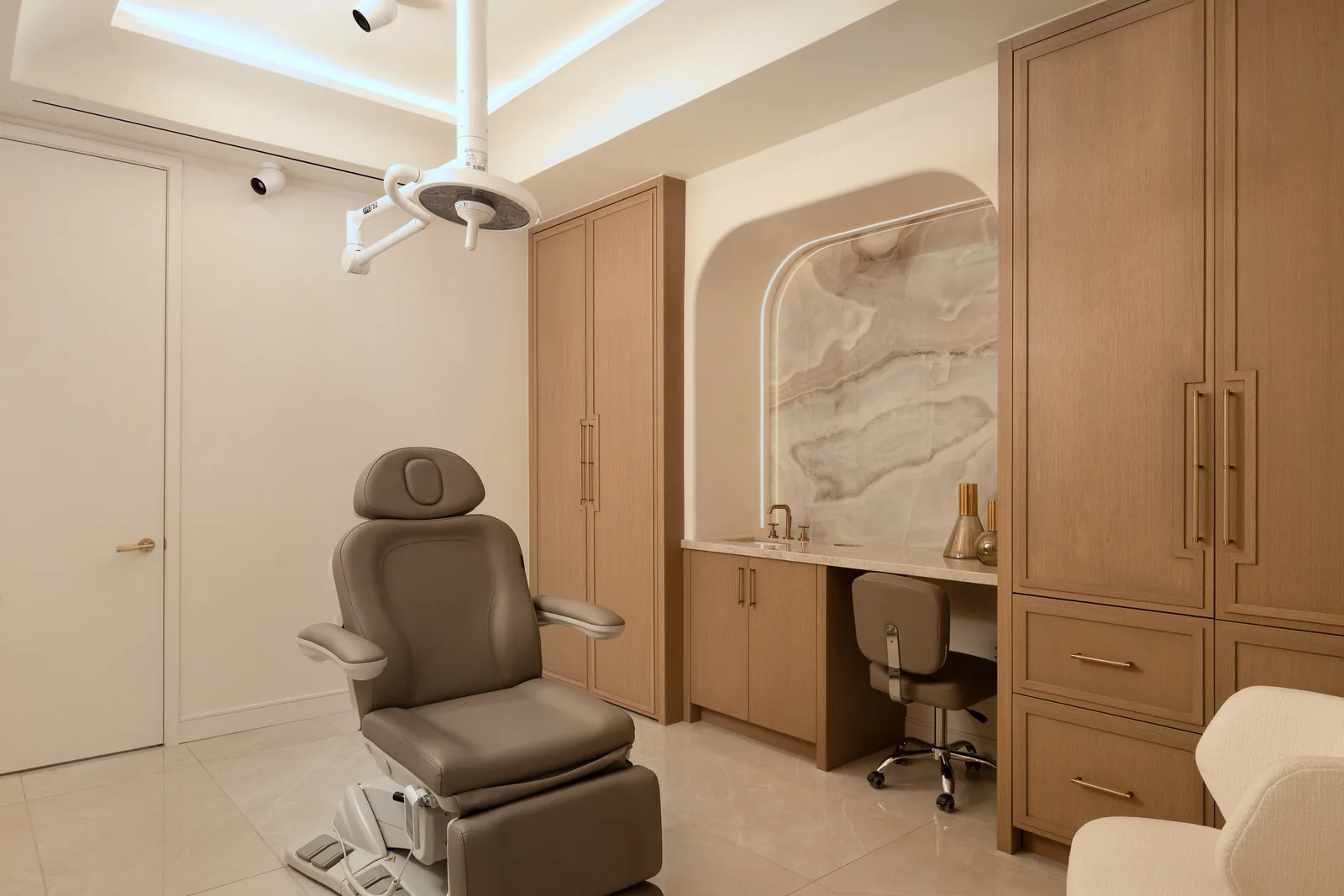
A MicroLaserPeel visit at Aesthetica by Ashley Howarth MD has three parts: an examination that decides the depth and who performs it, the laser pass itself, and a written healing and sun plan. The depth decision is the part that separates a medical practice from a spa, because it decides both the result and the days of recovery.
Skin type, sun history, and the depth decision
The team examines the surface under magnification, records your Fitzpatrick skin type and recent sun exposure, separates fine lines from etched wrinkles, flags any lesion that needs a dermatologist first, and chooses the depth in microns. Peels of 50 microns and deeper are scheduled with Dr. Howarth. Tanned skin postpones treatment.
Numbing, protective eyewear, and one even scanned pass
Numbing cream stays on for 30 to 45 minutes. You wear protective eyewear and the scanner delivers the erbium pulses in an even pattern over the face, which feels like a hot, prickly sting. The pass takes 15 to 30 minutes for a full face. Deeper peels add local nerve blocks and are performed by Dr. Howarth.
A healing and sun plan in writing
You leave with a bland occlusive ointment for the first days, a gentle cleansing routine, instructions not to pick at peeling skin, mineral SPF 30 or higher once the surface has closed, a hat-and-shade plan for 2 to 4 weeks, and the date of your follow-up or next peel.
Clear Information. Informed Choices.
Safety and Limitations of MicroLaserPeel
MicroLaserPeel is safe when the depth matches the skin type and the skin is untanned, and a lighter depth does not eliminate risk. Most side effects are expected and short-lived. The one that matters most in Arizona is post-inflammatory hyperpigmentation, a new darkening of treated skin that is more likely on tanned skin, on Fitzpatrick IV to VI skin, and on skin exposed to sun while healing. That risk is why the team screens skin type, schedules treatment between October and April, pretreats and test-spots Fitzpatrick IV skin, directs Fitzpatrick V and VI skin to MOXI or chemical peels, and reserves 50 microns and deeper for Dr. Howarth, who manages any complication personally.
Possible Side Effects Include
- Redness, warmth, and swelling for 1 to 3 days, longer with deeper peels
- Peeling and flaking for 2 to 10 days depending on depth
- Post-inflammatory hyperpigmentation, especially with sun or tanned skin
- Cold sore reactivation around the mouth without antiviral prophylaxis
- Rarely, infection, prolonged redness, lightening, or scarring
What Treatment Cannot Guarantee
- Improvement of etched wrinkles or loose skin
- A complete result from a single light peel
- Safe treatment of Fitzpatrick V and VI skin at any depth
- Permanent results while daily sun exposure continues
- A substitute for skin cancer screening
What Happens After MicroLaserPeel
Recovery After MicroLaserPeel
Recovery from MicroLaserPeel is measured in days and scales with depth: 1 to 3 days for a 10 to 20 micron weekend peel, 3 to 5 days at 30 microns, and 5 to 10 days at 50 microns and deeper or when stacked with ProFractional. The timeline below describes a 30 micron peel, the depth most patients at Aesthetica by Ashley Howarth MD choose. Deeper plans performed by Dr. Howarth follow the same stages over more days, and the Contour TRL page describes recovery from deep resurfacing.
The skin feels hot and tight for several hours and looks red or pink; cool compresses help. A bland occlusive ointment goes on before you leave and stays on; the surface is open, so no makeup, no active skin care, and no sun. Sleep with your head elevated to limit swelling.
The surface darkens slightly, tightens, and begins to peel in sheets or fine flakes by day 2 or 3. Cleanse gently 2 to 4 times a day and reapply ointment; do not pick, scrub, or exfoliate. Skip exercise, heat, and sweat until the surface has closed. New skin is visible by day 3 to 5 at 30 microns and makeup with mineral SPF can go on once peeling is complete.
Pinkness fades over 1 to 2 weeks and the skin looks noticeably smoother and brighter. Mineral SPF 30 or higher reapplied every two hours outdoors, hats, and shade for 2 to 4 weeks are what protect the result from post-inflammatory pigment in Arizona. Retinoids resume at about 2 weeks for a light peel. Read more in the Skin in Arizona guide.
Fine lines and texture keep improving as collagen remodels; Sciton describes continued improvement for up to 6 months. A second or third peel, if planned, is scheduled 6 to 8 weeks after the first, still within October to April. Most Scottsdale patients then maintain with one light peel each laser season and HydraFacial through the summer.
Before & After
MicroLaserPeel, Before and After Treatment
MicroLaserPeel results are best judged in photographs taken in the same light before treatment and 6 to 8 weeks after, once pinkness has faded and early collagen change has begun. Aesthetica by Ashley Howarth MD maintains before-and-after galleries for MicroLaserPeel, ProFractional, Contour TRL, and HALO, and the team can show you cases that match your skin type, the depth planned, whether the concern is fine lines or texture, and the time of year during your visit.
Patient Case Summaries
Selected MicroLaserPeel Case Summaries
These deidentified case summaries illustrate how the physician-led team at Aesthetica by Ashley Howarth MD plans MicroLaserPeel treatment in Scottsdale. They include light peels performed by the team and deeper peels performed by Dr. Howarth, fair and darker skin types, summer and laser-season timing, a single peel and a peel stacked with ProFractional, a first visit and annual maintenance, and a consultation in which the honest answer was a different treatment. Each summary connects the patient’s concern and skin assessment with the treatment performed or the recommendation made.
Case 01
Weekend peel
A 20 micron weekend peel for dull, rough skin before a wedding
Patient presentation
A woman in her thirties, a long-term Scottsdale resident, asked for something that would make her skin look smooth and bright for a wedding six weeks away without a week of peeling.
Skin assessment
The assessment found dull, mildly rough Fitzpatrick II skin with fine texture change and no pigment problem, no etched lines, and no suspicious lesion. She was untanned in early March.
Procedure performed
A single 20 micron MicroLaserPeel to the full face on a Thursday, performed by the physician-led laser technician under Dr. Howarth’s protocol, with numbing cream, ointment for 2 days, and a mineral SPF plan.
Clinical rationale
A 20 micron peel removes the dull outer epidermis and heals in 2 to 3 days, which fits a patient who wants visible brightness and smoothness with a weekend of recovery; deeper was not needed and would not have fit her schedule.
Follow-up
Her skin was flaking by Saturday and clear and smooth by Monday; she returned the following laser season for a 30 micron peel.
Case 02
Physician-performed deep peel
A 50 micron peel stacked with ProFractional, performed by Dr. Howarth
Patient presentation
A woman in her fifties who had moved to Scottsdale from the Northeast three years earlier reported that fine lines across her cheeks and a rough, crepey surface had worsened quickly in the desert.
Skin assessment
The assessment found fine crosshatched lines and rough texture on Fitzpatrick II skin with early superficial acne scarring on the cheeks, no etched perioral lines, and no laxity that would need surgery. She could take 10 days of recovery in January.
Procedure performed
A single session performed by Dr. Howarth: a 50 micron MicroLaserPeel to the full face stacked with ProFractional channels to the cheeks at a depth planned by zone, under topical anesthesia with local nerve blocks and antiviral prophylaxis.
Clinical rationale
A 50 micron peel reaches the base of the epidermis, where fine lines and texture change most, and stacking fractional channels adds dermal collagen remodeling for the shallow scars; because the depth exceeds the team’s protocol range and the fractional depth exceeds 1 mm, the session was physician-performed.
Follow-up
She peeled for 7 days, was pink for 2 weeks, and at her 3 month visit the lines and surface were markedly smoother; she maintains with a light peel each laser season.
Case 03
Darker skin type
Uneven texture on Fitzpatrick V skin, and why full-field erbium was not the answer
Patient presentation
A man in his forties with deep brown skin, recently relocated to Scottsdale, asked about a laser peel for rough texture and uneven tone that had worsened with outdoor work.
Skin assessment
The assessment showed rough texture with diffuse post-inflammatory hyperpigmentation on Fitzpatrick V skin. Full-field erbium ablation at any depth carries a meaningful risk of further darkening at this skin type, and the pigment was already the dominant concern.
Recommendation
A topical pigment program for six weeks, then a winter series of three conservative-density MOXI sessions with light chemical peels between them. MicroLaserPeel was not used.
Clinical rationale
On Fitzpatrick V skin the non-ablative 1927 nm fractional laser at conservative settings, paired with peels and topical suppression, improves texture and tone with far less risk than removing the full epidermal surface, and an honest no is part of a physician-led plan.
Follow-up
Over one laser season the texture and pigment improved noticeably; he continues the topical program, daily SPF, and one MOXI session each winter.
Case 04
Summer timing
A request for a laser peel in June that waited until October
Patient presentation
A woman in her forties asked for a MicroLaserPeel in June to smooth fine lines and roughness before a family reunion in August.
Skin assessment
Her skin was tanned from a summer of hiking, the Arizona UV index was above 11 most afternoons, and she could not realistically avoid sun for 2 to 4 weeks after the peel. The risk of post-inflammatory hyperpigmentation outweighed the benefit before the event.
Recommendation
Two HydraFacial treatments in June and July, a corrected mineral SPF habit, and a 30 micron MicroLaserPeel booked for October once the tan had faded.
Clinical rationale
Hydration and superficial exfoliation are safe in full sun and improve brightness enough for photographs; removing the epidermis on tanned skin in an Arizona summer was more likely to leave marks than remove them, so the peel waited for laser season.
Follow-up
She was pleased with her skin at the reunion and had the 30 micron peel in October with a second in December.
Case 05
Annual maintenance
A light peel each laser season to maintain a HALO result
Patient presentation
A woman in her sixties who had a HALO treatment two winters earlier asked how to keep the smoothness she had gained without repeating a week of peeling every year.
Skin assessment
Her face showed even tone and smooth texture on Fitzpatrick II skin with early return of fine surface lines and mild dullness, no new pigment, and no lesion of concern. She was untanned in November.
Procedure performed
A single 20 to 30 micron MicroLaserPeel to the face, neck, and chest each November, performed by the physician-led team, paired with BBL in the same visit and HydraFacial through the summer.
Clinical rationale
A light full-field peel refreshes the surface that a HALO treatment smoothed, with 2 to 4 days of recovery rather than a week, and pairing it with BBL keeps pigment and redness from returning as the skin ages under Arizona sun.
Follow-up
Her texture has held for three seasons of annual peels; she describes the November visit as the one that resets her skin for the year.
Case 06
Not this treatment
Etched lip lines and a changing spot, referred to a dermatologist and then to Contour TRL
Patient presentation
A woman in her seventies, a lifelong Arizona resident, asked for a series of laser peels to remove deep vertical lines above her lip and a rough patch on her temple that had been growing.
Skin assessment
The assessment found deeply etched perioral rhytides on Fitzpatrick II skin, beyond what any epidermal peel can reach, and a scaly, irregular lesion on the temple that needed a diagnosis before any laser treatment.
Recommendation
Referral to a dermatologist for the temple lesion first, then a consultation with Dr. Howarth for deep perioral Contour TRL resurfacing rather than a series of MicroLaserPeels.
Clinical rationale
A 10 to 50 micron peel cannot correct lines etched into the dermis, so repeating it would have cost her recovery without a result; deep perioral erbium resurfacing is the treatment that addresses them, and it is physician-performed. A growing lesion is examined before any laser touches it.
Follow-up
The temple lesion was treated by the dermatologist, and she returned in January for deep perioral Contour TRL performed by Dr. Howarth with an excellent result at 6 months.
From First Visit to a Plan You Can Keep
Booking, Planning, and Follow-Up at Aesthetica by Ashley Howarth MD
Aesthetica by Ashley Howarth MD is a medical practice with a spa’s convenience. Established patients book online. New patients can book online or request a consultation, and the team responds usually the same day.

Online booking or a consultation request
Book a skin assessment directly online, or request a consultation and describe the texture, lines, or dullness you notice, where it is, and how many days of peeling you can take. Either path starts with the same examination of your skin.
A depth, a performer, and a date in laser season
You leave your first visit with a written plan: the depth in microns; whether the physician-led team or Dr. Howarth performs it; whether ProFractional or BBL is stacked in the same session; how many peels and which months between October and April; and the ointment, sunscreen, and home routine that protects the result.
A check at 6 to 8 weeks, then annual maintenance
Results are reviewed at 6 to 8 weeks, when a second peel is scheduled if planned. Most Scottsdale plans then repeat annually: a light peel each laser season, summer HydraFacial, year-round mineral sunscreen. A-List members have the next season scheduled before they leave the last one.
Your Questions, Answered
MicroLaserPeel Frequently Asked Questions
MicroLaserPeel is Sciton’s full-field erbium laser peel. The 2940 nm erbium:YAG laser removes an even layer from the entire treated surface at a depth set in microns, from about 10 microns for a weekend peel to 50 microns or deeper. It treats fine lines, rough texture, dullness, and superficial sun damage, and heals in 2 to 10 days depending on depth.
MicroLaserPeel treats surface concerns: fine lines, rough or crepey texture, dullness, mottled tone, superficial sun-related change, enlarged pores, and shallow surface scars on the face, neck, chest, and hands. It does not treat etched wrinkles, loose skin, or deep acne scars; those go to Contour TRL, ProFractional, or surgery at Aesthetica by Ashley Howarth MD.
Water in the skin absorbs the 2940 nm erbium wavelength almost completely, so each pulse vaporizes a precise, thin layer with very little heat spread. A scanner delivers the pulses evenly across the full face at the depth chosen. The skin then re-epithelializes from below over 2 to 5 days for a light peel, with a smoother, brighter surface and collagen change that continues for months.
Fitzpatrick I to III skin is treated at any offered depth. Fitzpatrick IV skin is treated at light depths after pretreatment and a test area because full-field ablation raises the risk of post-inflammatory hyperpigmentation. Fitzpatrick V and VI skin is usually directed to MOXI or chemical peels instead. Tanned skin of any type postpones treatment, which is why Aesthetica by Ashley Howarth MD schedules peels October to April.
Sciton lists 1 to 3 treatments, repeated no sooner than 6 to 8 weeks apart. A single 30 micron peel gives a visible change; a series of 2 to 3 gives more. In Arizona the series is planned to finish within laser season, October to April, so a first peel in October leaves room for two more before spring. Most patients then maintain with one light peel a year.
Downtime scales with depth: 1 to 3 days of pinkness and fine flaking for a 10 to 20 micron weekend peel, 3 to 5 days of peeling at 30 microns, and 5 to 10 days at 50 microns or when stacked with ProFractional. After the surface closes, 2 to 4 weeks of strict sun protection follow, which in Scottsdale means scheduling between October and April.
With numbing cream for 30 to 45 minutes, a 10 to 30 micron peel feels like a hot, prickly sting during the 15 to 30 minute pass and like a strong sunburn for several hours afterward. Peels of 50 microns and deeper, performed by Dr. Howarth, add local nerve blocks and oral medication when needed. Cool compresses and ointment manage the first evening.
Brighter, smoother skin is visible as soon as peeling finishes, at 3 to 5 days for a 30 micron peel, and pinkness fades over 1 to 2 weeks. Fine lines and texture keep improving as collagen remodels; Sciton describes continued improvement for up to 6 months. Results are photographed and reviewed at 6 to 8 weeks.
Yes. MicroLaserPeel is most often stacked with ProFractional in the same session, the full-field peel smoothing the surface while fractional channels treat scars and collagen; those sessions are performed by Dr. Howarth. BBL is added first in the same visit for brown spots and redness. Botox and fillers are scheduled 2 weeks before or after, and MicroLaserPeel can blend transitions after Contour TRL or facial surgery.
The surface a MicroLaserPeel creates lasts as long as the skin is protected from new sun damage, and in Scottsdale that is about 300 days of sun a year. With daily mineral SPF 30 or higher, most patients hold a 30 micron result for a year and maintain it with one light peel each laser season. Without sunscreen, roughness and mottling return within a summer or two.
Concerns Treated
Concerns This Treatment Addresses
These guides explain each concern and where this treatment fits among the options at Aesthetica by Ashley Howarth MD in Scottsdale.
- Fine Lines & Wrinkles Fine surface lines, the first use of a full-field erbium peel
- Skin Texture, Pores & Dullness Rough, dull skin smoothed by removing a measured layer
- Sun Damage & Brown Spots Superficial sun-related change, often paired with BBL
- Acne & Acne Scars Shallow scars, with ProFractional stacked for deeper ones
- Dry & Dehydrated Skin When a peel helps and when hydration comes first
- Sciton Laser Comparison Which laser fits which concern
BEGIN HERE
Request a Consultation
Tell us what you are considering. A member of our patient care team will follow up with consultation availability and next steps.

Megan S.
Patient Coordinator
Prefer to talk or text?
Selected References