
Needle Piercing in a Medical Setting
What Registered Nurse Ear Piercing Is
Registered nurse ear piercing uses a sterile, single-use hollow needle in a medical office rather than a retail spring-loaded gun: the nurse examines the ear, marks placement with you looking in a mirror, pierces, and sets a sterile-packaged implant-grade titanium or 14k gold threadless stud, all in about 30 minutes for a pair of lobes. Placements range from lobes to helix, conch, and tragus, children are pierced from age 12 with a parent present, and lobes are typically tender-free by 6 to 8 weeks while cartilage takes 6 to 12 months to heal fully.
Registered nurse ear piercing is ear piercing performed by a registered nurse with a sterile, single-use hollow needle in a medical office, rather than by a retail employee with a spring-loaded gun. At Aesthetica by Ashley Howarth MD, the med spa of Howarth Plastic Surgery in Scottsdale, the nurse examines the ear, marks the placement with you looking in a mirror, pierces with a hollow needle that is opened in front of you and discarded after one use, and sets a sterile-packaged implant-grade titanium or 14k gold threadless stud in the same motion. The visit takes about 30 minutes for a pair of lobes, including the placement consultation and aftercare instructions. Placements include the first, second, and third lobe, the helix and flat helix, the conch, and the tragus, alone or planned as an ear stack. Children are pierced from age 12 with a parent present. Earlobes typically stop being tender by 6 to 8 weeks; cartilage placements take 6 to 12 months to heal fully, and jewelry stays in for at least 12 months. Aftercare is sterile saline twice daily and nothing else.
The reason to pierce in a plastic surgery practice is judgment before the needle and access after it. A piercing is a small controlled wound, and the same questions that precede any procedure apply: is there a history of keloids, an active skin condition, a blood thinner, a prior piercing that never healed. A registered nurse asks them, and a physician is in the building when the answer changes the plan. Piercing guns are not used because their spring-loaded mechanism cannot be autoclaved, the blunt stud is pushed through the tissue rather than passing through a cut channel, and the same device moves between customers; a 2004 outbreak of Pseudomonas cartilage infections traced to a retail kiosk is the case study the Association of Professional Piercers still cites. A 2008 cadaver study found guns and needles injure cartilage to a similar degree, which is the honest reason the practice emphasizes sterility, placement, and aftercare rather than promising a needle heals by itself. The same office offers HydraFacial, facials, and the rest of the medical aesthetics menu, and the ear is examined by people who also treat scars.

Why Patients Ask for Nurse Piercing
What Patients Who Choose Registered Nurse Ear Piercing Notice
Most people who ask Aesthetica by Ashley Howarth MD about ear piercing have a specific reason for not going back to a retail counter. Some had a lobe piercing years ago that healed crooked, low, or with a lump. Some are planning a stack and want the placements to line up. Many are parents who want a child’s first piercing done by someone with a medical license. These are the reasons the team hears most.
- A first lobe piercing from childhood that sits uneven or too close to the edge
- A helix or cartilage piercing from a studio that stayed sore for a year
- A raised bump or lump at an old piercing site
- A child who is ready for a first piercing, and a parent who is not ready for a kiosk
- An ear stack planned one piercing at a time with no plan for the whole ear
- Sensitivity to earring metals that made every stud itch
A nurse-placed piercing solves the placement and sterility problems directly and screens for the ones a retail counter cannot: keloid tendency, metal allergy, skin disease, and medications that affect healing. What it cannot do is heal cartilage faster than cartilage heals, so the plan is honest about months rather than weeks.


Surgeon-Directed Care
More Tools in the Toolbox: Why a Plastic Surgeon Directs Ear Piercing
Aesthetica by Ashley Howarth MD is the medical aesthetics practice of Ashley Howarth, MD, FACS, a board-certified plastic surgeon and instructor in plastic surgery at Mayo Clinic. Ear piercing does not need a surgeon to hold the needle; it benefits from a surgeon writing the protocol and being in the building. Plastic surgeons treat the two things that go wrong with piercings. Keloids of the earlobe and helix are a plastic surgery problem, treated with injection, excision, and sometimes pressure or radiation, and they are far easier to prevent than to treat, so Dr. Howarth’s protocol requires the registered nurse to ask about keloids in the patient and the family before any placement and to decline cartilage piercing when the answer is yes. Perichondritis, infection of the ear cartilage, is the other: a hot, swollen helix needs antibiotics that reach cartilage and sometimes drainage, and delay costs ear shape. At a retail counter neither problem has a doctor attached to it. Here both do.
The surgeon’s judgment also decides who should not be pierced today: the patient on a blood thinner without clearance, the teenager on isotretinoin, the adult with eczema flaring on the lobe, the child who is not ready to hold still. And because Aesthetica by Ashley Howarth MD is the med spa of a plastic surgery practice, an ear that needs more than a piercing, a torn or stretched lobe from heavy earrings, a lump that is a keloid, is evaluated and repaired by the same physician. The piercing itself is performed by a registered nurse under her protocols; the screening, the exceptions, and the complications are hers. More tools in the toolbox, and an honest answer about which one you need.

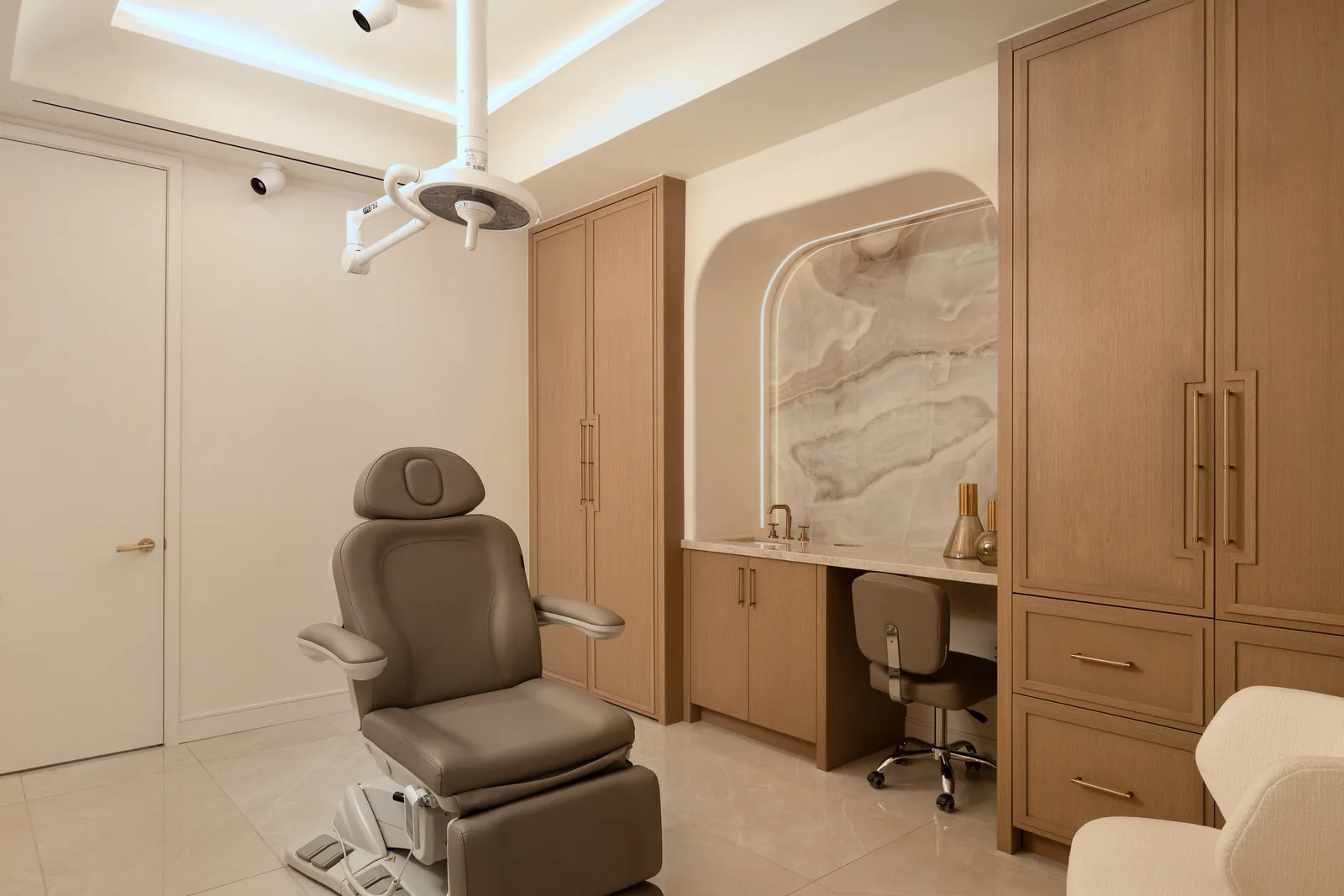
SCOTTSDALE · MODERN OFFICE SETTING
Where to Start
Who Ear Piercing at a Plastic Surgery Practice Is For, and What Happens First
Registered nurse ear piercing at Aesthetica by Ashley Howarth MD is for adults and for children age 12 and older with a parent present who want a lobe or cartilage piercing placed with medical technique, and it is especially suited to anyone with a prior piercing that healed poorly, a metal sensitivity, or a stack they want planned rather than accumulated. The placement consultation comes first and takes about ten minutes. The nurse examines both ears for asymmetry, thickness of the lobe, the shape of the helix rim and the conch bowl, and any old piercing tract, scar, or bump; asks about keloids in you or your family, eczema or psoriasis on the ear, blood thinners, isotretinoin, diabetes, and pregnancy; and then marks the placement with a surgical marker while you look in a mirror until the dots are where you want them. A history of keloids moves cartilage off the table and prompts a frank conversation about lobes. An active infection or irritated old piercing is treated first; a new hole is not placed next to a problem. If a lump at an old site is a keloid rather than an irritation bump, Dr. Howarth is the person in the building who treats keloids, and that conversation happens before any new piercing.
Dr. Ashley Howarth, MD, FACS is a board-certified plastic surgeon and an instructor in plastic surgery at Mayo Clinic. Aesthetica by Ashley Howarth MD is the medical aesthetics brand of her practice, Howarth Plastic Surgery, at 7373 N. Scottsdale Road, Suite C150, Scottsdale, Arizona 85253.

Needle, Jewelry, Placement, and Aftercare
How Ear Piercing Is Done at Aesthetica by Ashley Howarth MD
A Hollow Needle, Not a Piercing Gun
A hollow needle cuts a clean channel for the stud to follow, while a piercing gun’s plastic housing can’t be autoclaved between customers and was never designed for cartilage, though a 2008 cadaver study found needles and guns damage cartilage to a similar degree.
The registered nurse pierces with a sterile, single-use hollow needle opened from its package in front of you and discarded in a sharps container after one use. A hollow needle cuts a clean channel and the stud follows it; a piercing gun drives a blunt stud through the tissue with a spring, its plastic housing cannot be autoclaved between customers, and it was never designed for cartilage. The Association of Professional Piercers has opposed guns for decades on those grounds, and a 2004 JAMA report traced an outbreak of Pseudomonas cartilage infections to a retail kiosk using one. Honesty requires one more sentence: a 2008 cadaver study found needles and guns damage cartilage to a similar degree, which is why the practice’s claim is about sterility, control, and aftercare, not about a magic needle.
Implant-Grade Titanium and 14k Gold Studs
Initial jewelry is a sterile, threadless flatback stud in implant-grade titanium or 14k gold, with titanium recommended for anyone with a history of reacting to nickel in costume earrings.
Initial jewelry is a threadless flatback stud in implant-grade titanium or 14k yellow or white gold, packaged sterile and never reused. Titanium is the choice for anyone with a history of itching or rash from earrings, since nickel in costume and plated jewelry is the usual cause of that reaction; gold is the choice for those who want it and have no metal sensitivity. A flatback sits flush against the ear, does not snag in hair or on a pillow, and can be fitted with a slightly longer post to allow for the swelling of the first weeks, then downsized. Hoops are avoided for the first 4 to 6 months because they move in the channel with every turn of the head. Jewelry choice is part of the consultation, not an afterthought at the register.
Placement for a Single Piercing or an Ear Stack
The nurse plans the whole ear even when placing just one piercing today, so future additions to an ear stack line up, and cartilage placements are limited to one or two per visit since each is a months-long healing project.
Placement is marked on the ear with you watching. For a first lobe pair the nurse checks that the two ears, which are almost never symmetric, read as symmetric from the front. For a second or third lobe, a helix, a flat helix, a tragus, or a conch, the nurse plans the whole ear even when only one piercing is placed today, so that later additions line up and jewelry does not collide. Cartilage placements are limited to one or two per visit because each is a months-long healing project and sleeping on a fresh cartilage piercing is the most common reason it fails. A written map of the planned stack goes in your chart. Patients often coordinate a stack with the rest of their skin plan, from facials to Botox, at the same practice.
Aftercare, Healing Times, and When Something Is Wrong
Aftercare is simply sterile saline wash twice a day with nothing else, and spreading redness, increasing swelling, pus, fever, or a hot, painful cartilage piercing warrants a same-day call since untreated infection can deform the ear.
Aftercare is simple by design: sterile saline wound wash twice a day, hands washed before touching the ear, no rotating the jewelry, no alcohol, peroxide, or ointment, and no pools, lakes, or hot tubs while the piercing is open. Lobes usually stop being tender by 6 to 8 weeks; cartilage takes 6 to 12 months and can feel healed on the surface long before it is. Jewelry stays in for at least 12 months. Redness that spreads, swelling that increases after day three, pus, fever, or a cartilage piercing that becomes hot and painful is an infection until proven otherwise, and a cartilage infection is a same-day call to the office, because untreated perichondritis can deform the ear. A raised, firm, growing bump is examined for keloid, which a plastic surgeon treats and a piercer cannot.
At a Glance
Ear Piercing at a Glance
Placements offered by the registered nurse at Aesthetica by Ashley Howarth MD, typical healing times, initial jewelry, and the notes that decide placement; individual plans are set at the placement consultation.
| Placement | Healing time | Jewelry | Notes |
|---|---|---|---|
| First lobe | 6 to 8 weeks; downsized at 6 to 8 weeks | Implant-grade titanium or 14k gold threadless flatback | The standard first piercing; children from age 12 with a parent present; marked to read level from the front |
| Second and third lobe | 6 to 8 weeks | Titanium or 14k gold flatback, often smaller than the first | Spacing planned against the first piercing and the lobe edge; constellation designs mapped for the whole lobe |
| Helix and flat helix | 6 to 12 months; downsized at about 12 weeks | Titanium flatback with a longer initial post | Cartilage; one or two per visit; sleep off the ear; declined with a keloid history |
| Tragus | 6 to 12 months | Small titanium flatback | Cartilage; anatomy must be thick enough for a stud; earbuds avoided while healing; confirm availability at consultation |
| Conch | 6 to 12 months | Titanium flatback; a hoop only after healing | Cartilage in the bowl of the ear; a bold placement that anchors a stack; declined with a keloid history |
| Ear stack plan | 12 to 18 months for a full stack | Mixed metals matched across placements | Mapped at the first visit, placed one or two at a time, cartilage first in the cooler months; the map goes in your chart |
Three Ways to Get Pierced
Needle vs Gun vs Studio
How registered nurse needle piercing at Aesthetica by Ashley Howarth MD compares with a retail piercing gun and with a professional piercing studio; the practice’s advantage is medical screening and access to a physician, and a good studio shares the needle and jewelry standards.
| Registered nurse, needle | Piercing gun | Piercing studio | |
|---|---|---|---|
| Instrument and sterility | Sterile single-use hollow needle, opened in front of you, discarded after one use | Spring-loaded reusable device with plastic parts that cannot be autoclaved; a blunt stud is forced through the tissue | Sterile single-use hollow needle at a reputable studio; standards vary by studio |
| Who performs it | A registered nurse under a board-certified plastic surgeon's protocols | A retail employee, often with brief training | A professional piercer; training and licensing vary by state |
| Medical screening | Keloid history, skin disease, blood thinners, isotretinoin, diabetes, pregnancy, and old piercing sites reviewed before placement | Usually none | A consent form; medical judgment is outside a piercer's scope |
| Jewelry | Implant-grade titanium or 14k gold threadless flatbacks, sterile-packaged, never reused | Gun-loaded studs with butterfly backs, often plated, that trap debris during healing | Implant-grade titanium or gold at a good studio; broader style choice |
| Cartilage placements | Helix, flat helix, tragus, and conch, one or two per visit, declined with a keloid history | Not designed for cartilage; the setting of a 2004 outbreak of Pseudomonas cartilage infections | Widely offered, including placements the practice does not do |
| When something goes wrong | Same-day evaluation of infection; keloids and cartilage infections treated by the physician-led team; torn lobes repaired surgically | Referred elsewhere | Aftercare advice; medical problems are referred to a doctor |
A Thirty-Minute Visit
What to Expect at an Ear Piercing Visit at Aesthetica by Ashley Howarth MD
An ear piercing visit at Aesthetica by Ashley Howarth MD has three parts: a placement consultation with a short medical screen, the piercing itself, and written aftercare with a follow-up date. A pair of lobes takes about 30 minutes in the room; a single cartilage placement about the same, because most of the time is spent on placement, not on the needle. Optional topical numbing cream adds about 20 minutes of wait.
Ears examined, history taken, dots marked in the mirror
The registered nurse examines both ears and any old piercing sites, asks about keloids, skin conditions, blood thinners, isotretinoin, diabetes, and pregnancy, confirms a parent is present for a minor, marks the placement with a surgical marker, and adjusts it until you approve in the mirror. Jewelry metal and post length are chosen now.
Skin prep, a single-use hollow needle, and the stud placed in one motion
The ear is cleaned with an antiseptic, the sealed needle and sterile-packaged stud are opened in front of you, and the nurse pierces through the mark and seats the stud in one continuous motion. It feels like a quick firm pinch on a lobe and a pressure sensation on cartilage. A pair of lobes takes under a minute of actual piercing.
Saline, a healing timeline, and a follow-up date
You leave with sterile saline wound wash and written instructions, a healing timeline for your placement (6 to 8 weeks for lobes, 6 to 12 months for cartilage), the signs of infection that warrant a same-day call, and a downsizing appointment at about 6 to 8 weeks to swap the longer initial post for a snug one.
Clear Information. Informed Choices.
Safety and Limitations of Ear Piercing
Ear piercing is safe when the instrument is sterile and single-use, the jewelry is implant-grade, the placement suits the anatomy, and the aftercare is followed. Most problems are minor: tenderness, a little swelling, and crusting for the first week or two. The two that matter medically are infection of cartilage and keloid scarring. Cartilage has a poor blood supply, so an infected helix or conch piercing can progress to perichondritis and, if untreated, to a deformed ear; that is why cartilage placements are limited per visit, why sleeping on them is discouraged, and why any hot, painful cartilage piercing is seen the same day. Keloids run in families and are more common on darker skin and in adolescents and young adults; a 2005 Pediatrics survey found piercings placed after age 11 were far more likely to keloid than those placed earlier, and a personal or family history is the reason the practice advises against cartilage piercing and counsels carefully about lobes. Nickel allergy, embedded studs from tight jewelry, and a piercing that migrates or tears are the remaining risks, and all are reduced by implant-grade flatbacks fitted with the right post length.
Possible Side Effects Include
- Tenderness, mild swelling, and light crusting for 1 to 2 weeks
- Irritation bumps on cartilage piercings that are slept on or snagged
- Infection, including cartilage perichondritis, which needs same-day evaluation
- Keloid or hypertrophic scarring, more likely with a family history or darker skin
- Rarely, an embedded stud, tearing, migration, or metal allergy
What Treatment Cannot Guarantee
- Cartilage that heals in weeks rather than months
- No keloid in a patient with a strong keloid history
- Perfectly mirrored placement on two ears that are not mirror images
- A piercing that stays open if jewelry is removed early
- Healing on schedule without twice-daily saline and sleeping off the ear
What Happens After Ear Piercing
Healing After Ear Piercing
Healing after ear piercing depends almost entirely on placement. A lobe is soft tissue with a good blood supply and is comfortable in 6 to 8 weeks. Cartilage on the helix, flat, tragus, or conch has little blood supply and takes 6 to 12 months, often feeling healed on the surface at 3 months while the channel underneath is still fragile. The timeline below covers both. Sterile saline twice daily is the whole aftercare routine; the products that cause problems are the ones added to it. In Arizona, sweat and pool water are the two summer variables, so a cartilage piercing is often planned for a season when neither is constant.
The ear is warm and slightly swollen for the rest of the day, and a small amount of bleeding at the site is normal. Sterile saline that evening, hands washed first, and no touching or turning of the stud. Sleep on the opposite side; for cartilage, a travel pillow with the ear in the hole keeps pressure off. Hair products, perfume, and phone screens stay away from the site.
Swelling peaks around day 2 to 3 and settles over the first week, which is why the initial post is slightly long. Pale yellow crust at the stud is dried lymph fluid, not pus; rinse it with saline rather than picking it. Redness that spreads, swelling that increases after day three, thick discharge, or a hot painful cartilage piercing is a same-day call. No pools, lakes, or hot tubs. Makeup and hair dye stay off the ear.
Lobes are usually no longer tender by 6 to 8 weeks and the initial post is downsized to a snug one at the follow-up visit; a lobe stud can be changed after 8 weeks if there is no tenderness. Cartilage piercings are downsized at about 12 weeks but are not healed; changing the jewelry yourself, wearing a hoop, or sleeping on the ear at this stage is what produces the irritation bump that brings people back. Saline continues.
Cartilage is reliably healed between 6 and 12 months, and hoops can be worn after 4 to 6 months once the channel is stable. All jewelry stays in for at least 12 months so the piercing does not close. This is when the next placement in a planned stack is added. Any bump that is firm and growing rather than shrinking is examined for keloid; treatment for that is a physician’s job, and the physician is here. The medical aesthetics guide covers the rest of the menu.
Before & After
Ear Piercing Placement, Before and After
Ear piercing results are judged on placement and healing rather than on a transformation: a first lobe pair that reads level from the front, a helix that sits on the rim rather than in it, a stack whose pieces line up. Aesthetica by Ashley Howarth MD photographs placements at the visit and at the downsizing follow-up, and the team can show you healed examples of the placement you are considering during your consultation. The practice’s broader galleries cover HydraFacial, SkinPen, and the facial surgery that repairs torn or stretched lobes.
Patient Case Summaries
Selected Ear Piercing Case Summaries
These deidentified case summaries illustrate how the physician-led team at Aesthetica by Ashley Howarth MD plans ear piercing in Scottsdale. They include a keloid-prone adult who was advised against cartilage piercing, a child’s first piercing with a parent present, an infected earlier piercing that was treated before anything new was placed, an ear stack planned across a year, a metal-sensitive patient, and a lobe pair placed to correct an uneven childhood piercing. Each summary connects the patient’s request and ear assessment with the procedure performed or the recommendation made.
Case 01
Keloid-prone adult
A helix piercing request that became a lobe piercing after a keloid history was taken
Patient presentation
A woman in her twenties with deep brown skin asked for a helix piercing to start a stack she had seen on a friend.
Skin assessment
Both lobes had been pierced in early childhood and healed flat, but she reported a raised scar on her shoulder after a minor cut and a mother who had had an earlobe keloid removed. Fitzpatrick V skin, no active skin disease, no medications. Under Dr. Howarth’s protocol a personal or family keloid history moves cartilage piercing off the plan.
Recommendation
Cartilage piercing was declined and the reasons explained. A single second lobe piercing on each side was offered as the lower-risk option, placed by the registered nurse with implant-grade titanium flatbacks, with a keloid warning sheet and a follow-up at six weeks.
Clinical rationale
Keloids form more readily on cartilage than on the lobe, more readily on darker skin, and in patients with a family history; a 2005 survey found piercings placed after age 11 keloided far more often than earlier ones. A plastic surgery practice that treats keloids would rather decline a helix than remove a keloid from one.
Follow-up
The lobes healed flat at six weeks and remained flat at one year; she chose a curated two-piercing-per-lobe look instead of a cartilage stack.
Case 02
Child with a parent
A first lobe pair for a twelve-year-old with her mother in the room
Patient presentation
A mother brought her daughter, who had just turned 12, for a first lobe piercing after deciding against a mall kiosk.
Skin assessment
Healthy child with no keloid history in the family, no eczema, and ears of slightly different lobe size, which is typical. The nurse confirmed the parent’s consent, explained the process to the child directly, and marked placement so that the two ears read level from the front.
Procedure performed
Bilateral first lobe piercing by the registered nurse with single-use hollow needles and sterile-packaged 14k gold threadless flatbacks, with the mother seated beside her, no numbing cream by the child’s choice, and a saline aftercare plan that the child could do herself.
Clinical rationale
The practice’s minimum age of 12 with a parent present exists so the child can hold still, understand the aftercare, and consent alongside the parent; a nurse-placed, needle-pierced lobe with implant-grade jewelry removes the sterility and nickel questions a kiosk cannot answer.
Follow-up
The initial posts were downsized at 8 weeks; the piercings healed without irritation, and the family returned a year later to plan a second lobe.
Case 03
Infected prior piercing
A hot, swollen helix from a studio piercing treated before anything new was placed
Patient presentation
A man in his thirties came in asking for a second helix piercing to match one done at a studio two months earlier that was still red and sore.
Skin assessment
The existing helix piercing was warm, swollen, and tender with a small amount of discharge, consistent with early perichondritis; he had been sleeping on it and cleaning it with rubbing alcohol. Fitzpatrick III skin, otherwise healthy.
Recommendation
No new piercing. The registered nurse escalated to Dr. Howarth the same day; he was started on an antibiotic that reaches cartilage, the jewelry was left in place to preserve drainage, alcohol was stopped in favor of sterile saline, and he was seen again in 48 hours.
Clinical rationale
Cartilage has a poor blood supply, so infection there progresses faster than on a lobe and can leave a deformed ear; placing a second piercing beside an infected one would have doubled the problem. A physician-led practice treats the infection first and plans the stack later.
Follow-up
The infection resolved over two weeks; six months later, once the first helix had healed fully, the matching piercing was placed by the nurse with a travel-pillow sleeping plan.
Case 04
Ear stack plan
A five-piercing stack mapped at the first visit and placed over twelve months
Patient presentation
A woman in her forties, a long-term Scottsdale resident, wanted a curated stack on one ear: her existing first lobe plus a second lobe, a mid-helix, a flat helix, and a conch, and asked to have them all done that day.
Skin assessment
Healthy, Fitzpatrick II, no keloid history, an existing well-healed lobe piercing set slightly low. A helix rim with room for two placements and a conch bowl deep enough for a stud. The request for five in one visit was the issue.
Procedure performed
A written stack map was drawn with her in the mirror. Visit one, in October: the second lobe and the conch, titanium flatbacks. Visit two, at 4 months: the mid-helix. Visit three, at 9 months: the flat helix, with the earlier pieces downsized along the way.
Clinical rationale
Cartilage placements heal over 6 to 12 months and fail most often from sleeping pressure, so one or two per visit is the practical limit; mapping the whole ear first meant each later piercing landed where the jewelry would not collide, and starting in the cooler months kept sweat and pool water out of the first healing weeks.
Follow-up
All five were healed and downsized by month 14, and the stack reads as designed; she now books a placement check each fall alongside her skin visit.
Case 05
Metal sensitivity
A lifetime of itchy earrings solved with implant-grade titanium and a re-pierced lobe
Patient presentation
A woman in her fifties reported that every earring she had worn since childhood made her lobes itch and weep, and that both childhood piercings had partly closed from disuse.
Skin assessment
Both lobes showed thin, partially closed tracts with mild eczematous change, a pattern typical of nickel allergy from plated and costume jewelry. No keloid history, no active dermatitis on the day of the visit.
Procedure performed
Rather than forcing a post through the old tracts, the registered nurse re-pierced each lobe with a hollow needle at a slightly better position and set implant-grade titanium flatbacks, with a plan to wear only titanium or solid 14k gold going forward.
Clinical rationale
Nickel is the usual cause of earring dermatitis, and implant-grade titanium is essentially nickel-free; a clean new channel with inert jewelry heals in the 6 to 8 weeks a lobe needs, while a scarred, partially closed tract reopened with a stud does not.
Follow-up
Both lobes healed without itching for the first time she could remember; she was downsized at 8 weeks and has had no dermatitis at one year.
Case 06
Uneven childhood piercing
A crooked first lobe pair from a kiosk corrected with a new placement
Patient presentation
A woman in her thirties who had moved to Scottsdale the year before disliked that her left earring hung lower and further forward than her right, a childhood kiosk piercing she had lived with for decades.
Skin assessment
The left lobe piercing sat about 3 mm lower and closer to the face than the right, both tracts healed and unremarkable, Fitzpatrick III, no keloid history, no metal sensitivity.
Procedure performed
A new left lobe piercing was placed by the registered nurse to mirror the right, with the old tract left to close on its own, and a matching second lobe pair was added above both at the same visit so the retired hole would read as part of a stack if it did not fully close.
Clinical rationale
Ears are rarely symmetric, and a placement that reads level from the front is a judgment made in the mirror with a marker, not a template; an old lobe tract can be retired rather than fought, and the practice can close or revise it surgically if it ever needs to be.
Follow-up
The old tract closed within a few months; the new pair reads level, and she wears a matched stack of two studs on each side.
From First Visit to a Plan You Can Keep
Booking, Planning, and Follow-Up at Aesthetica by Ashley Howarth MD
Aesthetica by Ashley Howarth MD is a medical practice with a spa’s convenience. Established patients book online. New patients can book online or request a consultation, and the team responds usually the same day.

Online booking or a consultation request
Book an ear piercing visit directly online, or request a consultation and describe the placement you want, any old piercings, and whether a child is being pierced. A parent or legal guardian must attend with anyone under 18.
A placement map, not a single hole
You leave your first visit with placement marked and photographed, jewelry chosen, a written healing timeline for your placement, saline aftercare, the signs that warrant a same-day call, and, for a stack, a map of which piercings come next and when.
Downsizing at 6 to 12 weeks, then the next placement
Lobes are downsized at about 6 to 8 weeks and cartilage at about 12 weeks, with a placement check before any new piercing is added. Skin visits and piercing visits are often paired. A-List members have the next placement scheduled before they leave the last one.
Your Questions, Answered
Ear Piercing Frequently Asked Questions
A hollow needle lobe piercing feels like a quick, firm pinch that lasts about a second; the lobe has few nerves and is mostly fatty tissue. Cartilage placements such as the helix, tragus, or conch feel more like a sharp pressure and are tender for longer afterward, though most patients say it hurt less than expected. Topical numbing cream is available for anyone anxious or sensitive to pain.
Yes. A topical numbing cream can be applied about 20 minutes before the piercing for patients who want it, most often for cartilage placements or for nervous first-timers. Many adults and most lobe piercings do not need it, since the piercing itself takes about a second. The registered nurse discusses the option at the placement consultation, and the choice is yours.
At Aesthetica by Ashley Howarth MD in Scottsdale the minimum age is 12, with a parent or legal guardian present and consenting. The policy exists because a child needs to hold still for a needle piercing, understand the aftercare, and agree to it alongside the parent. The nurse explains each step to the child directly, and a parent stays in the room throughout.
Earlobe piercings usually stop being tender by 6 to 8 weeks. Cartilage piercings on the helix, flat helix, tragus, or conch take 6 to 12 months to heal fully and often feel healed on the surface at 3 months while the channel underneath is still fragile. Jewelry stays in place for at least 12 months so the piercing does not close. Sterile saline twice daily is the entire aftercare routine.
A lobe stud can be changed after about 8 weeks if there is no tenderness. Cartilage jewelry is downsized by the nurse at about 12 weeks and should not be changed at home until the piercing is fully healed, usually 6 to 12 months. Hoops are avoided for 4 to 6 months because they move in the channel with every turn of the head and cause irritation bumps.
Piercing guns drive a blunt stud through the ear with a spring, their plastic housings cannot be autoclaved between customers, and they were never designed for cartilage; a 2004 JAMA report traced an outbreak of cartilage infections to a retail kiosk using one. A sterile, single-use hollow needle cuts a clean channel and is discarded after one use. The Association of Professional Piercers has opposed guns for decades on the same grounds.
A registered nurse pierces, a board-certified plastic surgeon sets the protocol, and both are in the same building. That means a screen for keloid history, metal allergy, skin disease, and medications before any placement, sterile single-use needles and implant-grade jewelry, placement planned for the whole ear, and a physician who treats keloids and cartilage infections if a piercing, here or elsewhere, goes wrong. The medical aesthetics guide explains the rest of the practice.
Cautiously, and not on cartilage. Keloids run in families, are more common on darker skin, and form more readily after cartilage piercing than lobe piercing; a 2005 survey found piercings placed after age 11 keloided far more often than earlier ones. At Aesthetica by Ashley Howarth MD a personal or family keloid history rules out cartilage placements, and a lobe piercing is offered only after an honest discussion of the risk.
First, second, and third lobe placements, including constellation designs; mid-helix; helix and flat helix; conch; and tragus. All are performed by a registered nurse with a hollow needle at Aesthetica by Ashley Howarth MD in Scottsdale. Cartilage placements are limited to one or two per visit because each heals over 6 to 12 months, and a stack is mapped at the first visit and placed over time. Torn or stretched lobes are repaired by Dr. Howarth as part of facial surgery.
Initial jewelry is a threadless flatback stud in implant-grade titanium or 14k yellow or white gold, packaged sterile and never reused. Titanium is chosen for anyone with a history of itching or rash from earrings, since nickel in plated and costume jewelry is the usual cause. The first post is slightly long to allow for swelling and is downsized at the follow-up visit.
Concerns Treated
Concerns This Treatment Addresses
These guides explain each concern and where this treatment fits among the options at Aesthetica by Ashley Howarth MD in Scottsdale.
- Medical Aesthetics Which treatment fits which concern, across all eight services
- HydraFacial The no-downtime facial often booked with a piercing visit
- Facials Customized medical facials with the licensed aesthetician
- SkinPen Microneedling Collagen induction for texture and acne scars
- Facial Surgery Torn or stretched earlobe repair and keloid treatment with Dr. Howarth
- Skin in Arizona Why timing matters in the desert
BEGIN HERE
Request a Consultation
Tell us what you are considering. A member of our patient care team will follow up with consultation availability and next steps.

Megan S.
Patient Coordinator
Prefer to talk or text?
Selected References