
Collagen Induction Without Heat
What SkinPen Microneedling Is
SkinPen Precision, the first FDA-cleared microneedling device, makes thousands of controlled micro-injuries with a sterile, single-use needle cartridge to trigger new collagen and elastin, and its clearance covers facial acne scars in adults 22 and older of all Fitzpatrick types and neck wrinkles in Fitzpatrick II to IV. At Aesthetica by Ashley Howarth MD it’s performed by the licensed aesthetician or registered nurse in a series of 3 to 6 sessions, uses no heat or light so it’s safe on darker skin and in the Arizona summer, and leaves skin pink for 1 to 3 days.
SkinPen Precision is a microneedling device that makes thousands of controlled micro-injuries in the skin with a sterile, single-use needle cartridge, triggering the wound-healing response that lays down new collagen and elastin. It was the first microneedling device the U.S. Food and Drug Administration cleared, and its current clearance covers improving the appearance of facial acne scars in adults 22 and older of all Fitzpatrick skin types and of wrinkles of the neck in Fitzpatrick types II to IV. Because it uses no heat and no light, it is one of the few collagen treatments that is safe on Fitzpatrick IV to VI skin and can be performed in the Arizona summer with strict sun avoidance, outside laser season. At Aesthetica by Ashley Howarth MD, the med spa of Howarth Plastic Surgery in Scottsdale, SkinPen is performed by the licensed aesthetician or the registered nurse under protocols set by Dr. Howarth, in a series of 3 to 6 sessions 4 to 6 weeks apart, for acne scars, rough texture and pores, and fine lines on the face and neck. A session takes about 30 minutes after 20 to 30 minutes of numbing cream, and the skin is pink for 1 to 3 days.
The mechanism is collagen induction. Each needle pass creates a column of injury a fraction of a millimeter wide, the surrounding intact skin floods it with growth factors, and over the following weeks fibroblasts remodel the scar or the thinned dermis with new collagen. A 2020 systematic review in Dermatologic Surgery found that all 33 studies evaluated showed improvement of acne scar appearance after microneedling, and a 2016 review in the Journal of the American Academy of Dermatology described its safety profile in skin of color, where fractional lasers carry a higher risk of post-inflammatory hyperpigmentation. Depth is adjusted by area, deeper over rolling scars on the cheeks and shallower over the forehead and neck. Many patients at Aesthetica by Ashley Howarth MD add PRF, platelet-rich fibrin prepared from their own blood, applied to the skin immediately after needling, when the micro-channels are open. What SkinPen does not do is remove pigment, tighten loose skin, or resurface deep boxcar and ice-pick scars as thoroughly as an ablative fractional laser; for those the assessment moves you to HALO or ProFractional in season, and you can compare Sciton lasers side by side.

Why Patients Ask for SkinPen
What Patients Who Choose SkinPen Notice
Most people who ask Aesthetica by Ashley Howarth MD about SkinPen point to texture rather than color. It is the cheek that looks pitted in side light, the pores that show through foundation, or the lines on the neck that appeared in a phone photograph. Many have been told they are not candidates for a laser because of their skin type or because it is July. These are the findings the team hears most.
- Rolling acne scars on the cheeks that show in side light and in every video call
- Enlarged pores across the nose and inner cheeks that foundation sinks into
- Horizontal lines on the neck that appeared in a phone photograph
- A rough, crepey texture that makeup makes worse
- Darker skin that has been turned away from lasers
- A scar from surgery or a breakout that has stayed pink and uneven
Shallow rolling scars, texture, and pores are the problems SkinPen solves best, because collagen induction remodels the dermis under them without the heat that can mark darker or tanned skin. Deep ice-pick and boxcar scars, etched wrinkles, and pigment respond better to other tools, and the assessment says so.


Surgeon-Directed Care
More Tools in the Toolbox: Why a Plastic Surgeon Directs Microneedling
Aesthetica by Ashley Howarth MD is the medical aesthetics practice of Ashley Howarth, MD, FACS, a board-certified plastic surgeon and instructor in plastic surgery at Mayo Clinic. At Aesthetica by Ashley Howarth MD, SkinPen is performed by the licensed aesthetician or the registered nurse. The judgment a plastic surgeon adds comes before the first pass: reading the scar. Rolling scars that flatten when the cheek is stretched are tethered by fibrous bands under an otherwise intact surface, and collagen induction remodels them well. Ice-pick scars and deep boxcar scars are full-thickness losses of dermis with sharp walls, and no number of microneedling sessions will fill them; they need ProFractional channels to well over a millimeter, punch excision, or subcision, and a surgeon who does those procedures recognizes which scar is which. Dr. Howarth’s protocol is therefore that every scar plan starts with a stretch examination and a photograph in raking light, that deep scars are directed to a fractional laser in season or to a surgical option rather than to an open-ended series, and that active acne is controlled before any scar is treated. The second judgment is the skin-type decision. On Fitzpatrick IV to VI skin, microneedling without heat is the safer route to texture and scar improvement, and a practice that owns the Sciton lasers and still recommends SkinPen for a darker-skinned patient is recommending the tool, not the ticket.
The third judgment is coordination. SkinPen fits around HALO, MOXI, and BBL HERO in the calendar, around PRF and injectables in the same month, and around surgery: a surgical scar is not needled until Dr. Howarth clears it, and a patient whose real problem is laxity is told that no needling device tightens skin and is evaluated for physician-performed laser skin resurfacing or facelift and neck lift by the same physician. More tools in the toolbox, and an honest answer about which one you need.

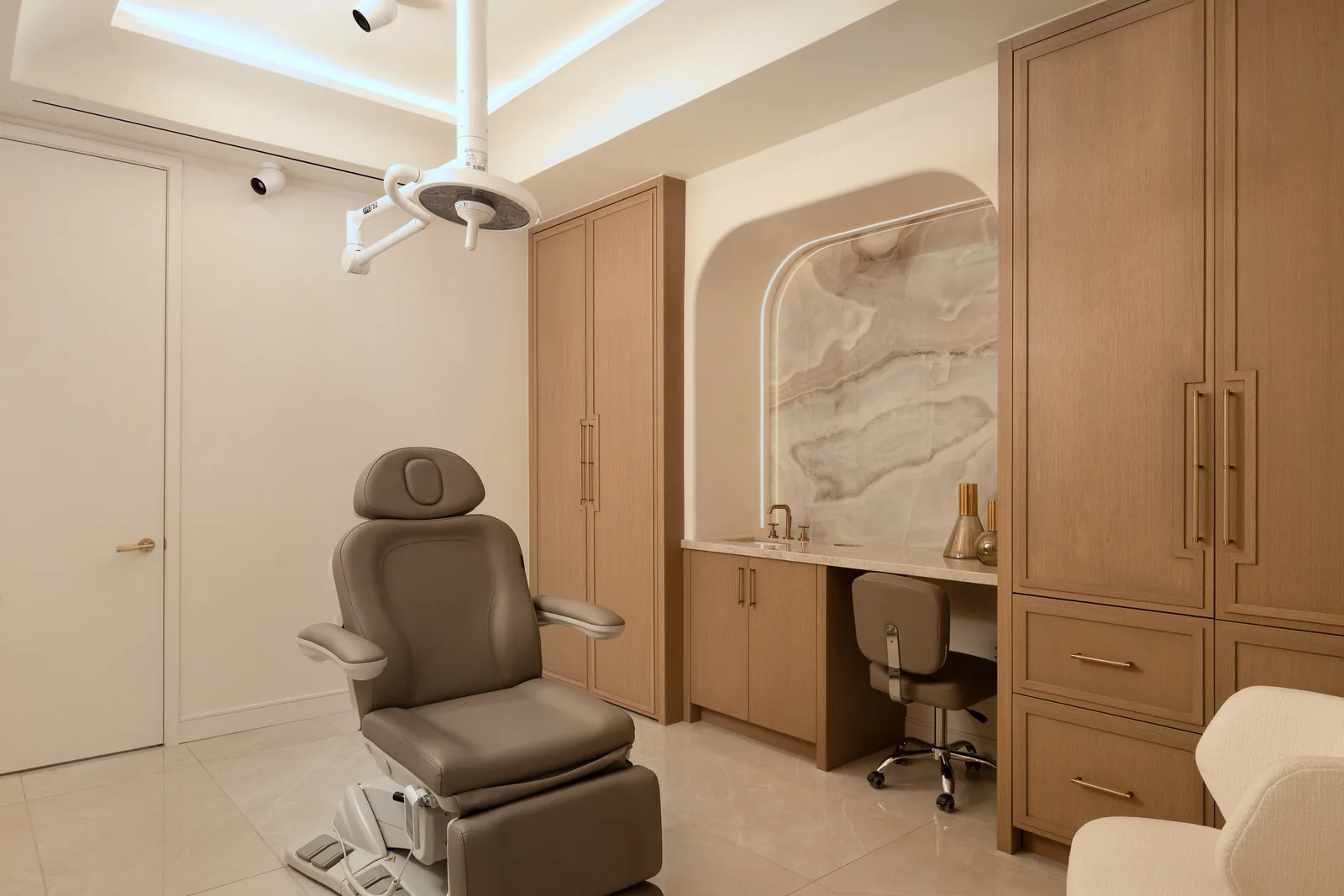
SCOTTSDALE · MODERN OFFICE SETTING
Where to Start
Who SkinPen Is For, and What Happens First
SkinPen at Aesthetica by Ashley Howarth MD is for adults of any Fitzpatrick type, I through VI, with acne scars, rough texture or enlarged pores, fine lines, or neck wrinkles, who can commit to a series of 3 to 6 sessions and to strict sun avoidance for about a week after each one. It is the right first choice for darker skin types, for tanned skin, for anyone who needs treatment between May and September, and for shallow rolling scars on the cheeks. The skin assessment comes first. The provider examines the scars with the skin stretched, which separates rolling scars that flatten when pulled, and respond well to microneedling, from ice-pick and deep boxcar scars that do not; records your Fitzpatrick type, sun exposure, and current products; checks for active acne cysts, cold sores, keloid history, isotretinoin use in the past six months, anticoagulants, and pregnancy; and decides depth by area. If the scars are deep, the lines are etched rather than fine, and the skin is fair and untanned in laser season, the honest recommendation may be HALO or ProFractional instead, and that is said at the first visit. Active acne is treated before scars are; the assessment may start with a clarifying HydraFacial or a salicylic peel series first.
Dr. Ashley Howarth, MD, FACS is a board-certified plastic surgeon and an instructor in plastic surgery at Mayo Clinic. Aesthetica by Ashley Howarth MD is the medical aesthetics brand of her practice, Howarth Plastic Surgery, at 7373 N. Scottsdale Road, Suite C150, Scottsdale, Arizona 85253.

One Device, Depth by Area, Add-Ons by Goal
How SkinPen Is Used in Scottsdale
Acne Scars on the Cheeks and Temples
For rolling and shallow boxcar acne scars (SkinPen’s on-label use), a typical plan is 4 to 6 sessions 4 to 6 weeks apart, with the result judged three to six months after the last session.
For rolling and shallow boxcar acne scars, the on-label use, the provider works the SkinPen at its deeper facial settings over the scarred zones in several directions until uniform pinpoint bleeding shows the dermis has been reached, then lighter over the surrounding skin so the result blends. Most scar plans are 4 to 6 sessions 4 to 6 weeks apart, and the 2020 Dermatologic Surgery systematic review found improvement in scar appearance across all 33 studies it evaluated. Scars remodel slowly; the result is judged three to six months after the last session, in the same raking light as the first photograph. Ice-pick scars and deep boxcar scars are identified at the assessment and directed to ProFractional in season.
Texture, Pores, and Fine Lines on the Face
For texture, enlarged pores, and early fine lines, a typical series is 3 sessions about four weeks apart, with skin looking brighter within weeks while the collagen change builds underneath over months.
For rough texture and enlarged pores and early fine lines, uses that are common practice rather than the labeled indication, SkinPen runs at moderate depth across the full face with a shallower setting over the forehead, around the eyes, and on the upper lip. A series of 3 sessions about four weeks apart is typical, and the skin looks brighter and finer within a few weeks as the epidermis renews, with the collagen change building underneath over months. This is the plan Aesthetica by Ashley Howarth MD offers to patients whose skin type or calendar rules out MOXI, and to patients who want maintenance between laser seasons.
Neck Wrinkles, and SkinPen with PRF
Horizontal neck lines in Fitzpatrick II to IV skin, SkinPen’s second labeled indication, are treated at shallow depth over 3 to 4 sessions, and any session can add PRF from the patient’s own blood for an extra 15 minutes.
Horizontal neck lines in Fitzpatrick II to IV skin are the second labeled indication, treated at shallow depth because neck skin is thin, over 3 to 4 sessions. Any SkinPen session can add PRF, platelet-rich fibrin spun from a small draw of your own blood at the visit and applied to the skin immediately after needling while the channels are open; the practice uses the same preparation as PRF EZ Gel. Meta-analyses of microneedling with platelet-rich plasma, a related preparation, have reported better acne scar improvement than microneedling alone, and PRF is offered on that basis as an add-on rather than a requirement. PRF adds a blood draw and about 15 minutes to the visit.
When HALO or ProFractional Is the Better Tool
SkinPen needs no season, no heat, and no skin-type ceiling but works at a shallower depth over more sessions than HALO or ProFractional, the fractional lasers reserved for untanned Fitzpatrick I to IV skin during laser season.
SkinPen and the fractional lasers overlap on texture and scars and are chosen by depth, skin type, and season. HALO combines non-ablative and ablative wavelengths in one pass and treats sun damage, pigment, and texture together in 1 to 2 sessions with 5 to 7 days of peeling; ProFractional drills ablative channels to well over 1 mm for deep scars. Both need untanned skin, October to April, and are most predictable on Fitzpatrick I to IV. SkinPen needs no season, no heat, and no skin-type ceiling, at the cost of more sessions and a shallower remodel. At Aesthetica by Ashley Howarth MD the assessment picks the tool, and a deep or zone-specific laser plan is physician-performed laser skin resurfacing by Dr. Howarth.
At a Glance
SkinPen at a Glance
Concerns treated with SkinPen at Aesthetica by Ashley Howarth MD, the depth and add-ons commonly used, typical sessions, downtime, and when in the Scottsdale year they are scheduled; individual plans are set at the skin assessment.
| Concern | Depth and add-ons | Sessions | Downtime | Scottsdale season |
|---|---|---|---|---|
| Rolling acne scars on the cheeks (cleared indication) | Deeper setting over scars, lighter around; PRF optional | 4 to 6, four to six weeks apart | Red 1 to 3 days, flaking days 3 to 5 | Year-round with a week of sun avoidance |
| Horizontal neck lines (cleared indication, Fitzpatrick II to IV) | Shallow neck setting | 3 to 4, four weeks apart | Pink 1 to 2 days | Year-round |
| Rough texture and enlarged pores | Moderate depth full face, shallower forehead and eyes | 3, four weeks apart | Red 1 to 2 days | Year-round; the summer alternative to MOXI |
| Fine lines and early crepiness | Moderate depth; PRF often added | 3 to 4, four to six weeks apart | Red 1 to 2 days | Year-round |
| Surgical scars once healed and cleared | Depth set by Dr. Howarth for the scar | 3 to 4, six weeks apart | Red 1 to 3 days | Year-round, after surgeon clearance |
| Maintenance between laser seasons | Moderate depth; HydraFacial a week before | 1 to 2 a year | Red 1 to 2 days | May to September |
Three Ways to Remodel Texture and Scars
SkinPen vs HALO vs ProFractional
How the three texture and scar treatments at Aesthetica by Ashley Howarth MD differ; the assessment chooses the tool, and the HALO and ProFractional pages cover those plans in full.
| SkinPen | HALO | ProFractional | |
|---|---|---|---|
| What it is | Mechanical microneedling, no heat; sterile single-use cartridge | Hybrid fractional laser, 1470 nm non-ablative plus 2940 nm ablative in one pass | 2940 nm ablative fractional erbium channels to well over 1 mm |
| Best for | Rolling acne scars, texture, pores, fine lines, neck lines; darker skin types | Sun damage, pigment, texture, pores, and fine lines together | Deep boxcar and ice-pick scars, etched lines, regional resurfacing |
| Sessions | 3 to 6, four to six weeks apart | 1 to 2 | 1 to 3, four to eight weeks apart |
| Downtime | Red 1 to 3 days, light flaking | 5 to 7 days: sunburn-like, then sandpaper, then peeling | 3 to 7 days depending on depth |
| Skin types | All, I to VI (cleared for acne scars in all types) | I to IV routinely, V with care | I to IV routinely, V with care |
| Season and who performs | Year-round; licensed aesthetician or nurse under Dr. Howarth's protocols | October to April; physician-led team, deeper plans physician-performed | October to April; Dr. Howarth or the team depending on depth |
A Visit Built Around Your Skin Type
What to Expect at a SkinPen Visit at Aesthetica by Ashley Howarth MD
A SkinPen visit at Aesthetica by Ashley Howarth MD has three parts: the assessment and numbing, the treatment itself, and a written aftercare plan. Plan on about 60 to 75 minutes in the room: 20 to 30 minutes of numbing cream, about 30 minutes of treatment for the face, and longer when the neck or PRF is added.
Scars examined under stretch, depth chosen, numbing applied
The provider photographs the treatment area in raking light, examines scars with the skin stretched, records your Fitzpatrick type and sun exposure, checks for active acne, cold sores, keloid history, isotretinoin, and anticoagulants, and sets the depth by area. The skin is cleansed and a topical numbing cream sits for 20 to 30 minutes.
A sterile cartridge, glide gel, and passes by zone
The numbing cream is removed, a sterile single-use cartridge is opened in front of you, and a glide gel goes on. The pen moves over the skin in overlapping passes in several directions, deeper over scarred cheeks and shallower on the forehead, around the eyes, and on the neck. It feels like a fine vibrating sandpaper, with more pressure over bone. If PRF was drawn, it goes on immediately after.
Bland skincare, sun avoidance, and the next date
You leave with a bland moisturizer or the PRF still on the skin, mineral SPF once the skin has calmed, and instructions: no makeup, sweating, or direct sun for 24 hours, only a gentle cleanser and moisturizer for 48 to 72 hours, retinoids and acids paused for about a week, a hat and shade for a week, and the next session 4 to 6 weeks out.
Clear Information. Informed Choices.
Safety and Limitations of SkinPen
SkinPen is safe when the cartridge is sterile and single-use, the depth matches the area, and the skin is free of active infection. Most side effects are expected and short-lived. The two that matter in Arizona are post-inflammatory hyperpigmentation and infection: even without heat, a freshly needled face exposed to a UV index 11+ afternoon can darken, which is why a week of strict sun avoidance follows every session; and micro-channels are open for hours, which is why nothing but bland, clean products touch the skin for the first two to three days, and why sweat, pools, and hot yoga wait 48 hours. The medical limits are candidacy: active cystic acne, cold sores, a keloid history, isotretinoin within six months, pregnancy, and anticoagulation each defer or change the plan. SkinPen does not treat pigment, does not tighten, and does not resurface deep scars or etched wrinkles the way an ablative laser does.
Possible Side Effects Include
- Redness and warmth like a sunburn for 1 to 3 days
- Pinpoint bleeding during treatment and small dry spots after
- Light dryness or flaking on days 3 to 5
- Temporary bruising or swelling, more with PRF or deeper settings
- Rarely, post-inflammatory hyperpigmentation, infection, cold sore reactivation, or track marks from wrong technique
What Treatment Cannot Guarantee
- Complete removal of ice-pick or deep boxcar scars
- A visible result from a single session
- Removal of brown spots, melasma, or redness
- Tightening comparable to surgery
- A result that holds without sun protection
What Happens After SkinPen
Recovery After SkinPen
Recovery from SkinPen is short and predictable: a sunburn-like face for a day or two, a few days of dryness, and then skin that looks brighter than it did before while the collagen work continues out of sight for months. The practical impact is small, a makeup-free day and a week under a hat. When PRF is added, expect slightly more redness and occasional mild swelling on day one. A HydraFacial is scheduled a week or two before a session rather than after, and a chemical peel waits at least two weeks.
The face is uniformly red and feels warm and tight for the rest of the day, with pinpoint dry spots where the needles reached the dermis. Only the moisturizer or PRF applied in the office touches the skin. No makeup, no sweating, no pool, no direct sun. Sleep on a clean pillowcase and skip the retinoid and acids.
Redness fades to pink by day two and most patients are back at work with mineral sunscreen; light mineral makeup is fine from day two if the skin is intact. Gentle cleanser and a bland moisturizer only through day three, since the micro-channels are still sealing. Hats and shade outdoors; hot yoga and hard workouts wait 48 hours.
Some dryness or fine flaking appears around days 3 to 5 and lifts on its own; do not exfoliate it off. Retinoids resume at about a week. By two weeks the surface looks brighter and finer as the epidermis has renewed, though the scars have not yet changed. Strict sun avoidance continues for about a week after each session; in the Arizona summer that means a hat, shade, and no midday errands.
Each session adds to the last, with the next 4 to 6 weeks out. Scars and texture are judged three to six months after the final session, when collagen remodeling has caught up; a series of 3 to 6 is the plan, not one visit. Most Scottsdale patients then keep 1 to 2 maintenance sessions a year, and pair SkinPen with laser season treatments the following winter. The Skin in Arizona guide sets out the calendar.
Before & After
SkinPen, Before and After Treatment
SkinPen results are best judged in photographs taken in the same raking light before the first session and three to six months after the last, when collagen remodeling has caught up with the treatment; a photograph at two weeks shows brighter skin but not the scar change. Aesthetica by Ashley Howarth MD maintains before-and-after galleries for SkinPen, HALO, and ProFractional, and the team can show you acne scar and texture cases that match your skin type, including darker skin types treated in summer.
Patient Case Summaries
Selected SkinPen Case Summaries
These deidentified case summaries illustrate how the physician-led team at Aesthetica by Ashley Howarth MD plans SkinPen microneedling in Scottsdale. They include rolling acne scars on Fitzpatrick V skin, a summer series with strict sun avoidance, neck lines in a long-term Arizona resident, SkinPen with PRF, a first-visit patient whose active acne came first, and deep boxcar scars for which the honest answer was a fractional laser rather than more needling. Each summary connects the patient’s concern and skin assessment with the treatment performed or the recommendation made.
Case 01
Fitzpatrick V scars
Rolling acne scars on deep brown skin treated with SkinPen after a laser was declined
Patient presentation
A man in his twenties with Fitzpatrick V skin asked about rolling acne scars across both cheeks that showed in side light, and mentioned that another office had offered a fractional laser.
Skin assessment
The scars flattened almost completely when the cheek was stretched, indicating tethered rolling scars with intact overlying skin, and there was mild post-inflammatory hyperpigmentation around them and no active acne. At his skin type an ablative fractional laser carried a meaningful risk of new dark marks.
Procedure performed
A series of six SkinPen sessions five weeks apart at the deeper facial setting over the scarred zones and lighter over the surrounding skin, with a topical pigment program at home and strict sun avoidance for a week after each visit.
Clinical rationale
SkinPen’s FDA clearance for facial acne scars covers all Fitzpatrick types, it uses no heat, and the 2016 review of microneedling in skin of color supports its safety profile; rolling scars that flatten under stretch are the scars it improves best.
Follow-up
Photographs at four months after the sixth session showed the scars markedly shallower and the surrounding pigment even; he returns for one maintenance session a year.
Case 02
Summer series
Texture and pores treated in June through August, with a hat and a plan
Patient presentation
A woman in her thirties who had moved to Scottsdale two years earlier wanted to improve rough texture and visible pores on her nose and inner cheeks before a fall event and asked what could be done in summer.
Skin assessment
Fitzpatrick III skin, lightly tanned, with coarse texture and enlarged pores, no scarring, and no pigment problem beyond mild unevenness. MOXI would have been the usual first choice but her tan and the July UV index made any light or laser treatment unsafe until fall.
Procedure performed
Three SkinPen sessions at moderate depth across the full face, four weeks apart in June, July, and August, each followed by a week of hat-and-shade sun avoidance and mineral SPF, with morning-only outdoor exercise during that week.
Clinical rationale
Microneedling has no thermal or light step, so tanned skin is not the contraindication it is for a laser; the risk in summer is sun on healing skin, which a strict one-week avoidance rule after each session manages.
Follow-up
Her texture was visibly finer by the event in October, and she added a MOXI session that winter for the residual unevenness once she was untanned.
Case 03
Neck lines
Horizontal neck lines in a lifelong Arizona resident treated on-label with SkinPen
Patient presentation
A woman in her fifties, born and raised in Scottsdale, was bothered by horizontal lines across her neck that she noticed in phone photographs, and asked whether the laser she had on her face would work there.
Skin assessment
Fitzpatrick II skin with fine to moderate horizontal neck lines, thin crepey texture, and mild sun-related mottling, with no significant laxity or banding. Neck skin is thin and heals less predictably with ablative lasers, and the lines fell within SkinPen’s cleared indication for neck wrinkles in Fitzpatrick II to IV.
Procedure performed
Four SkinPen sessions at a shallow neck setting, four weeks apart from November through February, with a retinoid and daily mineral SPF on the neck at home.
Clinical rationale
The neck is the second labeled indication for SkinPen, shallow needling suits thin neck skin, and building collagen without heat avoided the healing risks of an ablative pass on the neck.
Follow-up
At three months after the fourth session the lines were softer and the texture smoother; she now applies sunscreen to her neck as reliably as to her face and returns once a year.
Case 04
SkinPen with PRF
Acne scars and dull skin treated with SkinPen plus PRF from the patient's own blood
Patient presentation
A woman in her forties asked for the most she could do for shallow acne scars on her temples and a generally dull, tired surface without laser downtime, and had read about microneedling with PRF.
Skin assessment
Fitzpatrick II skin with shallow rolling scars at the temples, fine lines, and dull texture, untanned in January and with no laser in the past year. She was a candidate for either HALO or SkinPen; she preferred to avoid a week of peeling.
Procedure performed
Four SkinPen sessions four weeks apart, each with a small blood draw spun into PRF at the visit and applied to the skin immediately after needling, at deeper settings over the temples and moderate depth elsewhere.
Clinical rationale
PRF applied while the micro-channels are open is a common add-on, and meta-analyses of microneedling with platelet-rich plasma have reported better scar improvement than microneedling alone; it was offered as an option with that evidence stated plainly rather than as a requirement.
Follow-up
By four months the temple scars were shallower and the surface brighter; she chose a HALO the following winter for the sun-related unevenness that needling does not treat.
Case 05
Active acne first
A first visit for scars that started with treating the breakouts still causing them
Patient presentation
A woman in her twenties, new to the practice, asked for SkinPen for acne scars on her jawline and cheeks.
Skin assessment
The assessment found active inflammatory acne with several cysts along the jaw alongside older rolling scars on Fitzpatrick III skin. Needling through active lesions can spread bacteria and inflame the skin, and new scars were still forming.
Recommendation
Referral to her dermatologist for acne control, a series of clarifying HydraFacials and salicylic acid peels in the meantime, and SkinPen scheduled once the skin had been clear of cysts for two months.
Clinical rationale
Microneedling is deferred over active acne, and treating scars while the disease that makes them is uncontrolled wastes sessions; controlling the acne first is the physician-led sequence.
Follow-up
Her acne cleared over four months on her dermatologist’s plan, and she completed a five-session SkinPen series the following spring with clear improvement in the older scars.
Case 06
Not SkinPen
Deep boxcar and ice-pick scars on fair skin, for which the honest answer was ProFractional
Patient presentation
A man in his thirties, a long-term Scottsdale resident, had completed three microneedling sessions elsewhere with little change and asked whether SkinPen with PRF would finally work on his cheek scars.
Skin assessment
Fitzpatrick II skin with numerous sharp-walled boxcar scars and ice-pick scars on both cheeks that did not flatten when the skin was stretched, meaning full-thickness dermal loss rather than tethering. He was untanned in November.
Recommendation
Not another microneedling series. Dr. Howarth planned two ProFractional sessions at deep settings to the cheeks eight weeks apart in laser season, with a light MicroLaserPeel over the same areas in the second session, performed by her.
Clinical rationale
Ice-pick and deep boxcar scars are losses of dermis with sharp walls that collagen induction cannot fill; an ablative fractional laser drilling channels to well over a millimeter remodels them, and on untanned fair skin in season that is the tool that matches the scar.
Follow-up
Photographs at four months after the second ProFractional session showed the boxcar scars shallower and the ice-pick scars less distinct; he uses SkinPen once a year now for maintenance of the surrounding texture.
From First Visit to a Plan You Can Keep
Booking, Planning, and Follow-Up at Aesthetica by Ashley Howarth MD
Aesthetica by Ashley Howarth MD is a medical practice with a spa’s convenience. Established patients book online. New patients can book online or request a consultation, and the team responds usually the same day.

Online booking or a consultation request
Book a skin assessment directly online, or request a consultation and describe the scars, texture, or lines you notice, where they are, and whether you have had microneedling or a laser before. Either path starts with the same stretch examination and photographs.
A series, not a single appointment
You leave your first visit with a written plan: how many sessions and how far apart; the depth by area; whether PRF is added; whether any scars belong to ProFractional or HALO in season instead; and the sun rules and home routine that protect the result.
Photographs at three months, maintenance yearly
Results are photographed three to six months after the last session in the same raking light. Most Scottsdale plans then keep 1 to 2 SkinPen sessions a year, often in summer, with laser work in the fall. A-List members have the next session scheduled before they leave the last one.
Your Questions, Answered
SkinPen Microneedling Frequently Asked Questions
SkinPen Precision is a microneedling device with a sterile, single-use needle cartridge that creates thousands of controlled micro-injuries in the skin to stimulate new collagen and elastin. It is FDA-cleared to improve the appearance of facial acne scars in adults 22 and older of all Fitzpatrick skin types and of neck wrinkles in types II to IV. At Aesthetica by Ashley Howarth MD in Scottsdale it is performed by the licensed aesthetician or nurse under Dr. Howarth’s protocols.
SkinPen treats acne scars, especially rolling scars on the cheeks, and neck wrinkles, its two cleared indications. In common practice it is also used for rough texture and enlarged pores, fine lines, and surgical scars once they have healed. It does not remove brown spots, melasma, or redness, does not tighten loose skin, and does not fill deep ice-pick or boxcar scars, which are directed to ProFractional.
The cartridge’s fine needles oscillate vertically and create columns of micro-injury a fraction of a millimeter wide, with the intact skin between them intact. The surrounding tissue releases growth factors, and over the following weeks fibroblasts lay down new collagen and elastin that remodel the scar or thinned dermis. There is no heat, no light, and no chemical, which is why it is safe on every skin type and in summer.
Not much. A topical numbing cream sits on the skin for 20 to 30 minutes first, and most patients describe the treatment as a vibrating, sandpaper-like sensation that is more noticeable over the forehead, jawline, and other bony areas. The face feels warm and tight like a sunburn for the rest of the day. A full-face session takes about 30 minutes after numbing.
Plan for one makeup-free day and a week under a hat. The face is red on day one, pink on day two, and may flake lightly on days 3 to 5. Most people return to work the next day with mineral sunscreen. In Scottsdale the important rule is strict sun avoidance for about a week after each session, which in summer means shade, a hat, and no midday errands; hard workouts and pools wait 48 hours.
Most plans at Aesthetica by Ashley Howarth MD are 3 to 6 sessions spaced 4 to 6 weeks apart: about 3 for texture, pores, and fine lines, and 4 to 6 for acne scars or neck lines. Improvement builds for three to six months after the last session as collagen remodels, so results are photographed then rather than at two weeks. After the series, 1 to 2 maintenance sessions a year hold the result.
Yes. PRF, platelet-rich fibrin from a small draw of your own blood, is applied to the skin immediately after needling as a common add-on, with evidence from studies of the related platelet-rich plasma. A HydraFacial a week or two before a session clears the skin. HALO, MOXI, and BBL HERO are scheduled in separate months during laser season, and a chemical peel waits at least two weeks after SkinPen.
Yes. SkinPen’s clearance for facial acne scars covers all Fitzpatrick skin types, I through VI, because there is no heat to trigger the post-inflammatory hyperpigmentation that fractional lasers can cause on darker skin. It is often the first recommendation at Aesthetica by Ashley Howarth MD for Fitzpatrick IV to VI patients with scars or texture. Keloid-prone patients, active acne, and cold sores are the deferrals that apply to any skin type.
Collagen built by a SkinPen series is your own and does not disappear, so scar and texture improvement is long-lasting; what continues is aging and sun exposure, which in Arizona is about 300 days a year. Most patients hold their result with 1 to 2 maintenance sessions a year, daily mineral sunscreen, and a retinoid. Fine lines and pores need more regular maintenance than scars do.
Yes. SkinPen has no heat or light step, so tanned skin is not a contraindication the way it is for a laser, which makes it a summer treatment in Scottsdale as long as you avoid sun strictly for about a week after each session; the laser season and Skin in Arizona guides explain the calendar. Preparation is the same year-round: pause retinoids and acids for 3 to 5 days, arrive without a sunburn or active breakout, and tell the provider about isotretinoin, blood thinners, keloids, and cold sores.
Concerns Treated
Concerns This Treatment Addresses
These guides explain each concern and where this treatment fits among the options at Aesthetica by Ashley Howarth MD in Scottsdale.
- Acne & Acne Scars Rolling scars on the cheeks, the cleared indication and first use of SkinPen
- Skin Texture, Pores & Dullness Rough texture and enlarged pores on any skin type, any season
- Fine Lines & Wrinkles Fine facial lines and horizontal neck lines through collagen induction
- Skin Laxity Why needling does not tighten, and what does
- Skin in Arizona Why timing matters in the desert
- Sciton Laser Comparison Which laser fits which concern when SkinPen is not enough
BEGIN HERE
Request a Consultation
Tell us what you are considering. A member of our patient care team will follow up with consultation availability and next steps.

Megan S.
Patient Coordinator
Prefer to talk or text?
Selected References