
DONATED ADIPOSE TISSUE FOR LOCALIZED CONTOUR
What Is alloClae?
alloClae is a sterile, hydrated adipose-tissue allograft made from donated human tissue. It contains non-viable adipocytes, extracellular matrix, lipids, and connective tissue. It is placed in localized subcutaneous areas where fat naturally exists to provide cushioning and structural support.
Unlike hyaluronic acid facial filler, alloClae is an adipose-tissue matrix. Unlike fat transfer, it does not require liposuction to harvest your own fat. It is not an implant, stem-cell treatment, or large-volume body transformation.
At Aesthetica by Ashley Howarth MD, the decision begins with anatomy and scale. Breast and body concerns are evaluated within their full surgical family so an injectable is not used where revision, lifting, fat removal, skin treatment, or another plan is more appropriate.

START WITH THE CONTOUR—NOT THE PRODUCT
Why Patients Ask About alloClae
Patients often ask about alloClae because they want a modest contour change without an implant or a liposuction donor site. The consultation determines whether the concern is truly a localized soft-tissue deficit.
- A small breast contour difference or selected implant-edge visibility
- A modest hip-dip or body-contour depression
- A stable, localized irregularity after prior surgery
- Limited donor fat for an autologous fat-transfer plan
- A preference to compare nonsurgical and surgical options before deciding
alloClae does not replace facial filler, remove fat, tighten skin, correct muscle separation, reposition a breast, or deliver the scale of an implant or large-volume fat transfer.


MORE TOOLS IN THE TOOLBOX
Why a Plastic Surgeon Directs alloClae Treatment
An injectable can add selected volume, but it cannot diagnose why a contour looks the way it does. Implant position, capsule, skin laxity, fat distribution, muscle, scar tethering, and skeletal shape can each require a different answer.
Ashley Howarth, MD, FACS, directs care across Aesthetica and Howarth Plastic Surgery so the recommendation can move between nonsurgical treatment and surgery without forcing every concern into one category.

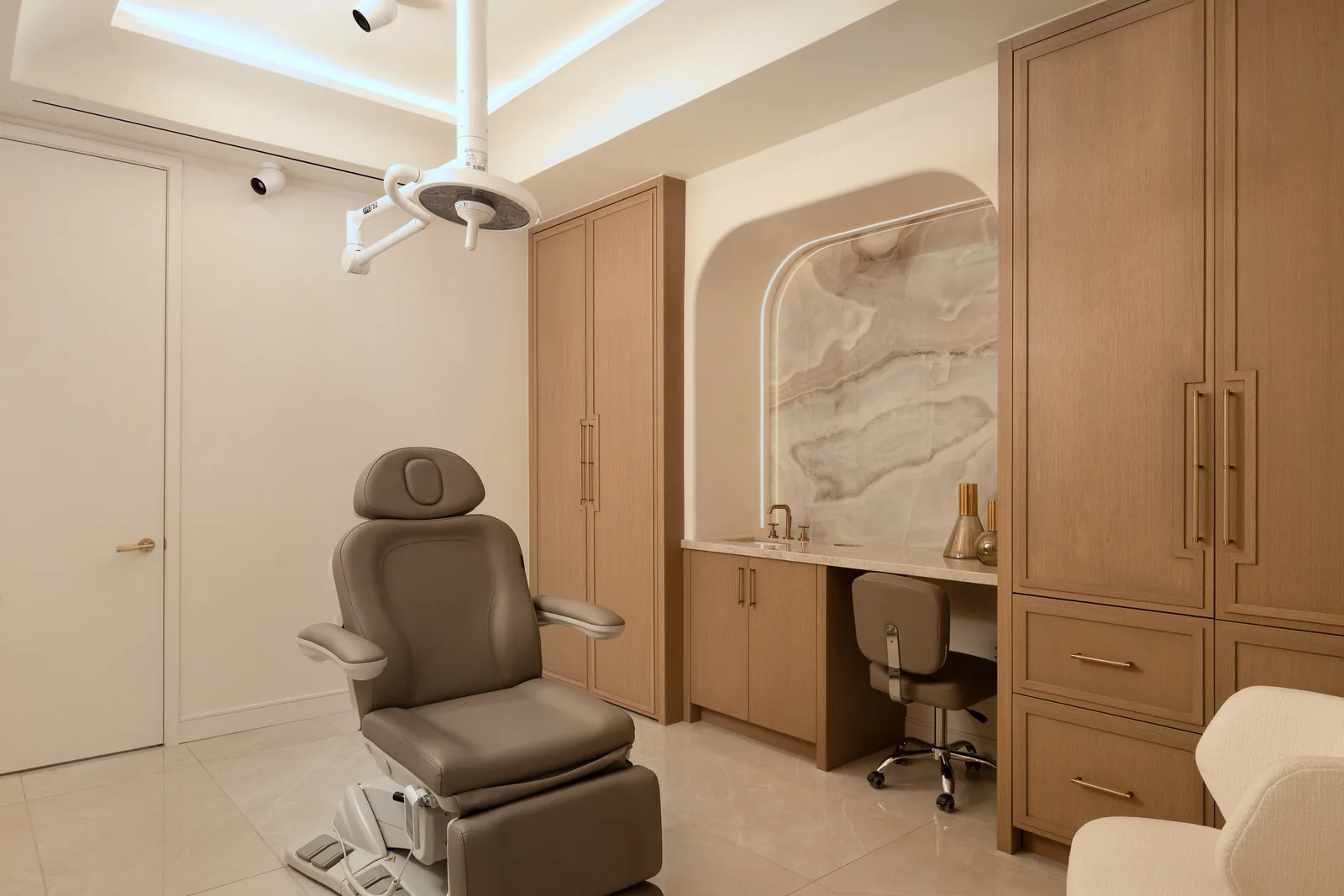
SCOTTSDALE · MODERN OFFICE SETTING
DONOR-TISSUE TRANSPARENCY. REALISTIC SCALE.
Who alloClae May Be For, and What Happens First
A possible candidate is a healthy adult with a small, localized subcutaneous contour deficit who understands the donated human-tissue source, alternatives, risks, and limits. The requested change should match the scale of an injectable plan.
Dr. Howarth reviews prior surgery, health, medications, allergies, nicotine exposure, tissue quality, scars, healing, weight stability, and the exact area. Breast concerns route to the Breast family; body concerns route to Body. A different injectable, surgery, observation, another specialist, or no treatment may be recommended.

FOUR DIFFERENT SOURCES OF VOLUME
How alloClae Compares
alloClae
Donated human adipose-tissue matrix for selected localized subcutaneous cushioning and contour support.
Hyaluronic Acid Filler
A manufactured gel used primarily for selected facial areas, with a different composition, behavior, risk profile, and reversibility discussion.
Fat Transfer
Your own harvested fat, requiring liposuction and a donor site, with variable graft survival and operative recovery.
Implant or Surgery
A different scale of structural, position, skin, or volume change when a small injectable correction does not address the cause.
At a Glance
Fillers at a Glance
Areas treated with hyaluronic acid filler at Aesthetica by Ashley Howarth MD, the product family typically chosen, expected longevity, and downtime; individual plans and product choices are set at the facial assessment.
| Area | Filler family used | Longevity | Downtime | Notes |
|---|---|---|---|---|
| Cheeks and midface | Juvederm Voluma XC, Restylane Lyft, or RHA 4, deep on bone | 12 to 18 months | Swelling 2 to 3 days | Treated first; lifts folds and under-eye shadow indirectly |
| Lips | RHA 2, Restylane Kysse, or Juvederm Volbella XC | 6 to 12 months | Swelling up to 5 to 7 days | Half to one syringe; judged at two weeks |
| Chin and jawline | Juvederm Volux XC or Restylane Defyne, on bone | 12 to 18 months | Swelling 2 to 3 days | A neck lift when the problem is descended tissue |
| Temples | Firm gel placed deep, cannula | 12 to 18 months | Mild swelling 1 to 3 days | Superficial temporal artery mapped before injection |
| Nasolabial folds and marionette lines | RHA 3 or Restylane Refyne | 9 to 12 months | Swelling 2 to 3 days | After the cheek, never as the only step |
| Under eyes (tear trough) | Restylane Eyelight, cannula, conservative volume | 9 to 12 months | Swelling and possible bruising up to 1 week | Bags go to eyelid surgery; thin skin to PRF EZ Gel |
| Backs of the hands | Restylane Lyft | About 12 months | Swelling 2 to 5 days | Often paired with BBL for pigment on the hands |
Three Answers to Lost Volume
Filler vs Fat Transfer vs Surgery
How hyaluronic acid filler compares with the surgical options Dr. Howarth performs, so the consultation at Aesthetica by Ashley Howarth MD can recommend the right one; the face surgery pages cover fat transfer, facelift, and eyelid surgery in full.
| HA filler | Fat transfer | Facelift or lift | |
|---|---|---|---|
| What it does | Replaces a few milliliters of volume; adds contour | Replaces larger volume with the patient's own fat | Repositions descended tissue; removes loose skin |
| Longevity | 6 to 18 months | Long-lasting for the fat that survives, typically a majority | Years; aging continues from a new baseline |
| Reversible | Yes, with hyaluronidase | No | No |
| Downtime | A few days of swelling | 1 to 2 weeks of swelling and bruising | About 2 weeks before social activity |
| Best for | Focal volume loss in skin that still fits the face | Diffuse volume loss needing several areas every year | Jowls, loose neck, sagging cheeks, hooded lids or bags |
| Performed by | Dr. Howarth or an advanced aesthetic nurse injector under her direction | Dr. Howarth | Dr. Howarth |
EVALUATE · MAP · REASSESS
What to Expect at an alloClae Visit
The process is built around the specific breast or body concern. Product amount, access, comfort measures, staging, and follow-up are individualized after examination.
The concern is placed in context.
Dr. Howarth determines whether the visible change comes from a localized volume deficit or from skin, fat, muscle, scar, implant, capsule, skeletal shape, or another layer.
Source, alternatives, and risks are reviewed.
The team explains donated human tissue, what the product can and cannot do, possible complications, product amount, access points, aftercare, and other options.
The contour is reassessed over time.
If treatment proceeds, alloClae is placed in the selected subcutaneous area and follow-up evaluates swelling, firmness, symmetry, tissue response, and the evolving result.
CLEAR INFORMATION. INFORMED CHOICES.
alloClae Safety, Risks, and Limitations
alloClae is donated human tissue regulated as a human cellular and tissue-based product. Donor screening and processing reduce risk but cannot eliminate every risk. The official Instructions for Use report possible local and systemic reactions and make no biological claim.
Possible Risks and Reactions Include
- Pain, tenderness, swelling, bruising, redness, or discoloration
- Bleeding, hematoma, infection, delayed healing, or fluid collection
- Lumps, cysts, nodules, firmness, contour irregularity, or asymmetry
- Allergic, immune, or anaphylactic reaction, plus the residual disease-transmission risk of donated human tissue
- An unsatisfactory change, need for more treatment, or need for surgical correction
What alloClae Cannot Guarantee
- A specific volume, shape, symmetry, or duration of correction
- The same behavior as living fat transferred from your own body
- A substitute for an implant, lift, skin-removal procedure, or weight loss
- That one session will address every contour difference
- A complication-free treatment or a result unchanged by aging and tissue change
HEALING AND RESULTS EVOLVE
What Happens After alloClae
Aftercare depends on the breast or body location, amount, access points, tissue quality, prior surgery, and whether treatment is staged or combined with another procedure.
Tenderness, bruising, fullness, firmness, or asymmetry may be more noticeable before the area settles.
Work, exercise, compression, sleeping position, and travel instructions depend on the location, access points, and any combined procedure.
Dr. Howarth evaluates healing, tissue response, symmetry, and whether observation or another step is appropriate.
No exact duration can be promised. Aging, weight change, tissue quality, healing, and the amount placed all influence the visible result.
PATIENT CASE SUMMARIES
alloClae Patient Consultation Case Summaries
These deidentified patient case summaries show how the physician-led team compared alloClae with hyaluronic acid filler, autologous fat transfer, and surgery for selected breast and body contours. Identifying information is omitted. Each case reflects an individual clinical decision and does not predict another patient’s treatment or outcome.
Case 01
ALLOCLAE VS FILLER
A breast or body contour question was separated from routine facial dermal filler treatment
Patient presentation
The patient, familiar with lip or cheek filler, asked whether alloClae was simply a longer-lasting filler for a breast or body hollow.
Clinical evaluation
The assessment identified the anatomic layer, location, tissue thickness, scale of correction, prior surgery, alternatives, and donor-tissue considerations.
Treatment decision
The team explained that alloClae is a donated human adipose-tissue matrix used for selected subcutaneous contours, not a hyaluronic acid facial filler.
Clinical rationale
Product category, reversibility, evidence, risks, and treatment location differed, so the decision was not reduced to syringe size or longevity.
Case boundary
alloClae is not dissolvable hyaluronic acid filler, living fat, or a regenerative stem-cell treatment.
Case 02
ALLOCLAE VS FAT TRANSFER
A small volume deficit with limited donor fat required an alloClae-versus-fat-transfer discussion
Patient presentation
The patient wanted a localized breast or body contour softened but preferred to avoid liposuction or had limited harvestable fat.
Clinical evaluation
The evaluation compared donor-site availability, required volume, recipient tissue, prior procedures, healing, desired scale, and tolerance for surgery.
Treatment decision
The small deficit was evaluated for alloClae, while staged fat transfer, an implant, another operation, observation, or no treatment remained alternatives for broader goals.
Clinical rationale
Fat transfer uses the patient’s living harvested fat and creates a donor site; alloClae uses processed donated human adipose tissue without harvesting.
Case boundary
The two options are not biologically identical, and neither guarantees a specific retained volume or duration.
Case 03
BREAST CONTOUR
Localized breast contouring received a plastic-surgery evaluation before alloClae was considered
Patient presentation
The patient asked about alloClae for implant rippling, a post-explant hollow, or a small cleavage or upper-pole contour difference.
Clinical evaluation
Dr. Howarth evaluated the implant when present, capsule, breast position, skin envelope, tissue thickness, scars, imaging history, and the exact deficit.
Treatment decision
The consultation compared alloClae, fat transfer, implant revision, breast lift, augmentation, observation, and no procedure.
Clinical rationale
The visible contour could arise from several layers, and an injectable approach could not conceal a device or structural problem that required surgery.
Case boundary
alloClae cannot repair an implant, correct a capsule, lift the breast, or create a predictable cup-size increase.
Case 04
BODY CONTOUR
A hip dip or stable body depression was assessed as a localized volume deficit before alloClae planning
Patient presentation
The patient asked about a modest hip dip or a small stable depression after prior liposuction or surgery.
Clinical evaluation
The assessment distinguished missing soft-tissue volume from adjacent fat, scar tethering, loose skin, muscle, skeletal anatomy, and an incompletely healed result.
Treatment decision
The consultation compared alloClae, fat transfer, scar treatment, surgical revision, observation, and no procedure according to cause and scale.
Clinical rationale
The team limited alloClae consideration to localized subcutaneous support when that tissue layer was the relevant problem.
Case boundary
It is not weight loss, liposuction, skin tightening, or predictable large-volume buttock augmentation.
Case 05
DONOR-TISSUE CONSENT
Donated human tissue, alternatives, and residual risks were addressed during the alloClae consultation
Patient presentation
The patient was interested in nonsurgical contouring and wanted to understand where alloClae came from and how it was processed.
Clinical evaluation
The clinical team reviewed donor-tissue source, official Instructions for Use, processing, screening, possible local and systemic reactions, and alternatives.
Treatment decision
Treatment selection followed discussion of the product category, residual disease-transmission risk, uncertainties, aftercare, and other options.
Clinical rationale
Clear consent was part of treatment selection, not a formality after a product had already been chosen.
Case boundary
Screening and processing reduce risk but cannot eliminate every risk, and long-term aesthetic data are still developing.
Case 06
ALLOCLAE NOT SELECTED
Large-volume goals, loose skin, implant problems, or unclear anatomy made alloClae the wrong choice
Patient presentation
The patient requested a major breast or body transformation, or the visible concern had not yet been tied to a specific tissue layer.
Clinical evaluation
The physician-led assessment defined the cause, scale, health factors, prior procedures, skin and scar behavior, realistic alternatives, and whether treatment should occur at all.
Treatment decision
The evaluation redirected the plan to surgery, fat transfer, implant care, weight management, observation, referral, or no procedure rather than alloClae.
Clinical rationale
The plan began with diagnosis and declined a product that could not reasonably address the patient’s primary goal.
Case boundary
Nonsurgical does not mean risk-free, and a smaller intervention is not automatically the correct intervention.
FROM FIRST QUESTION TO A CLEAR PLAN
Booking, Planning, and Follow-Up for alloClae
Request a consultation so the team can route the concern to the right clinical setting. Your patient care coordinator helps with records, estimates, forms, and follow-up logistics; Dr. Howarth and her clinical team make the medical recommendation.

Start with the exact concern.
Share the area, prior procedures, goals, timing, and the best way to reach you so the team can route the consultation appropriately.
Anatomy determines the options.
Dr. Howarth evaluates the tissue layer, scale, alternatives, donor-tissue considerations, risks, and whether treatment should proceed.
Logistics follow the recommendation.
If alloClae fits, the team provides the proposed area, amount or staging approach, estimate, preparation, aftercare, and follow-up plan.
YOUR QUESTIONS, ANSWERED
alloClae Frequently Asked Questions
alloClae is made from donated human adipose tissue. The Instructions for Use describe non-viable adipocytes, extracellular matrix, lipids, and connective tissue in a hydrated allograft.
It is injectable, but it is not a hyaluronic acid facial filler. It is a donated adipose-tissue matrix with a different source, composition, intended tissue context, and risk discussion.
The manufacturer describes alloClae as a human cellular and tissue-based product regulated under Section 361 of the Public Health Service Act and 21 CFR Part 1271. That is not the same as marketing it as an FDA-approved drug or device.
The Instructions for Use describe non-viable adipocytes and make no biological claim. It should not be marketed as a stem-cell or regenerative treatment.
Its labeled use is for localized subcutaneous areas where fat naturally exists. At HPS and Aesthetica, treatment planning currently routes selected breast concerns to Breast and selected body concerns to Body.
Fat transfer uses your own fat harvested by liposuction and involves a donor site. alloClae uses processed donated human adipose tissue and does not require fat harvesting. They are not biologically identical.
That cannot be determined from a menu or photograph alone. The location, dimensions, tissue thickness, symmetry, desired scale, and whether staging is appropriate all affect the plan and estimate.
An exact duration cannot be promised, and long-term aesthetic data are still developing. The visible course may vary with placement, amount, tissue quality, healing, aging, and weight change.
Possible risks include pain, swelling, bruising, infection, bleeding, cysts, nodules, firmness, asymmetry, allergic or immune reactions, anaphylaxis, discoloration, unsatisfactory contour, and residual disease-transmission risk.
The answer depends on the cause and scale of the concern. A localized volume deficit may fit alloClae, while implant, capsule, breast position, loose skin, muscle, excess fat, or larger volume goals may require another approach.
Concerns Treated
Concerns This Treatment Addresses
These guides explain each concern and where this treatment fits among the options at Aesthetica by Ashley Howarth MD in Scottsdale.
- alloClae Breast ContouringFor selected localized breast contour concerns.
- alloClae Body ContouringFor selected localized body contour concerns.
- Dermal FillersCompare hyaluronic acid facial fillers with a different composition and purpose.
- InjectablesCompare the full Aesthetica injectables family by concern.
BEGIN HERE
Request a Consultation
Tell us what you are considering. A member of our patient care team will follow up with consultation availability and next steps.

Megan S.
Patient Coordinator
Prefer to talk or text?