
Regenerative Scalp Treatment
What PRF Hair Restoration Is
PRF hair restoration is a series of scalp injections of platelet-rich fibrin, a concentrate of platelets and fibrin from the patient’s own blood, used where hair is thinning but the follicles are still alive; the platelets release growth factors that prolong the hair growth phase and improve blood supply around the follicle. At Aesthetica by Ashley Howarth MD the standard plan is 3 to 4 sessions spaced 4 to 6 weeks apart, with patients commonly noticing less shedding within about a month and visible thickening at 2 to 3 months, judged at six months.
PRF hair restoration is a series of scalp injections of platelet-rich fibrin, a concentrate of platelets and fibrin taken from the patient’s own blood, into areas where hair is thinning but the follicles are still alive. The platelets release growth factors that prolong the growth phase of the hair cycle, improve blood supply around the follicle, and reduce the inflammation that accompanies pattern hair loss; the fibrin matrix, which PRF has and PRP does not, releases those growth factors over days rather than minutes. At Aesthetica by Ashley Howarth MD, the med spa of Howarth Plastic Surgery in Scottsdale, the standard plan is 3 to 4 sessions spaced 4 to 6 weeks apart, then a maintenance session every 4 to 6 months. Patients commonly notice less shedding within about a month and visible thickening at 2 to 3 months, with the result judged at six months. It is for the mild to moderate hair thinning described in the concern guide, in men and women, and it is not seasonal: scalp treatment is scheduled year-round in Arizona. It is not a treatment for bald skin with no follicles, for scarring forms of hair loss, or for hair loss that has not been diagnosed.
The evidence sits mostly in the platelet-rich plasma literature, which is larger and older than the PRF literature. Meta-analyses of randomized trials of PRP in androgenetic alopecia, including a 2022 review in the Journal of Dermatological Treatment and a 2024 review of randomized trials in the Anais Brasileiros de Dermatologia, found a significant increase in hair density in treated scalp compared with control, with a low rate of adverse events, while noting that protocols vary widely between studies. Injectable PRF has early clinical reports in androgenetic alopecia and a favorable safety profile, and the honest statement is that PRF is a newer preparation with a plausible advantage in growth factor release and less trial data behind it than PRP. PRF is one tool: it works best alongside a topical or prescription plan agreed with a physician, and the scalp assessment at Aesthetica by Ashley Howarth MD is where that plan is built. Skin quality on the face is a separate conversation, covered in Skin in Arizona, and the same PRF is used on the face as PRF EZ Gel.

Why Patients Ask for PRF Hair Restoration
What Patients Who Choose PRF Hair Restoration Notice
Most people who ask Aesthetica by Ashley Howarth MD about PRF for hair have been watching one thing for a year or more: the part that has widened, the temples that have crept back, the drain that catches more hair than it used to. Many have tried a topical and stopped, or are not willing to take a daily medication, and most want to know honestly whether their follicles can still respond. These are the findings the team hears most.
- A part line that has widened so scalp shows in photographs taken from above
- Temples and a hairline in a man that have receded while the crown thins
- A ponytail that is noticeably thinner than it was a few years ago
- More hair in the drain, on the pillow, or in the brush than before
- Thinning that started after pregnancy, menopause, illness, or a major stress and did not fully recover
- A wish for a non-surgical, medication-free option, or to support a transplant
Miniaturized hair on a scalp that still shows follicles is what PRF treats. A smooth, shiny area with no follicles cannot regrow hair from any injection, and shedding with scalp redness, scale, or pain is a diagnosis before it is a treatment. The scalp assessment sorts those before anything is drawn.


Surgeon-Directed Care
More Tools in the Toolbox: Why a Plastic Surgeon Directs PRF Hair Restoration
Aesthetica by Ashley Howarth MD is the medical aesthetics practice of Ashley Howarth, MD, FACS, a board-certified plastic surgeon and instructor in plastic surgery at Mayo Clinic. The judgment a physician adds to PRF hair restoration comes before the first injection, in deciding whether the scalp in front of her should be injected at all. Hair loss is a symptom with many causes, and the ones that look most like each other are treated most differently: androgenetic thinning responds to platelet treatment, telogen effluvium after a trigger mostly recovers on its own once the trigger is fixed, alopecia areata and the scarring alopecias are immune conditions that need a dermatologist and anti-inflammatory treatment, and diffuse shedding can be the first sign of thyroid disease or iron deficiency. Dr. Howarth’s protocol is that every scalp is examined under magnification for miniaturized hairs, follicle density, scale, redness, and scarring before any PRF is drawn, that diffuse shedding in a woman is screened with laboratory tests, that scarring, patchy, or inflamed patterns are referred to a dermatologist rather than treated, and that PRF is described as one part of a plan that usually includes a topical or prescription option the patient discusses with a physician. PRF hair restoration at Aesthetica by Ashley Howarth MD is performed by Dr. Howarth or by an advanced aesthetic nurse injector under her direction and protocols.
The second thing a plastic surgeon brings is the rest of the toolbox and the honesty that comes with it. A practice that only offers scalp injections will inject every scalp. Because Aesthetica by Ashley Howarth MD is the med spa of a plastic surgery practice, a man with a bare crown is told that a surgical consultation about transplantation is the honest next step and that PRF can support it afterward, and a patient whose real concern is a thinning part above a face that has also lost volume can have both addressed, the scalp with PRF and the face with PRF EZ Gel, SkinPen with PRF from the same draw, filler, or Botox, and sun-damaged facial skin with physician-performed laser skin resurfacing, from the same assessment. More tools in the toolbox, and an honest answer about which one you need.

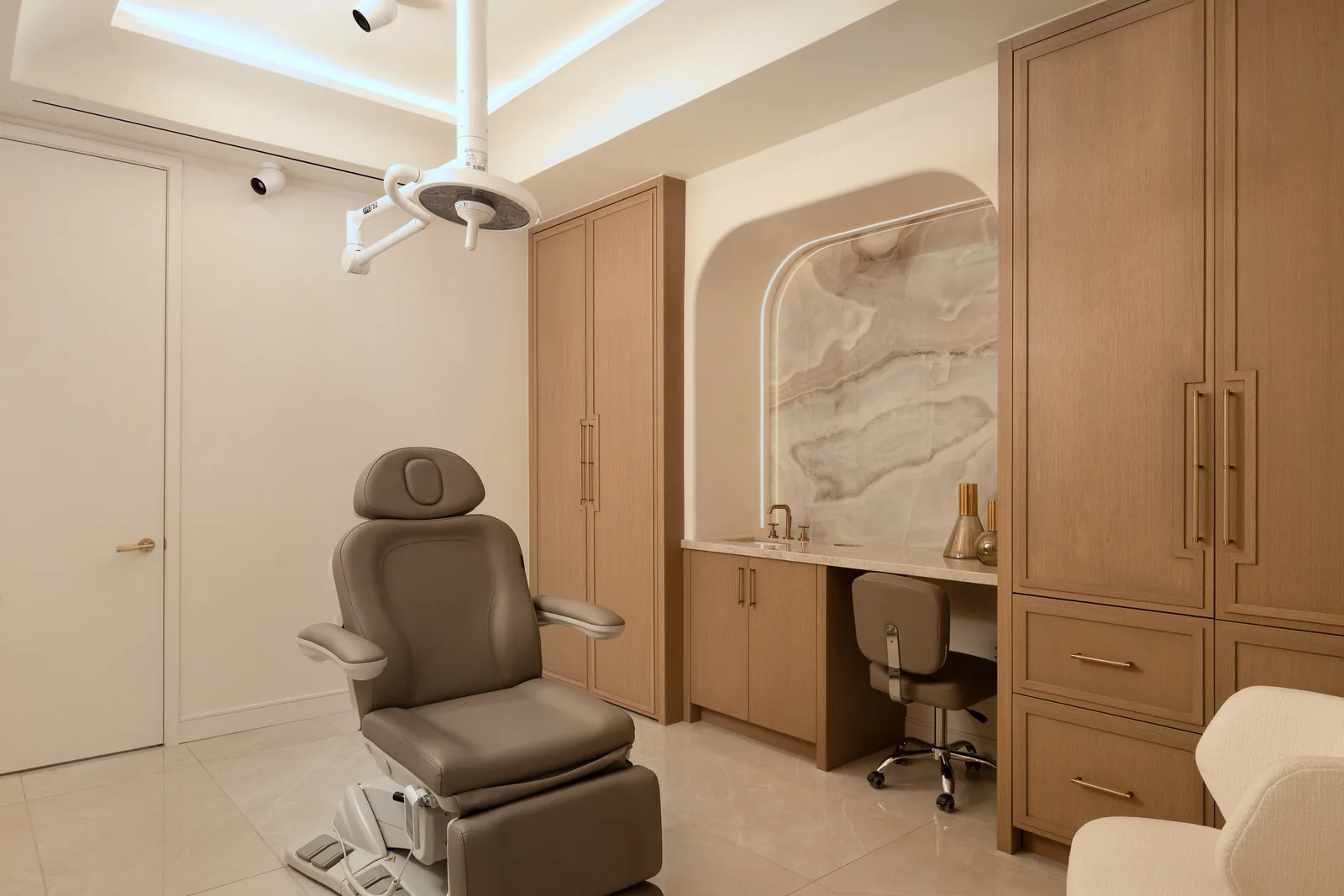
SCOTTSDALE · MODERN OFFICE SETTING
Where to Start
Who PRF Hair Restoration Is For, and What Happens First
PRF hair restoration at Aesthetica by Ashley Howarth MD is for men and women with mild to moderate pattern thinning, a widened part, receding temples, or diffuse thinning after a trigger such as pregnancy or illness, whose scalp still shows follicles in the thinning area, and who can commit to a series of 3 to 4 sessions and then maintenance. The scalp assessment is the first step and the one that decides whether PRF is the right tool. The injector examines the scalp under magnification and documents the pattern: miniaturized hairs alongside normal ones, which is the signature of androgenetic loss PRF addresses; the density of follicles in the thinning area; any redness, scale, pustules, or smooth scarred patches; and the hair pull. It records when the thinning started, family history, recent illness or weight loss, medications, and, for women, menstrual and menopausal history, and it requests thyroid, ferritin, and where indicated hormone tests before treating diffuse shedding, since an untreated cause makes any scalp treatment pointless. If the pattern is scarring, patchy, or inflamed, or the follicles are gone, the recommendation is a dermatologist first, and the Hair Thinning guide explains the differences. If PRF is the right tool, the visit ends with a written plan that usually pairs it with a topical or prescription option the patient discusses with a physician.
Dr. Ashley Howarth, MD, FACS is a board-certified plastic surgeon and an instructor in plastic surgery at Mayo Clinic. Aesthetica by Ashley Howarth MD is the medical aesthetics brand of her practice, Howarth Plastic Surgery, at 7373 N. Scottsdale Road, Suite C150, Scottsdale, Arizona 85253.

Your Own Platelets, Placed at the Follicle
How PRF Hair Restoration Is Used in Scottsdale
Pattern Thinning in Women
Female pattern hair loss, a widened part with thinning over the crown, is treated with PRF injected at about 1 cm intervals in a series of 3 to 4 sessions, with most women noticing less shedding within the first month.
Female pattern hair loss usually shows as a widened part and thinning over the crown with the frontal hairline kept, and it is the most common reason women ask Aesthetica by Ashley Howarth MD about PRF. After laboratory screening has ruled out thyroid disease and iron deficiency, the thinning zone is mapped and PRF is injected at roughly 1 cm intervals along and beside the part and across the crown, in a series of 3 to 4 sessions 4 to 6 weeks apart. Meta-analyses of platelet-rich plasma in pattern loss report increased hair density in treated scalp compared with control, and the injectable PRF reports that exist describe a similar direction of effect. Most women notice less hair in the drain within the first month and a thicker part at 2 to 3 months. The Hair Thinning guide describes the female pattern in detail.
Temples and Crown in Men
In men, PRF works best on the temples and crown while fine miniaturized hairs remain, thickening existing hair rather than recreating a hairline that has already gone bare, where a transplant is instead the honest answer.
Male pattern loss recedes the temples and thins the crown, and PRF is most useful while those areas still show fine miniaturized hairs rather than smooth skin. The injections cover the receding hairline, the temples, and the crown, in the same 3 to 4 session series, and the honest counseling is that PRF slows loss and thickens existing hair more reliably than it recreates a hairline that has been bare for years. Men who are already using a topical or a prescription option discussed with their physician keep using it; the evidence for platelet treatments is strongest as an addition to those rather than a replacement. A man with an advanced pattern and a smooth crown is told plainly that a hair transplant is the answer, and that PRF can support the transplanted and surrounding hair afterward.
Diffuse Shedding After a Trigger
Shedding that begins two to four months after a trigger like childbirth or illness is usually telogen effluvium and often recovers on its own within 6 to 12 months, with PRF used when that recovery has stalled.
Shedding that began two to four months after childbirth, an illness, surgery, rapid weight loss, or a period of severe stress is usually telogen effluvium, a temporary shift of many follicles into the resting phase at once, and most of it recovers on its own within 6 to 12 months. PRF is used at Aesthetica by Ashley Howarth MD when that recovery has stalled, when the shedding has revealed an underlying pattern loss, or when a patient wants to support regrowth actively, and it is used only after the trigger has been identified and any deficiency corrected. A scalp assessment that finds inflammation, scale, or patchy loss is not treated; it is referred. Because the treatment is autologous and not light-based it runs through the Scottsdale summer, unlike the facial treatments on the laser season calendar.
When PRF Is Not the Answer
Scarring alopecia, a fully bald area with no visible follicles, or shedding with an undiagnosed medical cause all stop a PRF plan, and the practice refers those patients first rather than injecting.
Three findings at the scalp assessment stop a PRF plan. The first is scarring alopecia: smooth, shiny patches with no follicle openings, often with redness or scale at the edge, seen in conditions such as frontal fibrosing alopecia and lichen planopilaris, which need a dermatologist’s diagnosis and anti-inflammatory treatment, and in which injections can make things worse. The second is a fully bald area with no visible follicles, where nothing injected can regrow hair and a surgical consultation about transplantation is the honest next step. The third is shedding with a medical cause not yet found, such as thyroid disease, iron deficiency, or a medication effect. In each case Aesthetica by Ashley Howarth MD refers first and treats later, if at all. PRF also has a sibling on the face: PRF EZ Gel, the same fibrin heated into a gel for thin skin under the eyes.
At a Glance
PRF Hair Restoration at a Glance
The stages of a PRF hair restoration plan at Aesthetica by Ashley Howarth MD, from the scalp assessment through maintenance, with the timing and what patients typically notice at each; individual plans are set at the assessment.
| Stage | What happens | Timing | What you notice |
|---|---|---|---|
| Scalp assessment | Scalp examined under magnification; pattern documented; laboratory screen requested if shedding is diffuse; referral if scarring or inflamed | Visit 1 | A diagnosis and a written plan, or a referral |
| Session 1 | Blood draw, low-speed spin, PRF injected across the thinning zone at about 1 cm intervals | Week 0 | Tender scalp for a few hours; nothing visible yet |
| Session 2 | Repeat injections to the same map; photographs compared | Week 4 to 6 | Less hair in the drain and brush |
| Sessions 3 to 4 | Series completed; topical or prescription plan continued | Weeks 8 to 18 | Fine new hairs along the part or temples; existing hair feels thicker |
| Six-month review | Photographs at the same distance as visit 1; plan adjusted | Month 6 | A narrower part, denser temples, stable shedding |
| Maintenance | Single session, year-round | Every 4 to 6 months | Result held; drift back toward baseline if stopped |
Where PRF Fits
PRF vs Other Hair Options
How PRF compares with the other options for pattern hair thinning, so the assessment at Aesthetica by Ashley Howarth MD can place it honestly; prescription options are discussed with a physician and surgical consultation is arranged through the surgical practice.
| Option | How it works | Evidence | Where it fits |
|---|---|---|---|
| PRF scalp injections | Your own platelets and fibrin release growth factors at the follicle over days | Early clinical reports in pattern loss; PRP meta-analyses show increased density versus control | Mild to moderate thinning with follicles present; added to a topical or prescription plan |
| PRP scalp injections | Liquid platelet concentrate with anticoagulant; growth factors release quickly | Multiple meta-analyses of randomized trials showing increased hair density | The same patients; PRF is the practice's preferred preparation for its sustained release |
| Topical minoxidil | Prolongs the growth phase and enlarges follicles; applied daily | FDA-approved over the counter for pattern loss in men and women | First-line foundation for most patients; continued through PRF |
| Prescription options discussed with a physician | Address the hormonal drivers of pattern loss or are used off-label for it | Established for male pattern loss; used with individual judgment in women | Decided with the patient's physician; PRF is added, not substituted |
| Low-level laser devices | Red light stimulates follicle activity; used at home several times a week | FDA-cleared devices with modest trial support | An add-on between sessions for patients who will use it consistently |
| Hair transplant | Moves permanent follicles from the back of the scalp into bald areas | Long-established surgical result | Smooth bald areas with no follicles; PRF supports the surrounding hair afterward |
A Visit Built Around Your Scalp
What to Expect at a PRF Hair Restoration Visit at Aesthetica by Ashley Howarth MD
A PRF hair session at Aesthetica by Ashley Howarth MD has three parts: the blood draw and processing while the scalp is numbed, the injections, and a written aftercare plan with the next session booked. Plan on about 45 to 60 minutes in the room; the injecting itself takes 15 to 20 minutes.
Scalp photographed, blood drawn, numbing applied
The injector photographs the part line and crown at a fixed distance for comparison, confirms the treatment map from your assessment, draws 20 to 40 mL of blood from the arm, and applies numbing cream or a cold pack to the scalp while the tubes are spun at low speed without anticoagulant, about 10 to 15 minutes. The PRF is used within minutes of spinning, before it clots.
Small injections across the thinning area
The PRF is drawn into small syringes and injected just under the scalp skin at roughly 1 cm intervals across the thinning zone, along the part, at the temples, or over the crown. Each injection feels like a brief sting and pressure. The scalp is slightly bumpy and tender for a few hours and the hair is not wet or oily afterward.
Aftercare in writing and the next session booked
You leave with instructions not to wash your hair for 12 to 24 hours, to avoid hats that press on the scalp for a day and hard exercise or heat for 24 hours, to hold hair color for three days, to continue any topical or prescription plan from the next day, and the date of your next session 4 to 6 weeks out.
Clear Information. Informed Choices.
Safety and Limitations of PRF Hair Restoration
PRF hair restoration is among the safest scalp treatments because the material is the patient’s own blood with no additives, so there is no allergic reaction to it and no foreign material left in the scalp. Side effects are those of any set of small injections: tenderness, a tight or bumpy scalp for a day, occasional pinpoint bruising, and a mild headache in some patients. Infection is rare with sterile technique. The main risk is a wasted series, which is why the scalp assessment matters more than the injections: PRF cannot regrow hair from follicles that are gone, cannot treat a scarring alopecia and can inflame it, and cannot fix shedding caused by an untreated medical problem. The second limitation is honesty about the evidence, which is stronger for PRP than for PRF, varied in protocol, and clear that platelet treatments slow loss and thicken existing hair rather than restore a full head of it. Aesthetica by Ashley Howarth MD screens for those problems first, refers scarring, patchy, or inflamed scalps to a dermatologist, and describes the expected result as modest and cumulative.
Possible Side Effects Include
- Scalp tenderness and a tight, bumpy feeling for a few hours to a day
- Pinpoint bruising or small red marks at injection sites for a few days
- A mild headache the day of treatment
- Temporary increase in shedding in the first weeks as follicles cycle
- Rarely, infection or a reaction at the draw site
What Treatment Cannot Guarantee
- Regrowth in a bald area with no visible follicles
- Improvement in scarring or inflammatory alopecia
- A result from a single session
- A permanent result without maintenance
- A substitute for diagnosing the cause of hair loss
What Happens After PRF Hair Restoration
Recovery After PRF Hair Restoration
Recovery from a PRF scalp session is a matter of hours, and the timeline that matters is the hair cycle’s, not the injection’s: hair grows about a centimeter a month and a follicle that has been pushed back into growth takes 2 to 3 months to show it, so patience between session one and the first visible change is part of the plan. The treatment is not seasonal and runs year-round in Scottsdale, with sunscreen or a hat for a thinning part in the Arizona sun. PRF EZ Gel to the face can be done from the same draw in the same visit.
The scalp feels tight and tender, like a mild sunburn, for a few hours, and small bumps at the injection sites flatten by evening. Do not wash your hair for 12 to 24 hours, skip hats that press on the scalp, and avoid hard exercise, saunas, and alcohol for 24 hours. Acetaminophen is fine for a headache; anti-inflammatory painkillers are held for a day. Any spreading redness, warmth, or fever is a same-day call to the practice.
Wash and style normally from the next day. Any topical or prescription plan agreed with your physician resumes the day after treatment, and hair color or chemical treatments wait three days. Pinpoint marks fade within a few days. A small increase in shedding in the first two weeks can happen as follicles reset and is not a sign of failure.
Most patients notice less hair in the drain and brush by about the fourth week, which is when the second session is due. Between sessions two and three, at 8 to 12 weeks, fine new hairs appear along the part or temples and existing hair feels thicker. The series continues at 4 to 6 week intervals to 3 or 4 sessions. The Hair Thinning guide explains why regrowth takes this long.
The result is judged at about six months from the first session, in photographs taken at the same distance as the first visit: a narrower part, denser temples, and less shedding. Improvement is modest and cumulative by design. Maintenance is a single session every 4 to 6 months, because pattern hair loss continues in the background and platelet treatment slows it rather than ending it. Patients who stop maintenance drift back toward their baseline over the following year.
Before & After
PRF Hair Restoration, Before and After Treatment
PRF hair results are best judged in photographs of the same part line or crown taken from the same distance and angle under the same light before the first session and at six months, because hair density changes are subtle from day to day and obvious across half a year. Aesthetica by Ashley Howarth MD maintains before-and-after galleries for PRF hair restoration, PRF EZ Gel, and the other treatments on the injectables hub, and the team can show you cases that match your pattern, whether a widened part, receding temples, or diffuse thinning, during your visit, including cases where the recommendation was a dermatologist or a surgical consultation instead.
Patient Case Summaries
Selected PRF Hair Restoration Case Summaries
These deidentified case summaries illustrate how Dr. Howarth and the physician-led team at Aesthetica by Ashley Howarth MD plan PRF hair restoration in Scottsdale. They include a first-time female pattern patient, a man with receding temples, a patient with postpartum shedding, a maintenance patient several years into treatment, a patient who had been injected elsewhere without a diagnosis, and a patient for whom PRF was not recommended and a dermatologist was. Each summary connects the patient’s concern and scalp assessment with the treatment performed or the recommendation made.
Case 01
First-time female pattern
A widened part in a woman in her forties treated with a four-session PRF series after laboratory screening
Patient presentation
A woman in her forties, a long-term Scottsdale resident, said her part had widened over three years and scalp showed in photographs taken from above; she did not want a daily medication and asked whether PRF would help.
Skin assessment
Scalp examination under magnification showed miniaturized hairs mixed with normal ones along the part and over the crown, preserved frontal hairline, no scale, redness, or scarring, and a negative pull test. Her mother had the same pattern. Thyroid and ferritin tests requested before treatment were normal.
Procedure performed
Four PRF sessions to the part and crown five weeks apart, with a topical option discussed with her physician started at the same time, and photographs of the part at a fixed distance at each visit.
Clinical rationale
Miniaturized hairs on a scalp with visible follicles and a normal laboratory screen is the pattern PRF addresses, and the evidence for platelet treatments is strongest alongside a topical rather than alone.
Follow-up
At six months the part was measurably narrower in the comparison photographs and shedding had fallen within the first month; she maintains with a session every five months.
Case 02
Male temples and crown
Receding temples and early crown thinning in a man in his thirties, treated with PRF alongside his existing plan
Patient presentation
A man in his thirties who had used a topical for two years asked whether PRF could add to it, since his temples were still receding and the crown had begun to thin.
Skin assessment
The temples showed fine miniaturized hairs rather than smooth skin and the crown showed diffuse thinning with follicles present throughout. There was no scarring or inflammation, and the hairline itself had not been bare long enough to lose its follicles.
Procedure performed
Three PRF sessions to the temples, hairline, and crown six weeks apart with the topical continued, and a conversation with his physician about prescription options, then maintenance every four months.
Clinical rationale
PRF thickens miniaturized hair and slows loss most reliably when the follicles are still present and when it is added to, rather than substituted for, an existing plan; treating early is what keeps the temples from becoming a transplant question.
Follow-up
At six months the temples were denser and the crown thinning had stopped progressing; he was told plainly that if the crown ever went smooth, a transplant consultation would be the next step.
Case 03
Postpartum shedding
Shedding eight months after childbirth that had stalled, treated with PRF after the trigger was confirmed
Patient presentation
A woman in her thirties reported heavy shedding that began three months after her second child and had slowed but not stopped at eight months, leaving her temples and the front of her part visibly thinner.
Skin assessment
The pattern was diffuse with a positive pull test at the temples and no scale or scarring, consistent with a postpartum telogen effluvium that had uncovered mild pattern thinning at the temples. Ferritin was low and was corrected with her physician before treatment.
Procedure performed
After iron replacement, three PRF sessions to the temples and frontal part five weeks apart, timed after she had finished breastfeeding, with a follow-up photograph at six months.
Clinical rationale
Shedding after a trigger mostly recovers on its own, so the first step is to correct the cause; PRF was used once the deficiency was treated and the residual thinning showed a pattern that would not recover unaided.
Follow-up
Shedding fell to normal within a month of the first session and the temples had filled at six months; she returns for maintenance twice a year.
Case 04
Maintenance patient
Three years of PRF maintenance in a woman in her fifties who stopped and restarted
Patient presentation
A woman in her fifties who had completed a PRF series three years earlier and maintained it every six months paused for a year while travelling and returned because her part had begun to widen again.
Skin assessment
The scalp showed a partial return toward her original pattern with miniaturized hairs along the part, no new findings, and preserved follicle density. Her laboratory screen from the original assessment was repeated and was normal.
Procedure performed
A short reset series of two PRF sessions five weeks apart to the part and crown, then a return to maintenance every four to six months.
Clinical rationale
Pattern hair loss continues in the background and platelet treatment slows rather than ends it, so a lapse in maintenance drifts back toward baseline; a brief reset series restores the effect faster than a single maintenance session.
Follow-up
Her part narrowed again over the following four months, and she now schedules maintenance before each trip rather than after.
Case 05
Injected elsewhere
A man in his forties injected with PRP at another clinic without a diagnosis, reassessed and screened before any PRF
Patient presentation
A man in his forties who had moved to Scottsdale from another state had received six PRP sessions elsewhere over a year with no improvement and asked whether PRF would work better.
Skin assessment
Scalp examination found diffuse thinning across the whole scalp rather than a pattern, with a positive pull test everywhere and no miniaturization at the temples, which does not fit androgenetic loss. No laboratory testing had ever been done. Thyroid testing requested at the assessment showed an underactive thyroid.
Recommendation
Referral to his physician for thyroid treatment and a dermatology opinion, with no PRF until the shedding had stabilized; a PRF series was offered six months later once the diffuse loss had settled and an underlying mild pattern thinning remained.
Clinical rationale
Six sessions of any platelet treatment cannot fix shedding driven by an untreated medical cause, and a physician-led practice diagnoses first and injects second.
Follow-up
His shedding stopped within months of thyroid treatment, and after a later three-session PRF series to the crown he described the result as the first that had done anything.
Case 06
Dermatology instead
Frontal hairline loss with smooth scarred skin in a woman in her sixties, and why PRF was not recommended
Patient presentation
A woman in her sixties asked for PRF because her hairline had receded evenly by about two centimeters over four years and her eyebrows had thinned, and she had read that PRF regrows hair.
Skin assessment
Dr. Howarth’s examination found a band of smooth, pale, shiny skin behind the original hairline with no follicle openings, faint redness and scale around the surviving hairs at its edge, and loss of the outer eyebrows, a pattern characteristic of frontal fibrosing alopecia, a scarring alopecia.
Recommendation
No PRF. Referral to a dermatologist for confirmation, which included a scalp biopsy, and anti-inflammatory treatment to stop the progression; PRF was explained as unable to regrow hair where follicles have been replaced by scar and as a possible irritant in an active inflammatory condition.
Clinical rationale
Scarring alopecias destroy the follicle, so nothing injected can regrow hair there, and the priority is to halt the inflammation before it takes more; recommending a paid series would have been dishonest and potentially harmful.
Follow-up
Her dermatologist confirmed the diagnosis and started treatment, and the progression has stabilized; she returns to Aesthetica by Ashley Howarth MD for facial care and has been told PRF may be reconsidered for the unaffected crown if it ever thins.
From First Visit to a Plan You Can Keep
Booking, Planning, and Follow-Up at Aesthetica by Ashley Howarth MD
Aesthetica by Ashley Howarth MD is a medical practice with a spa’s convenience. Established patients book online. New patients can book online or request a consultation, and the team responds usually the same day.

Online booking or a consultation request
Book a scalp assessment directly online, or request a consultation and describe when the thinning started, where you notice it, what you have tried, and any recent illness, pregnancy, or medication change. Bring recent laboratory results if you have them.
A diagnosis, then a series
You leave your first visit with a written plan: whether PRF is the right tool, or a dermatologist or laboratory screen comes first; how many sessions, usually 3 to 4, and how far apart; which topical or prescription option to discuss with your physician; and the photograph schedule that will show the result. The Hair Thinning guide explains the reasoning.
Six-month photographs, then maintenance every 4 to 6 months
The result is photographed at six months and maintenance is scheduled every 4 to 6 months, year-round, since scalp treatment does not depend on the Scottsdale season. A-List members have the next visit on the calendar before they leave, and PRF EZ Gel for the face can share the same draw, with a HydraFacial in the same visit if the face is on the plan.
Your Questions, Answered
PRF Hair Restoration Frequently Asked Questions
PRF, platelet-rich fibrin, is a concentrate of platelets and fibrin spun from your own blood without additives. Injected into thinning scalp, the platelets release growth factors that prolong the growth phase of the hair cycle, improve blood supply around the follicle, and reduce inflammation, and the fibrin releases them over days. It thickens miniaturized hair and slows loss from follicles that are still alive; it cannot regrow hair where follicles are gone.
Both come from your own blood. PRP is spun faster with an anticoagulant and is a liquid whose growth factors release within minutes. PRF is spun at lower speed with no additives and forms a fibrin scaffold that releases growth factors over days. The PRP evidence in pattern hair loss is larger and older; PRF has a plausible advantage in sustained release and less trial data, and no head-to-head trial proves it superior.
Men and women with mild to moderate pattern thinning, a widened part, receding temples, or diffuse thinning after a trigger, whose scalp still shows follicles in the thinning area. It is not for smooth bald areas, scarring alopecia, patchy or inflamed loss, or shedding with an untreated medical cause, which are referred to a dermatologist or a physician first. The scalp assessment at Aesthetica by Ashley Howarth MD decides; the Hair Thinning guide explains the patterns.
The standard plan at Aesthetica by Ashley Howarth MD is a series of 3 to 4 sessions spaced 4 to 6 weeks apart, then a single maintenance session every 4 to 6 months. The series is what produces the result; maintenance is what keeps it, because pattern hair loss continues in the background. Patients who stop maintenance tend to drift back toward their starting point over the following year.
Almost none. Numbing cream or a cold pack is applied first, each injection feels like a brief sting, and the scalp is tender and slightly bumpy for a few hours. You skip washing your hair for 12 to 24 hours, hats that press on the scalp for a day, and hard exercise or heat for 24 hours, then return to normal. Hair color waits three days. Most patients return to work the same day.
Less shedding is usually the first change, within about a month of the first session. Fine new hairs and a thicker feel to existing hair appear at 2 to 3 months, between the second and third sessions, because hair grows about a centimeter a month and a follicle pushed back into growth needs that long to show it. The result is judged at six months in photographs taken from the same distance as the first visit.
Yes, and it usually should be. The evidence for platelet treatments in pattern loss is strongest alongside a topical or a prescription option discussed with your physician, and both are continued through the series. Low-level laser devices can be used at home between sessions. PRF is also used before and after a hair transplant to support the transplanted and surrounding hair. Supplements are reviewed at the assessment rather than assumed.
No. Pattern hair loss is driven by genetics and hormones that do not stop, so PRF slows it and thickens existing hair rather than curing it. After a series of 3 to 4 sessions the improvement holds with maintenance every 4 to 6 months, and fades gradually over about a year if maintenance stops. A hair transplant is the only option that moves permanent follicles into a bald area, and PRF can support it afterward.
Yes. Female pattern hair loss, a widened part and crown thinning with the hairline kept, is the most common reason women come to Aesthetica by Ashley Howarth MD for PRF, and the platelet-treatment trials include women. The difference is the screening: diffuse thinning in a woman is checked for thyroid disease and iron deficiency before any injection, and thinning after pregnancy or menopause is assessed for a trigger first. The series and maintenance are the same as for men.
Not directly. Pattern hair loss is genetic and hormonal, and the causes of shedding are the same in Scottsdale as anywhere. What the desert does is expose a widened part to a summer UV index of 11 or more, which burns and ages the scalp skin, and heat and sweat can aggravate a scalp condition. A hat or scalp sunscreen protects the thinning area, and PRF is scheduled year-round because it does not depend on the season. Skin in Arizona covers the sun and the skin.
Concerns Treated
Concerns This Treatment Addresses
These guides explain each concern and where this treatment fits among the options at Aesthetica by Ashley Howarth MD in Scottsdale.
- Hair Thinning Patterns, causes, what PRF treats and what it does not
- Skin in Arizona Why timing matters in the desert
- Skin Texture, Pores & Dullness PRF on the face with SkinPen microneedling
- Fine Lines & Wrinkles PRF EZ Gel for thin skin under the eyes
- PRF EZ Gel The same platelet-rich fibrin, heated into a gel for the face
- Dermal Fillers Facial volume addressed at the same assessment
BEGIN HERE
Request a Consultation
Tell us what you are considering. A member of our patient care team will follow up with consultation availability and next steps.

Megan S.
Patient Coordinator
Prefer to talk or text?
Selected References