
Dry Air Leaves a Mark
What Causes Rough Texture, Enlarged Pores, and Dull Skin in Arizona
Rough texture, enlarged pores, and dullness in Arizona come from three causes: dry air that lets dead cells build up, UV exposure that breaks down the collagen keeping pore walls firm, and oil and residue that congest pores. At Aesthetica by Ashley Howarth MD, texture is treated in two layers: HydraFacial and chemical peels to clear and hydrate the surface year-round, and HALO, MOXI, and the MicroLaser Peel to rebuild the surface and collagen beneath it between October and April.
Rough texture, visible pores, and dull skin have three causes in Arizona: dry air, sun, and oil. Afternoon humidity in Scottsdale often falls below 15 percent, and skin in that air loses water faster than it can replace it. A dehydrated surface layer does not shed its dead cells on schedule, so they build up into a thicker, rougher, light-scattering layer that reads as dullness and a coarse feel. Years of ultraviolet exposure, at a summer UV index of 11 or higher, break down the collagen that keeps pore walls firm, so pores stretch and stay open. Oil, dead cells, and sunscreen residue then congest those pores, and the surface looks uneven even when the skin is otherwise healthy. At Aesthetica by Ashley Howarth MD, the med spa of Howarth Plastic Surgery in Scottsdale, texture is treated in two layers: clearing and hydrating the surface with HydraFacial and chemical peels year-round, and rebuilding the surface and collagen beneath it with HALO, MOXI, and the MicroLaser Peel between October and April.
This page covers the four patterns we see most: a rough, sandpaper feel on the cheeks and forehead; enlarged pores on the nose and central cheeks; a dull, gray cast that makeup does not fix; and congestion with small bumps and blackheads. It explains which treatment corrects which pattern, what each one involves, how many sessions to expect, and why the desert calendar decides when the laser work happens. It is written for people who have lived with Arizona air for decades and for people who noticed the change within months of arriving.

Surface, Pores, and Light
What Patients Notice About Texture in Scottsdale
Texture concerns rarely arrive alone. Most patients at Aesthetica by Ashley Howarth MD describe some combination of the following, usually after a move to Arizona, a summer of pool and sun, or a decade of both.
- A rough or sandpaper feel on the cheeks and forehead
- Pores that look larger on the nose and central cheeks
- A dull, gray, or tired cast that makeup sits on top of
- Blackheads, congestion, and small bumps along the jaw and nose
- Flaking and tightness that moisturizer improves for only a few hours
- Skin that looks older in Arizona light than it did elsewhere
The most common sentence we hear is “my skin used to glow.” Glow is light reflecting evenly off a smooth, hydrated surface. Dry desert air takes that surface apart one dead cell at a time, and treatment puts it back.


Surgeon-Directed Care
More Tools in the Toolbox: Why a Plastic Surgeon Directs This Care
Aesthetica by Ashley Howarth MD is the medical aesthetics practice of Ashley Howarth, MD, FACS, a board-certified plastic surgeon and instructor in plastic surgery at Mayo Clinic. Resurfacing lasers remove and heat skin at measured depths, and the margin between an excellent result and a pigment complication is a settings decision that depends on skin type, sun history, and the time of year. Dr. Howarth sets those protocols, selects the Sciton technology, and trains the team. She is also the physician who evaluates texture that is not ordinary: a rough patch that does not shed, a persistent scaly spot, or a change in a single area, any of which can be actinic damage or an early skin cancer in a state with one of the highest skin cancer rates in the country. A resurfacing treatment should never be the first thing that touches a lesion no one has characterized.
Aesthetica by Ashley Howarth MD is the med spa of a plastic surgery practice, and that changes what can be offered. Most skin concerns are treated without surgery, and most patients never need it. When skin care and nonsurgical treatment reach their limit, the conversation does not end at the door: the same physician evaluates the next step, from deep laser skin resurfacing performed by Dr. Howarth to eyelid surgery, facelift, and neck lift. A surgeon directing the plan means more tools in the toolbox, and an honest answer about which one you need.

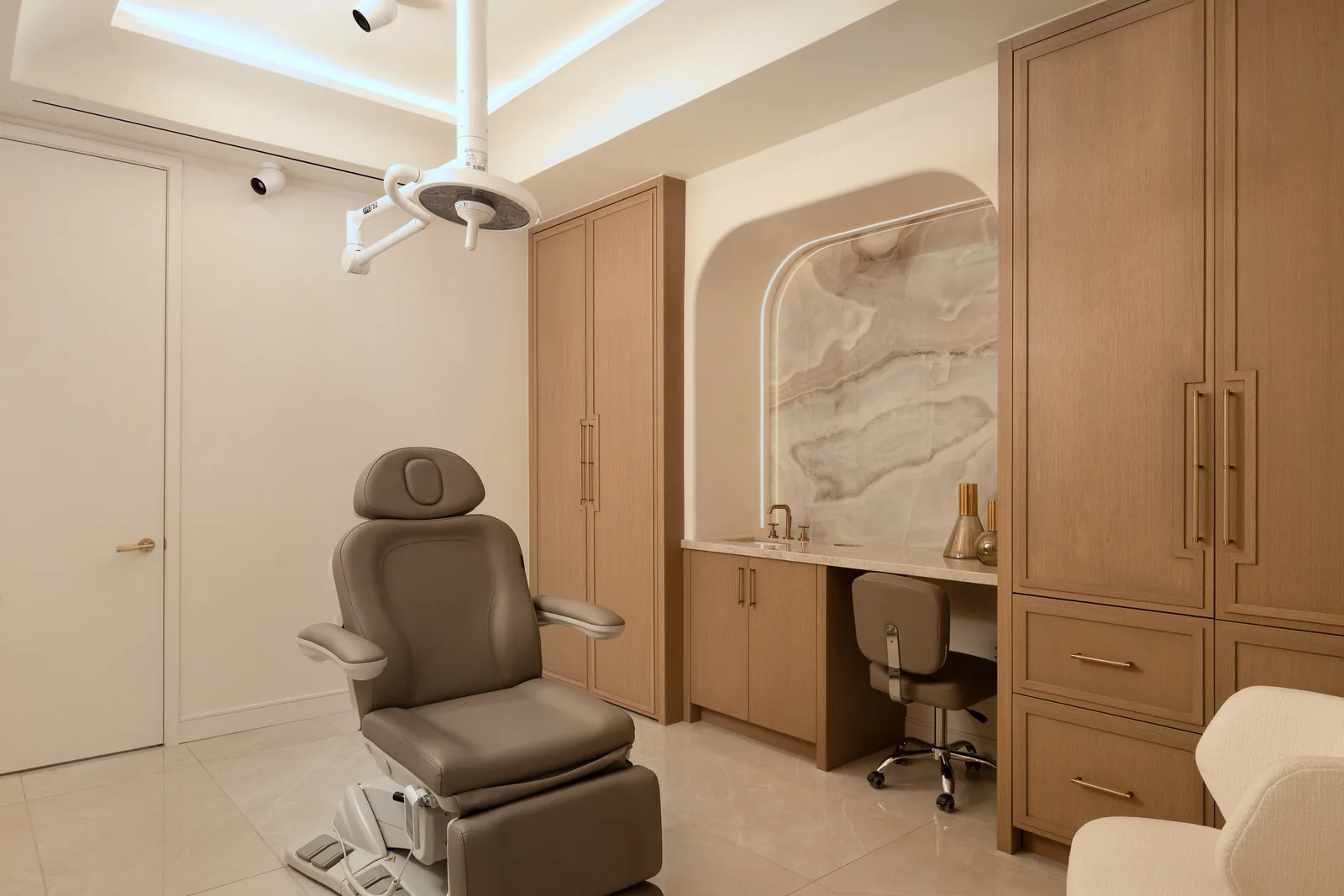
SCOTTSDALE · MODERN OFFICE SETTING
Where to Start
Who This Is For, and What Happens at the Skin Assessment
Texture treatment at Aesthetica by Ashley Howarth MD is for anyone whose skin feels rough, looks dull, or shows pores and congestion that home care has not fixed. The skin assessment comes before any treatment. A member of the physician-led team examines the surface under magnification, distinguishes dehydration and dead-cell buildup from true pore enlargement and sun-related collagen loss, and checks for active acne, rosacea, or melasma that would change the plan. The recommendation depends on your skin type, how deep the texture change goes, how much sun you can realistically avoid over the next month, and the time of year. In July the first step is usually a HydraFacial and a corrected home routine, with laser resurfacing planned for October. In January it may be HALO on the first visit.
Dr. Ashley Howarth, MD, FACS is a board-certified plastic surgeon and an instructor in plastic surgery at Mayo Clinic. Aesthetica by Ashley Howarth MD is the medical aesthetics brand of her practice, Howarth Plastic Surgery, at 7373 N. Scottsdale Road, Suite C150, Scottsdale, Arizona 85253.

Matched to the Layer, Not the Menu
Which Treatment Corrects Which Texture Problem
Rough Texture and Enlarged Pores
HALO is the hybrid fractional laser for established texture and pore size, combining ablative resurfacing with non-ablative collagen rebuilding over 1 to 2 sessions.
Sciton HALO is the hybrid fractional laser for established texture and pore size. It combines an ablative wavelength that resurfaces the top layer with a non-ablative wavelength that heats the dermis to rebuild collagen around each pore. Most patients need 1 to 2 sessions with 5 to 7 days of downtime, scheduled between October and April.
Early Texture, Tone, and Maintenance
MOXI is the gentle non-ablative laser for early roughness and uneven tone, delivered as a series of 3 sessions and also used to maintain HALO results in later seasons.
Surface Buildup and Dullness
The MicroLaser Peel removes a precise depth of thickened surface skin for the fastest route to an even finish during laser season, while chemical peels do a lighter version year-round.
The MicroLaser Peel removes a precise, measured depth of the thickened surface layer with an erbium laser and is the fastest route to a smooth, even finish during laser season. Chemical peels do a lighter version of the same work in a series of 3 to 6 and can continue year-round.
Congestion, Blackheads, and Dehydration
HydraFacial clears congested pores with vortex extraction while infusing hydration, making it the year-round treatment and the correct first step in summer.
HydraFacial clears congested pores with vortex extraction while infusing hydration, which is why it is the year-round treatment and the correct first step in summer. Customized facials address oil, dehydration, and home-care habits between laser seasons.
Planning at a Glance
Sessions, Downtime, and Season
Sessions, downtime, and the months each texture treatment is scheduled in Scottsdale. Individual plans are set at the skin assessment.
| Treatment | Sessions | Downtime | Scottsdale season |
|---|---|---|---|
| HALO | 1 to 2 | 5 to 7 days of redness, bronzing, and flaking | October to April; none after mid-April |
| MOXI | 3, four weeks apart | 1 to 2 days of pinkness; flaking by day 3 to 5 | October to April; select summer cases |
| MicroLaser Peel | 1 to 3 | 3 to 7 days of flaking, by depth | October to April |
| HydraFacial | Every 4 to 6 weeks | None | Year-round; the summer default |
| Chemical peels | Series of 3 to 6 | 1 to 5 days of flaking, by depth | Year-round; lighter peels in summer |
A Visit Built Around the Surface
What to Expect at a Texture Visit at Aesthetica by Ashley Howarth MD
Texture visits at Aesthetica by Ashley Howarth MD begin by deciding which layer is the problem. Dead-cell buildup and dehydration are corrected the same day in any season. Pore enlargement and collagen loss need laser work, and laser work waits for untanned skin and a realistic month of sun avoidance.
Surface, pores, and sun history
The team examines the skin under magnification, reviews recent sun exposure and tanning, and asks about retinoids, exfoliating acids, and any history of acne, melasma, or scarring. Tanned skin postpones laser treatment because the risk of post-inflammatory pigment rises.
The treatment that fits the day
In laser season, HALO, MOXI, or a MicroLaser Peel proceeds with topical numbing where needed and a treatment time of 30 to 60 minutes. In summer, or when sun avoidance is not realistic, a HydraFacial or a lighter peel clears and hydrates the surface and the laser date is set for fall.
A skin and sun plan in writing
You leave with specific instructions: a mineral SPF 30 or higher reapplied every two hours outdoors, a bland moisturizer applied while the skin is damp, when to restart retinoids and acids, and the date of the next session.
Clear Information. Informed Choices.
Safety and Limitations of Texture Treatment in a High-UV Climate
Resurfacing treatments are safe when matched to skin type and timed around sun exposure. Most side effects are expected parts of healing. The one that matters most in Arizona is post-inflammatory hyperpigmentation, a darkening of treated skin that is more likely when skin is tanned at treatment, exposed to sun while healing, or belongs to a darker skin type treated at settings meant for fair skin. Conservative settings and the October to April calendar are how it is avoided.
Possible Side Effects Include
- Redness, warmth, and swelling for 1 to 7 days depending on depth
- A sandpaper feel and bronzed flaking as treated skin sheds
- Post-inflammatory hyperpigmentation with sun exposure or tanned skin
- Temporary dryness, tightness, and sensitivity to products
- Rarely, acne flare, infection, prolonged redness, or scarring
What Treatment Cannot Guarantee
- Permanently smaller pores; pore size is reduced, not erased
- A complete result from a single session
- Smooth skin that stays smooth without daily hydration and sunscreen
- Correction of deep acne scars, which need a scar-specific plan
- A result identical to another patient's
What Healing Looks Like
After HALO or MOXI for Texture: A Timeline
Resurfacing lasers work by creating controlled micro-injuries that the skin repairs with new, better organized tissue. The visible healing is short; the collagen rebuilding runs for months. The timeline below is for HALO, the deeper of the two treatments. MOXI follows the same sequence in about a third of the time, and HydraFacial has no downtime at all.
Treated skin darkens to a bronzed tone and develops a fine, gritty texture as thousands of microscopic treatment columns rise to the surface and shed. This is the treatment working, not a complication. No picking, no exfoliating, mineral sunscreen indoors and out, and makeup once the surface is intact.
Flaking finishes and the new surface is noticeably smoother and more reflective. Pores look tighter as swelling resolves and early collagen forms. Sun avoidance continues through week four; this is when post-inflammatory pigment would appear if the skin were exposed, and it is why the Scottsdale calendar matters.
Texture and pore improvement continue for 3 to 6 months as the dermis remodels. A second HALO, if planned, follows in the same season or the next. HydraFacial every 4 to 6 weeks and daily hydration and SPF maintain the surface through summer, and a MOXI series the following winter maintains the result.
Before & After
Texture and Pores, Before and After Treatment
Texture results are best judged in raking light, where roughness and open pores cast shadows, in photographs taken weeks apart under the same conditions. Aesthetica by Ashley Howarth MD maintains before-and-after galleries for HALO, MOXI, the MicroLaser Peel, and skin treatments, and the team can show you cases that match your skin type and texture pattern during your visit.
Patient Case Summaries
Selected Texture, Pores & Dullness Case Summaries
These deidentified case summaries illustrate how the physician-led team at Aesthetica by Ashley Howarth MD plans texture treatment around the Arizona climate. They include long-term residents, new arrivals, summer timing, darker skin types, single and combination treatments, and a consultation in which the recommendation was to see a dermatologist first. Each summary connects the patient’s concern and skin assessment with the treatment performed or the recommendation made.
Case 01
Long-term resident
Thirty years of desert air and sun on fair skin
Patient presentation
A woman in her fifties who had lived in Scottsdale for three decades described skin that felt like fine sandpaper across her cheeks and forehead, with enlarged pores on her nose and a dull cast that no product improved.
Skin assessment
The assessment showed a thickened, dehydrated surface layer, widened pores on the central face from sun-related collagen loss, and scattered solar lentigines. Fair skin, untanned in December, no lesions requiring referral.
Procedure performed
A single HALO treatment in December with topical numbing, a mineral SPF and bland moisturizer routine, and a HydraFacial every six weeks beginning one month later.
Clinical rationale
Established texture and pore enlargement on fair, untanned skin in peak laser season is the ideal HALO case; one deeper treatment does what a year of superficial treatments cannot.
Follow-up
At six weeks the surface was smooth and reflective and pore size was visibly reduced; improvement continued through spring, and a MOXI series was planned for the following winter as maintenance.
Case 02
New arrival
Skin that turned rough and dull within six months of moving from Seattle
Patient presentation
A man in his thirties reported that since relocating from Seattle his skin had become tight, flaky, and dull, with new blackheads across his nose and chin.
Skin assessment
The assessment showed marked dehydration with dead-cell buildup and congested pores, but no true pore enlargement or collagen loss. His routine was a foaming cleanser, no moisturizer, and no sunscreen. The visit was in July and he was tanned.
Procedure performed
A HydraFacial in July with a corrected home routine: a gentle cleanser, a humectant moisturizer applied to damp skin, and a mineral SPF 30. A second HydraFacial five weeks later.
Clinical rationale
His problem was entirely in the surface layer, which dry air had built up and congested. That is corrected safely in full sun; no laser was needed and none would have been appropriate on tanned skin.
Follow-up
After two HydraFacials and eight weeks of the new routine the texture and finish had normalized, and he continued HydraFacial every six to eight weeks without any laser treatment.
Case 03
Summer timing
A request for HALO in May with a wedding in July
Patient presentation
A woman in her forties asked for HALO in mid-May to smooth her texture and pores before her daughter’s wedding in July. She swam most mornings.
Skin assessment
Her texture was a good HALO indication, but her skin was already tanned, UV was climbing, and two to four weeks of sun avoidance after treatment was not realistic with a daily swim.
Recommendation
HALO was deferred to October. A series of three HydraFacials in May, June, and early July, a light chemical peel in June, a wide-brim swim hat, and mineral SPF 50 reapplied at the pool.
Clinical rationale
A resurfacing laser on tanned skin in a Scottsdale summer carries a real risk of post-inflammatory pigment that would have been visible at the wedding. Hydration and light exfoliation delivered a smoother surface for the event with no risk.
Follow-up
Her skin was noticeably smoother and brighter for the wedding, and she had HALO in October with untanned skin and a full month of realistic sun avoidance.
Case 04
Darker skin type
Enlarged pores and rough texture on Fitzpatrick V skin
Patient presentation
A woman in her thirties with deep brown skin (Fitzpatrick V) described enlarged pores on her cheeks and nose and a rough, uneven surface she had been told was untreatable by laser.
Skin assessment
The team documented true pore enlargement and surface roughness with no active acne and no melasma. Her skin type carried a higher risk of post-inflammatory hyperpigmentation with ablative or high-energy resurfacing.
Procedure performed
A series of four MOXI sessions at conservative settings, spaced four weeks apart from November to February, with a HydraFacial between sessions and a pigment-suppressing topical started two weeks before the first session.
Clinical rationale
Non-ablative fractional treatment at conservative energy improves texture and pore appearance on darker skin types with a far lower pigment risk than ablative HALO. A longer, gentler series reaches a similar endpoint more safely.
Follow-up
By March her texture was smoother and pores less visible with no post-inflammatory pigment. She maintains with HydraFacial through summer and a shorter MOXI series each winter.
Case 05
Combination plan
Dullness, congestion, and early texture treated in layers over one season
Patient presentation
A woman in her twenties who worked outdoors described a dull, gray complexion, blackheads on her nose and chin, and a rough feel on her forehead that had appeared over two Arizona summers.
Skin assessment
The assessment showed congestion and surface buildup as the dominant problem, with early texture change beginning underneath. Untanned in October, fair-to-olive skin, no active acne.
Procedure performed
A HydraFacial in October to clear congestion, a MicroLaser Peel in November to remove the thickened surface layer, and a MOXI session in January for tone and early texture, with a mineral SPF 50 and a hat at work.
Clinical rationale
Clearing the pores first lets a resurfacing treatment work on a clean surface; the MicroLaser Peel corrects buildup quickly during laser season; MOXI addresses the deeper change. Sequencing the three across one season matched each layer to the right tool.
Follow-up
By February the finish was even and reflective, congestion had not returned with the new routine, and she planned a single MOXI each winter with HydraFacial through the summer.
Case 06
Honest guidance
A rough patch that needed a dermatologist before it needed a laser
Patient presentation
A man in his sixties who had spent decades outdoors asked to have the rough texture on his forehead and temples resurfaced.
Skin assessment
Most of the roughness was ordinary sun-related texture, but the assessment identified several persistent scaly, gritty spots on the forehead and one on the temple that did not shed and had been present for months. The physician-led team does not resurface skin it cannot characterize.
Recommendation
Referral to a dermatologist for evaluation and treatment of the scaly lesions, suspected actinic keratoses, before any resurfacing. HALO for the surrounding texture was scheduled for the following laser season after clearance.
Clinical rationale
Persistent rough, scaly spots on chronically sun-exposed skin can be precancerous, and Arizona has one of the highest skin cancer rates in the country. A cosmetic laser passed over them can delay a diagnosis. Screening comes first.
Follow-up
The lesions were treated by the dermatologist, and the patient returned the following winter for HALO on cleared skin with an annual skin check now part of his routine.
From First Visit to a Plan You Can Keep
Booking, Planning, and Follow-Up at Aesthetica by Ashley Howarth MD
Aesthetica by Ashley Howarth MD is a medical practice with a spa’s convenience. Established medspa patients book online. New patients can book online or request a consultation, and the team responds usually the same day.

Online booking or a consultation request
Book a skin visit directly online, or request a consultation and describe what you notice about your texture, pores, or finish. Either path starts with the same skin assessment.
Surface first, then structure
You leave your first visit with a written plan: which layer is being treated first, which treatment and how many sessions, when they fall on the Scottsdale calendar, and the home routine that keeps the surface hydrated between visits.
Maintenance timed to the seasons
Most texture plans repeat annually: HALO or a MOXI series in the cooler months, HydraFacial through summer, and daily hydration and sunscreen year-round. A-List members have the next season scheduled before they leave the last one.
Your Questions, Answered
Texture, Pores & Dullness Frequently Asked Questions
Afternoon humidity in Scottsdale often falls below 15 percent, and skin in dry air loses water faster than it can replace it. A dehydrated surface layer stops shedding dead cells on schedule, so they build up into a thicker, rougher layer that scatters light and reads as dullness. Add sun damage to the collagen beneath, and the texture becomes established rather than temporary.
For established pore enlargement, HALO is the most effective single treatment at Aesthetica by Ashley Howarth MD in Scottsdale. It resurfaces the top layer and heats the dermis to firm the collagen around each pore, in 1 to 2 sessions between October and April. Congested pores that look large because they are full are cleared first with HydraFacial, which can be done in any season.
Not permanently. Pore size is set by genetics and by the firmness of the collagen around the opening. Treatment makes pores less visible in two ways: clearing the oil and debris that stretch them, and rebuilding the collagen that holds the walls firm. HALO and MOXI do the second; HydraFacial and peels do the first. Results are maintained, not fixed forever.
HALO is a hybrid fractional laser that combines ablative and non-ablative wavelengths for deeper correction of texture and pores in 1 to 2 sessions with 5 to 7 days of downtime. MOXI is a gentler non-ablative fractional laser for early texture and tone in a series of 3 sessions with 1 to 2 days of pinkness. HALO corrects; MOXI refines and maintains.
Most patients see a meaningful change from a single HALO treatment, and 1 to 2 sessions is the usual course. Collagen remodeling continues for 3 to 6 months after each session. A second treatment, if planned, is scheduled in the same laser season or the next, and the result is maintained with MOXI and HydraFacial.
The MicroLaser Peel uses an erbium laser to remove a precise, measured depth of the thickened surface layer that dry air and sun build up. It is the fastest way to restore a smooth, even, light-reflecting finish, with 3 to 7 days of flaking depending on depth. It is scheduled in laser season, October to April, on untanned skin.
Yes, at the surface level. HydraFacial, customized facials, and lighter chemical peels clear congestion and dead-cell buildup and restore hydration in any season with no pigment risk. Laser resurfacing with HALO, MOXI, or the MicroLaser Peel waits for October, when skin is untanned and two to four weeks of sun avoidance is realistic.
Every 4 to 6 weeks matches the skin’s natural turnover cycle and keeps pores clear and the surface hydrated. In Scottsdale many patients use HydraFacial monthly through the summer, when laser treatment is off the calendar, and space it out during laser season when HALO or MOXI is doing the heavier work.
Yes, with the right device and settings. Darker skin types (Fitzpatrick IV to VI) carry a higher risk of post-inflammatory hyperpigmentation after ablative resurfacing, so the physician-led team favors MOXI at conservative settings in a longer series, often with a pigment-suppressing topical started beforehand, over HALO. The plan is set at the skin assessment based on your skin type.
Established med spa patients can book online. New patients can book online or request a consultation through this page; the team responds usually the same day. Aesthetica by Ashley Howarth MD, the med spa of Howarth Plastic Surgery, is located at 7373 N. Scottsdale Road, Suite C150, Scottsdale, Arizona 85253, and can be reached by call or text at 480.535.5021.
Related Care
Treatments for Arizona Skin
These pages explain the treatments named in this guide. Concern-specific guides for sun damage, redness, melasma, dryness, and texture are being added to this section.
- HALO Hybrid Fractional Laser Deeper correction of texture and pores
- MOXI Laser Gentle fractional laser for early texture and tone
- MicroLaser Peel Measured erbium resurfacing for surface buildup
- HydraFacial Congestion and hydration, safe year-round
- Chemical Peels Surface renewal matched to skin type
- Skin in Arizona Why timing matters in the desert
BEGIN HERE
Request a Consultation
Tell us what you are considering. A member of our patient care team will follow up with consultation availability and next steps.

Megan S.
Patient Coordinator
Prefer to talk or text?
Selected References