
Procedure Overview
What Is Labiaplasty Revision?
Labiaplasty revision is secondary surgery considered after a prior labial procedure. The purpose of consultation is to understand the present anatomy, symptoms, scars, remaining tissue, healing, and what—if anything—another procedure may reasonably change.
Revision is not simply a repeat of the first operation. Prior incisions, tissue removal, blood supply, scar pattern, and healing can limit or change the available options. You do not need to know whether another operation is the answer before requesting an evaluation. Patients considering a first operation can begin with the labiaplasty overview.

CURRENT ANATOMY. REALISTIC OPTIONS.
Reasons Patients Seek a Labiaplasty Revision Evaluation
Patients may request a second opinion about persistent discomfort, asymmetry, scarring, contour concerns, residual tissue, tissue loss, wound history, or uncertainty about whether healing is complete. An evaluation can be useful even when additional surgery is not recommended.
- Persistent discomfort or tightness
- Asymmetry or contour concerns
- Scarring or prior wound separation
- Residual tissue or tissue deficiency
- Questions about healing or prior technique
A revision consultation is an independent evaluation—not a promise of another operation and not a judgment of the prior surgeon.


A Thoughtful Conversation
When Is Labiaplasty Revision Evaluation Appropriate?
You may request an evaluation whenever you want a clearer understanding of the concern. Definitive surgical planning may need to wait until healing has progressed enough for the tissue and scar pattern to be evaluated reliably.
When available, an operative report, prior photographs, postoperative instructions, and a timeline of healing can add context. Dr. Howarth determines whether more time, a limited change, or a staged plan is appropriate after examining the current tissue.
When Surgery May Not Be the Right Choice
The purpose of consultation is to identify the most appropriate next step—not to presume that an operation is needed. Dr. Howarth may recommend waiting, further evaluation, a different setting or approach, nonsurgical care, or no surgery when that is the more appropriate recommendation.

PRIVACY AND DISCRETION
Privacy During Labiaplasty Consultation and Care
Questions about labiaplasty are personal. The practice handles consultation requests and care information according to its privacy practices. When you contact the practice, you can indicate how you prefer to be reached and whether a voicemail may be left.
Planned for Your Anatomy
Different Revision Concerns Require Different Plans
Residual Tissue
Remaining tissue is evaluated when concerns involve under-resection, asymmetry, or contour different from the intended result.
Scars or Tension
Scar location, firmness, tenderness, and tension are assessed together with healing and the condition of surrounding tissue.
Asymmetry or Contour
Differences between sides may reflect tissue amount, scar behavior, swelling, or limits created by the first operation.
Tissue Deficiency
Remaining tissue and blood supply determine whether reconstruction or another change may be appropriate after tissue removal.
COMFORT, DISCRETION, AND A CLEAR PLAN
What to Expect if Revision Surgery Is Recommended
Revision surgery is planned only after the current anatomy and healing are evaluated. Technique, anesthesia, setting, and whether treatment should occur in one stage or more depend on the individual revision plan.
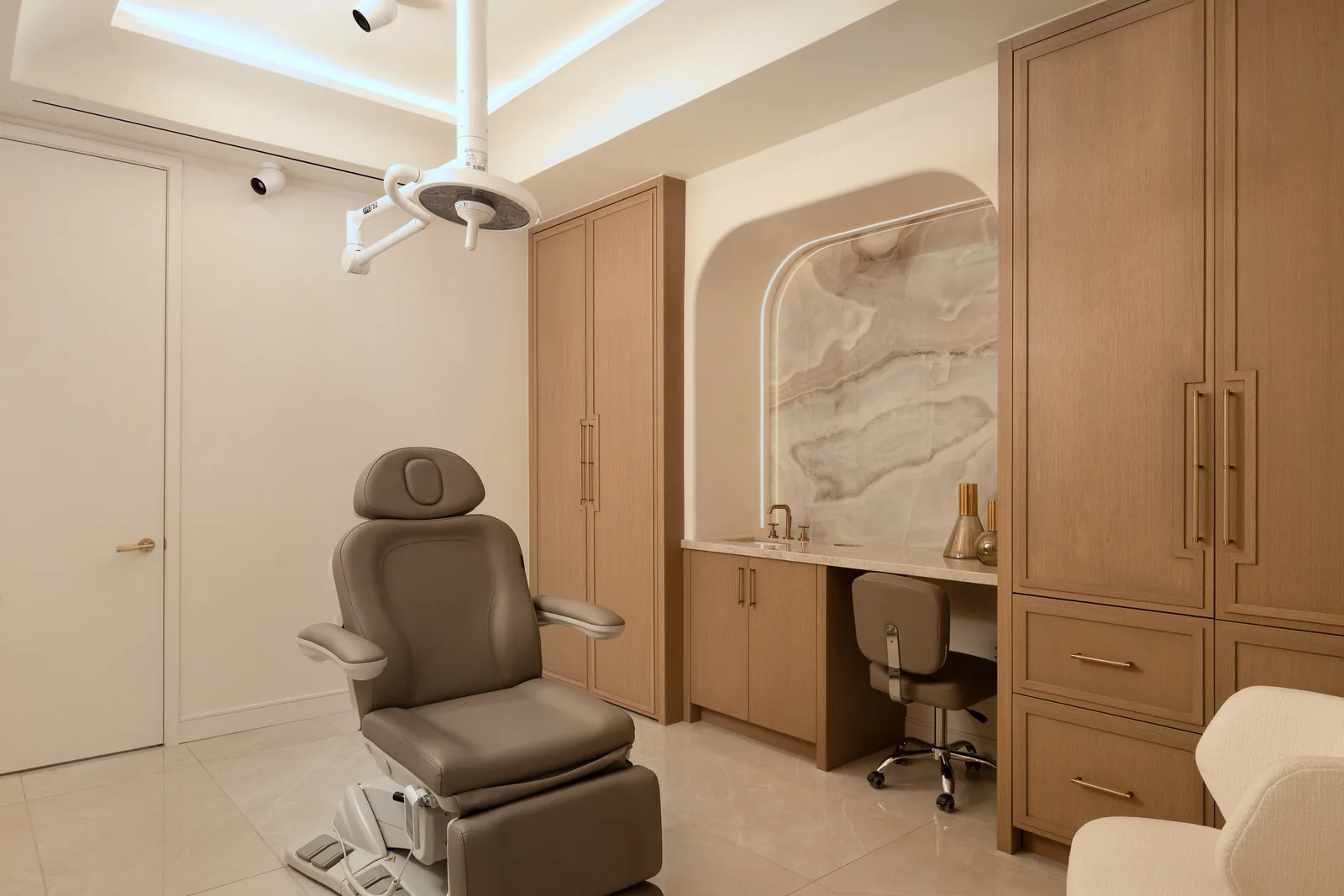
The revision plan is confirmed
Dr. Howarth reviews the intended change, existing scars, anesthesia, and procedure-specific instructions with you before surgery.
Treatment follows current anatomy
The procedure is limited to the change supported by the tissue and plan discussed with you.
Follow-up reflects prior surgery
The team reviews medications, activity guidance, incision care, follow-up, and how to reach the practice.
CLEAR INFORMATION. INFORMED CHOICES.
Labiaplasty Revision Safety and Limitations
Every surgery carries risk, and prior surgery may affect anatomy and healing. The possible complications summarized below vary with the current tissue and proposed plan. Dr. Howarth reviews the risks, limitations, and alternatives relevant to you during consultation.
Possible Complications Include
- Bleeding or infection
- Delayed healing or wound separation
- Additional scarring
- Asymmetry or contour changes
- Persistent discomfort or altered sensation
- Additional treatment
What Consultation Clarifies
- Your health and anatomy
- The proposed procedure
- Anesthesia and setting
- Alternatives and limitations
- Your individual recovery plan
HEALING HAPPENS IN STAGES
Recovery After Revision Labiaplasty
Revision recovery is not assumed to match recovery after a first operation. Timing depends on the prior tissue changes, scope of revision, daily demands, and individual healing. Dr. Howarth provides guidance based on the procedure and progress.
Swelling, tenderness, and bruising are common early. Plan for a quieter start while following your postoperative instructions.
Comfort, work demands, and individual healing guide the return to everyday routines. Physically demanding activities may require more time.
Exercise, intimacy, and activities that create pressure or friction resume later, after healing has progressed and your surgeon provides clearance.
Swelling and firmness continue to settle as healing progresses. The final shape becomes easier to assess as the tissues recover over time.
Care That Begins With Listening
Choosing a Labiaplasty Revision Surgeon: Why Dr. Howarth
Ashley Howarth, MD, FACS, is a board-certified plastic surgeon in Scottsdale, an Instructor in Plastic Surgery at Mayo Clinic, and a coauthor of the peer-reviewed article “Labiaplasty” in the Journal of Women’s Health. In revision consultation, she evaluates the prior operation, scars, remaining tissue, blood supply, current symptoms, and realistic limits before determining whether another procedure may offer meaningful improvement.
Dr. Howarth’s role is to explain what appears modifiable and what may be limited by the present anatomy. When revision is recommended, she performs the procedure herself.
TRAINING
PLASTIC SURGERY
COAUTHOR

SCOTTSDALE · MODERN OFFICE SETTING
BEFORE & AFTER GALLERIES
Private Revision Labiaplasty Before & After Gallery
Revision Labiaplasty before-and-after photographs can feel deeply personal. As both a woman and a surgeon, Ashley Howarth, MD, FACS, understands the trust involved in sharing them. Howarth Plastic Surgery in Scottsdale makes galleries of real patient results available by request through private before-and-after reviews.
Keeping revision labiaplasty before-and-after galleries off unrestricted public pages helps preserve patient dignity and clinical context while limiting casual viewing, unauthorized reposting, and collection by automated systems or AI agents.
During your private before-and-after review, you can see a range of revision labiaplasty results and discuss how starting anatomy, surgical choices, healing, and time influenced each outcome. These photographs can support an informed consultation, but individual results vary, and no image can predict your outcome.
PATIENT CASE SUMMARIES
Selected Revision Labiaplasty Case Summaries
These deidentified case summaries show how Ashley Howarth, MD, FACS, evaluates revision labiaplasty at Howarth Plastic Surgery in Scottsdale. The cases address prior surgery, remaining tissue, scars, blood supply, pain, reconstructive limits, referral, and when no further surgery is safer. To protect patient privacy, select identifying details have been generalized or modified. The clinical concerns, treatment decisions, procedures, and follow-up remain faithful to the underlying patient records. Individual anatomy, procedures, healing, and results vary.
Case 01
Scar tethering
A prior scar pulls or creates discomfort
Patient presentation
Tightness, pulling, or discomfort centered on a scar from surgery elsewhere.
Clinical evaluation
Scar position, pliability, remaining tissue, sensation, and whether the scar truly explains the symptom.
Procedure performed
A conservative scar release and revision were performed after examination confirmed that mature tethering corresponded with the reported pulling and discomfort.
Clinical rationale
The goal shifts from routine reduction toward restoring movement and comfort within reconstructive limits.
Follow-up
Longer follow-up assessed scar maturation, the original pulling symptom, comfort, and the remaining limitations created by prior surgery.
Case 02
Residual asymmetry
The two sides healed to different endpoints
Patient presentation
A persistent side-to-side difference after prior labiaplasty.
Clinical evaluation
What was removed, what remains, scar quality, blood supply, and whether more reduction would create new harm.
Procedure performed
A selective unilateral revision was performed to address the dominant asymmetry while preserving adequate tissue on the shorter, more limited side.
Clinical rationale
Symmetry goals must be weighed against preserving adequate tissue and sensation.
Follow-up
As swelling settled, the treated side was assessed against the conservative endpoint discussed before revision without promising exact symmetry.
Case 03
Edge irregularity
Scalloping or contour interruption after prior reduction
Patient presentation
An irregular edge or contour that became apparent after healing.
Clinical evaluation
Depth and location of irregularity, remaining edge length, tissue quality, and the cost of smoothing it.
Procedure performed
Direct excision and layered closure were performed on the most correctable segment of the irregular edge while adjacent tissue was preserved.
Clinical rationale
Chasing a perfectly smooth edge can require disproportionate tissue removal.
Follow-up
Follow-up showed how the selectively revised edge evolved after swelling subsided while preserving the tissue that had not required correction.
Case 04
Over-resection
Too little tissue remains for another reduction
Patient presentation
Functional or appearance concerns after excessive tissue removal in a previous operation.
Clinical evaluation
Remaining tissue, scarring, sensation, blood supply, reconstructive options, and the realistic limits of improvement.
Recommendation
No further reduction was recommended because the remaining tissue and prior over-resection made additional excision more likely to worsen the limitation.
Clinical rationale
Revision cannot reliably recreate anatomy that has been removed, and honesty about limits is essential.
Follow-up
At follow-up, the patient continued with observation after reviewing why additional excision was more likely to worsen the limitation than improve it.
Case 05
Wedge separation
A healed notch after prior wound separation
Patient presentation
A notch or discontinuity remains after a prior wedge closure separated and completed secondary healing.
Clinical evaluation
Scar maturity, tissue mobility, remaining vascularity, depth of the notch, sensation, and whether closure can be achieved without excessive tension.
Procedure performed
Reconstruction was delayed until the scar and tissues were stable, then performed conservatively to repair the healed notch without excessive closure tension.
Clinical rationale
Attempting correction before scars mature or closing under tension may exchange one problem for another.
Follow-up
Follow-up assessed closure integrity, scar maturation, sensation, contour, and the stability of the reconstructive repair over time.
Case 06
Persistent pain
Pain without a correctable surgical target may need referral
Patient presentation
Pain, burning, or sensitivity persists after prior surgery, but the patient is unsure whether another operation will help.
Clinical evaluation
Scar tenderness, neuroma or tethering concerns, tissue quality, sensation pattern, pelvic-floor findings, dermatologic or gynecologic causes, and the relationship between anatomy and pain.
Recommendation
No revision was recommended because examination did not identify a reproducible surgical target for the persistent pain; specialist evaluation and nonoperative care were advised.
Clinical rationale
Additional surgery can worsen pain when the source is uncertain, so diagnosis and expectation-setting come before an operative plan.
Follow-up
Follow-up tracked the pain pattern, response to specialist or nonoperative care, and whether a reproducible surgical target became identifiable.
FROM CONSULTATION TO CONFIDENCE
Labiaplasty Consultation and Patient Care Coordination
After you contact the practice, your patient care coordinator helps you understand the process, answers general questions about labiaplasty, preparation, and recovery, and organizes practical next steps. Questions specific to your health, anatomy, surgical plan, or recovery are answered by Dr. Howarth or her clinical team.

A thoughtful conversation
Your patient care coordinator can arrange an in-person or virtual consultation with Dr. Howarth and explain what information to have ready. The consultation focuses on your concerns, health history, and goals. An in-person physical examination is completed before the operative plan is finalized.
Clear information before you decide
After Dr. Howarth recommends a plan, your patient care coordinator can review the written cost estimate, available financing options, scheduling requirements, forms, and next steps. Your coordinator can explain the practice process and help you understand what is needed before you decide whether to schedule.
Practical details, clearly organized
If you are traveling to Scottsdale from elsewhere in Arizona or out of state, your patient care coordinator can help align required appointment dates and share planning guidance for consultation, surgery, and follow-up. Dr. Howarth and her clinical team provide individualized medical and recovery guidance.
PLANNING WITH CLARITY
Revision Labiaplasty Cost, Financing, and Travel to Scottsdale
Revision Labiaplasty Cost
At Howarth Plastic Surgery in Scottsdale, revision labiaplasty typically costs $7,500 to $18,000. More complex corrections or plans combined with other procedures may exceed this range. Because revision surgery is highly individualized, your final fee reflects your current anatomy, changes from prior surgery, the extent of correction required, anesthesia, and surgical setting. After consultation with Dr. Howarth, you will receive a personalized written estimate for the plan she recommends.
Financing Options
Howarth Plastic Surgery is a cash-pay practice and does not accept or bill insurance. Your patient care coordinator can review financing through PatientFi and CareCredit, subject to third-party approval.
Planning Care in Scottsdale
If you are traveling from elsewhere in Arizona or out of state, out-of-town patient information can help you plan around consultation, surgery, and follow-up. Required appointment dates, how long to remain nearby, and when travel may resume are individualized. An initial consultation may take place virtually, but an in-person examination is required before the operative plan is finalized.
Your Questions, Answered
Labiaplasty Revision Frequently Asked Questions
Labiaplasty revision is secondary surgery considered after a prior labial procedure. Planning begins with the present anatomy, scars, remaining tissue, symptoms, healing, and realistic limits.
You do not need to decide that before consultation. Dr. Howarth evaluates the concern and may recommend more healing time, a limited change, a staged plan, or no additional surgery.
You may request an evaluation whenever you want a clearer understanding. Definitive planning may need to wait until healing has progressed enough for the tissue and scar pattern to be assessed reliably.
If available, bring the prior operative report, before-and-after photographs, postoperative instructions, relevant medical records, and a timeline of healing and concerns. An evaluation can still begin if some records are unavailable.
Revision may address some asymmetry, contour, or scar concerns, but the current tissue and prior healing establish limits. No operation can guarantee symmetry, erase scar tissue, or fully reverse every prior change.
Sensation after prior surgery is evaluated carefully, but restoration cannot be promised. Further surgery also carries a risk of altered sensation or nerve symptoms. Dr. Howarth discusses these considerations in relation to your anatomy.
Revision can be more complex because prior incisions, scars, tissue removal, blood supply, and healing change the anatomy. The degree of complexity varies from patient to patient.
The labia minora, labia majora, scars, and clitoral hood are evaluated separately. Any combined plan is individualized and may change the setting, anesthesia, risks, recovery, or need for staging.
Recovery depends on the prior tissue changes and the scope of the revision. It begins with a quieter period and progresses gradually according to healing and Dr. Howarth’s guidance.
At Howarth Plastic Surgery in Scottsdale, revision labiaplasty typically costs $7,500 to $18,000. More complex corrections or plans combined with other procedures may exceed this range. Because revision surgery is highly individualized, your final fee reflects your current anatomy, changes from prior surgery, the extent of correction required, anesthesia, and surgical setting. After consultation with Dr. Howarth, you will receive a personalized written estimate for the plan she recommends.
Related Care
Related Labiaplasty Procedures
These pages explain options that may be considered separately depending on your anatomy, goals, and surgical history. You can also review questions to ask at a labiaplasty consultation before your visit.
BEGIN HERE
Request a Consultation
Tell us what you are considering. A member of our patient care team will follow up with consultation availability and next steps.

Megan S.
Patient Coordinator
Prefer to talk or text?
Selected Medical References