
Customized Medical Facials
What a Facial at Aesthetica by Ashley Howarth MD Is
A facial at Aesthetica by Ashley Howarth MD is a customized 60-minute treatment, built from a skin analysis and performed by a licensed aesthetician under Dr. Howarth’s protocols with medical-grade lines including skinbetter science, ZO Skin Health, and Alastin. There is no downtime, and in Scottsdale it is the treatment patients return for year-round.
A facial at Aesthetica by Ashley Howarth MD, the med spa of Howarth Plastic Surgery in Scottsdale, is a customized 60-minute medical facial performed by the licensed aesthetician. Every visit starts with a skin analysis under magnification, and the steps that follow are chosen from what that analysis shows: cleansing, enzyme or light acid exfoliation, steam and manual extractions where pores are congested, a targeted mask or serum, gentle lymphatic massage, LED light where used, and a finishing layer of moisturizer and mineral sunscreen from medical-grade lines the practice carries, including skinbetter science, ZO Skin Health, and Alastin. There is no downtime. Most patients schedule a facial monthly, and in Scottsdale the facial is the year-round treatment: it is safe in July when the UV index is 11+, and it is the maintenance step between laser season treatments from October to April. When the concern is dehydration, dullness or congestion, sensitivity and redness, or a breakout, a medical facial is the first step; the Skin in Arizona guide explains why the desert dries skin the way it does.
A medical facial differs from a spa facial in three ways. First, the analysis is diagnostic: the aesthetician records skin type, hydration, congestion, and any lesion that should be examined by a physician, and that record shapes the plan. Second, the actives are medical-grade rather than cosmetic, so an enzyme exfoliant, a retinoid-compatible serum, or a peptide mask is chosen for the skin in front of her and not for the fragrance. Third, the facial sits inside a treatment plan. When analysis shows a problem a facial cannot solve, the honest answer is a different treatment: HydraFacial for deeper hydration and extraction, chemical peels for pigment and texture, SkinPen microneedling for acne scars, and light or laser treatment such as BBL HERO or MOXI for sun damage. The facial is where that escalation is first recognized.

Why Patients Ask for a Facial
What Patients Who Choose a Medical Facial Notice
Most people who book a facial at Aesthetica by Ashley Howarth MD describe skin that is not wrong, exactly, but is not behaving. In Scottsdale the pattern is specific: the desert pulls water out of skin, sunscreen and sweat sit in pores, and the face that looked fine in April looks tired by August. These are the findings the aesthetician hears most.
- Skin that feels tight an hour after moisturizer and looks dull by afternoon
- Blackheads and small bumps along the nose, chin, and hairline that never quite clear
- Makeup that sits in fine lines and flakes on the cheeks
- Redness and stinging with products that used to be fine
- A face that looks puffy and grey after a flight or a bad week of sleep
- Skin that needs to look its best before an event in two to three weeks
Dehydration, congestion, dullness, and a reactive barrier are the problems a customized facial solves best, because each is a surface condition that responds to exfoliation, extraction, hydration, and the right products used consistently. A facial does not lift, does not erase sun spots, and does not fill lines. When those are the concern, the analysis says so and the plan changes.


Surgeon-Directed Care
More Tools in the Toolbox: Why a Plastic Surgeon Directs Facial Care
Aesthetica by Ashley Howarth MD is the medical aesthetics practice of Ashley Howarth, MD, FACS, a board-certified plastic surgeon and instructor in plastic surgery at Mayo Clinic. The judgment a plastic surgeon adds to something as gentle as a facial is the ability to tell a skin-care problem from a medical or surgical one. Arizona has one of the highest skin cancer rates in the country, and a monthly facial puts the same trained eyes on a patient’s face twelve times a year. Dr. Howarth’s protocol is that the aesthetician documents every pigmented lesion, non-healing spot, or patch of persistent redness at the skin analysis and refers it for a physician’s examination, and that nothing is exfoliated or extracted over a lesion that has not been cleared. The second judgment is honest escalation. Dullness and dehydration are facial problems; sun spots are BBL HERO and MOXI problems during laser season; acne scars are SkinPen or ProFractional problems; etched lines are physician-performed laser skin resurfacing problems; jowls and a loose neck are facelift and neck lift problems. A practice with all of those tools does not need to oversell the facial.
The third judgment is post-procedure care. The Cooling Recovery and Lymphatic Lift facials exist because the same practice performs HALO, Contour TRL, facelift, and eyelid surgery, and Dr. Howarth decides when healing skin can safely receive steam, exfoliation, or lymphatic massage. The licensed aesthetician performs every facial under her protocols; the physician-led team performs the light and non-ablative treatments the facial escalates to; and deep resurfacing and surgery are performed by Dr. Howarth. More tools in the toolbox, and an honest answer about which one you need.

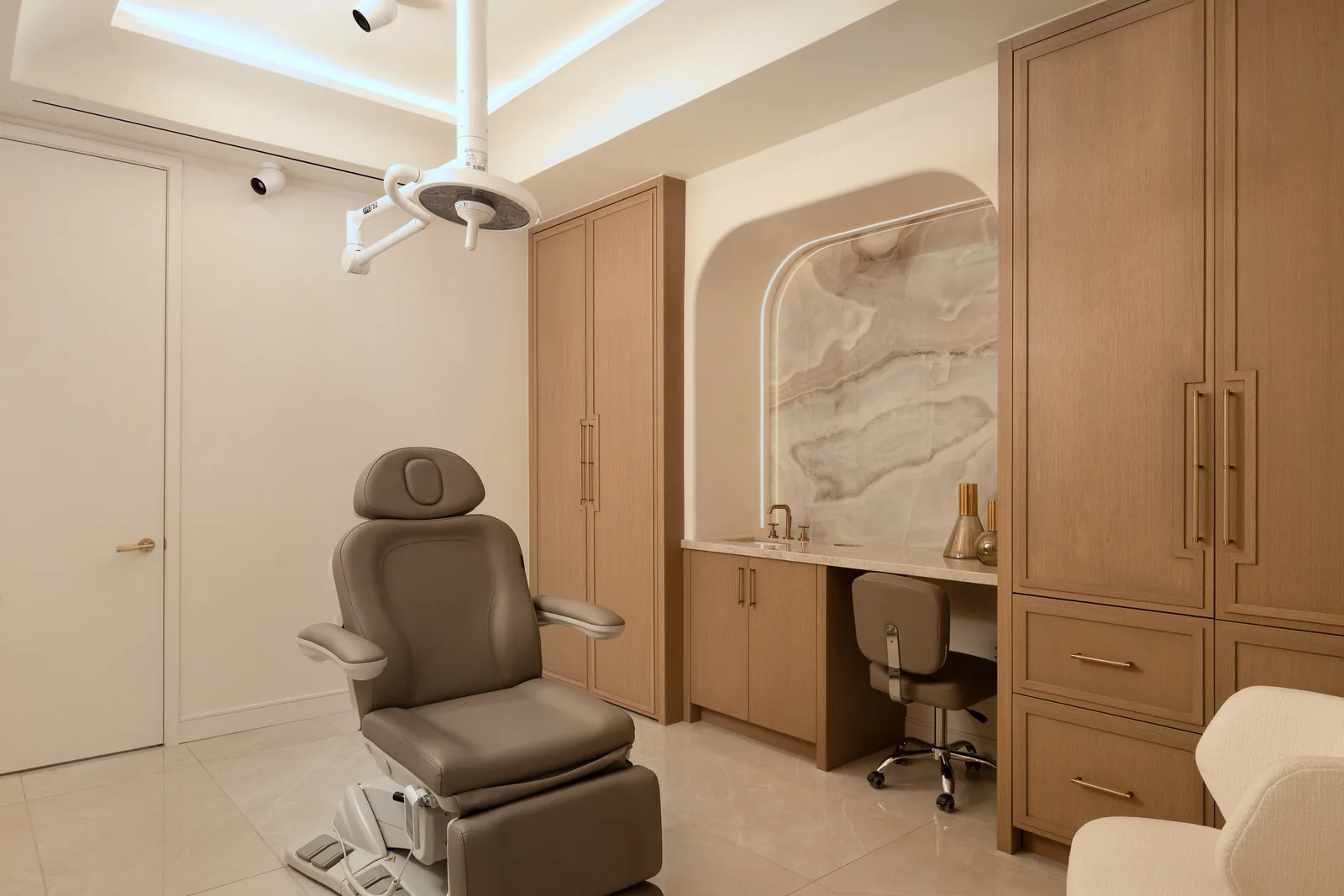
SCOTTSDALE · MODERN OFFICE SETTING
Where to Start
Who a Medical Facial Is For, and What Happens First
A facial at Aesthetica by Ashley Howarth MD is for adults of every skin type, Fitzpatrick I to VI, including sensitive, rosacea-prone, acne-prone, and post-procedure skin, who want healthier skin month to month or who need a reset before an event, after travel, or between laser treatments. The skin analysis is the first step at every visit. The licensed aesthetician examines the skin under magnification, records hydration, oil, congestion, sensitivity, and pigment, asks about retinoid, acid, and prescription use, notes any recent laser, peel, microneedling, or surgery, and flags any spot that has changed, bleeds, or will not heal for a physician’s examination. From that analysis she builds the facial: a calming, cooling protocol for reactive or post-laser skin, a clarifying protocol with extractions for active breakouts, a peptide and light-exfoliation protocol for early lines and dullness, or a hydration protocol for Arizona-dry skin. If the analysis shows a concern a facial will not fix, such as solar lentigines, melasma, etched lines, or laxity, she says so and the plan escalates to a peel, SkinPen, a Sciton light or laser treatment during laser season, or a consultation with Dr. Howarth.
Dr. Ashley Howarth, MD, FACS is a board-certified plastic surgeon and an instructor in plastic surgery at Mayo Clinic. Aesthetica by Ashley Howarth MD is the medical aesthetics brand of her practice, Howarth Plastic Surgery, at 7373 N. Scottsdale Road, Suite C150, Scottsdale, Arizona 85253.

One Analysis, Many Protocols
How Facials Are Customized in Scottsdale
Hydration, Barrier Repair, and the Signature Facial
The Signature facial is the baseline protocol for dehydrated, tight, or dull skin (cleanse, enzyme exfoliation, a hydrating mask, and lymphatic massage), paired with a barrier-supporting home routine for Scottsdale’s often sub-15-percent humidity.
The Signature facial is the baseline protocol for dehydrated, tight, or dull skin: cleanse, enzyme exfoliation to lift dead cells without irritation, steam, gentle extractions where needed, a hydrating mask, lymphatic massage, and a barrier-supporting moisturizer and mineral sunscreen. In Arizona, where afternoon humidity is often below 15 percent, the barrier is the first thing to fail, and a monthly facial with a home routine built on a gentle cleanser, a humectant serum, and a ceramide moisturizer is what keeps it working. Patients who need more hydration and extraction than hands can deliver move to HydraFacial, which uses a vortex tip to do both at once.
Cooling Recovery and Lymphatic Lift Facials
The Cooling Recovery facial calms sensitive, rosacea-prone, or post-laser skin with no steam or acids, while the Lymphatic Lift facial uses manual lymphatic drainage to reduce puffiness after facelift or eyelid surgery, only once Dr. Howarth has cleared the patient.
Two protocols exist for skin that is healing. The Cooling Recovery facial is built for sensitive, rosacea-prone, and post-laser skin: no steam, no acids, cooling masks, and calming actives that reduce redness and replace water after HALO, MOXI, or a peel, once the skin has fully re-epithelialized. The Lymphatic Lift facial uses manual lymphatic drainage, light exfoliation, and antioxidant masks to move fluid and reduce puffiness, and it is the facial the practice schedules for patients after facelift or eyelid surgery on the face surgery side of the practice, only after Dr. Howarth’s clearance. Neither is performed on skin that is still open, crusted, or peeling.
Advanced Clarifying and Peptide Illuminating Facials
The Advanced Clarifying facial targets active acne and congestion every 2 to 4 weeks, while the Peptide Illuminating facial addresses early lines and dullness and is the event-prep facial typically booked 7 to 10 days before photographs.
The Advanced Clarifying facial targets congestion and active acne: a salicylic or enzyme exfoliant, steam, thorough manual extractions under magnification, an anti-inflammatory mask, and a home plan that follows the American Academy of Dermatology’s advice not to pick or scrub. It is scheduled every 2 to 4 weeks while breakouts are active, then monthly. The Peptide Illuminating facial addresses early lines, dullness, and rough texture with gentle exfoliation, peptide and antioxidant serums, and LED light where used, and it is the event-prep facial booked 7 to 10 days before photographs. When acne has left scars, or lines are etched rather than fine, the plan escalates to SkinPen microneedling or laser.
When a Facial Is Not Enough
A facial improves hydration, congestion, dullness, and mild redness, but solar lentigines, melasma, acne scars, and loose skin call for chemical peels, BBL or MOXI in season, or an evaluation for Ellacor or surgery instead.
A facial improves what lives at the surface: hydration, congestion, dullness, mild redness, and the first signs of aging. It does not clear solar lentigines, treat melasma, resurface acne scars, or tighten loose skin. When the analysis finds those, the answer at Aesthetica by Ashley Howarth MD is a different treatment: chemical peels for pigment and texture year-round at light depth, BBL HERO and MOXI for sun damage from October to April, the Sciton laser comparison for choosing among them, and for jowls or heavy laxity, an evaluation with Dr. Howarth for Ellacor micro-coring or surgery. The facial then becomes the maintenance step between those treatments, which is the role it plays best.
At a Glance
Facials at a Glance
Facial protocols at Aesthetica by Ashley Howarth MD organized by skin goal, what each includes, how often it is scheduled, and when in the Scottsdale year it fits; every facial is customized at the skin analysis.
| Skin goal | Protocol | What it includes | How often | Scottsdale season |
|---|---|---|---|---|
| Hydration and barrier repair | Signature facial | Enzyme exfoliation, light extractions, hydrating mask, lymphatic massage, medical-grade moisturizer and SPF | Monthly | Year-round |
| Sensitive, rosacea-prone, or post-laser skin | Cooling Recovery facial | No steam or acids; cooling masks, calming actives, barrier repair | Monthly, or 1 to 2 weeks after each laser session once healed | Year-round; timed to laser season |
| Puffiness after facial surgery or travel | Lymphatic Lift facial | Manual lymphatic drainage, light exfoliation, antioxidant masks | As needed; after surgery only with Dr. Howarth's clearance | Year-round |
| Early lines, dullness, event prep | Peptide Illuminating facial | Gentle exfoliation, peptide and antioxidant serums, LED light where used | Monthly, or 7 to 10 days before an event | Year-round |
| Congestion, texture, deeper hydration | Hydrafusion facial | HydraFacial vortex cleansing and extraction plus targeted skincare | Monthly | Year-round; the summer bridge between laser seasons |
| Active acne and breakouts | Advanced Clarifying facial | Salicylic or enzyme exfoliation, thorough extractions under magnification, anti-inflammatory mask | Every 2 to 4 weeks while active, then monthly | Year-round |
Three Ways to Clean and Hydrate
Medical Facial vs Spa Facial vs HydraFacial
How a customized medical facial at Aesthetica by Ashley Howarth MD compares with a spa facial and with HydraFacial; the skin analysis decides which one a given month calls for.
| Medical facial | Spa facial | HydraFacial | |
|---|---|---|---|
| Who performs it | Licensed aesthetician under a board-certified plastic surgeon's protocols | Aesthetician in a spa setting | Licensed aesthetician under the same protocols |
| How it starts | Skin analysis under magnification with a record of hydration, congestion, sensitivity, and lesions | A menu choice and a brief consultation | Skin analysis, then a booster chosen for the concern |
| Products | Medical-grade lines such as skinbetter science, ZO Skin Health, and Alastin | Cosmetic and spa ranges | HydraFacial serums and boosters |
| Exfoliation and extraction | Enzyme or light acid; manual extractions under magnification | Scrub or mask; manual extractions vary | Vortex tip peels, extracts, and hydrates in one pass |
| Time and downtime | About 60 minutes; none | About 60 to 90 minutes; none | 30 to 45 minutes; none |
| Best for | Sensitive, reactive, post-procedure, or acne-prone skin that needs a customized protocol | Relaxation and general cleansing | Deeper hydration and extraction, congestion, an event in a few days |
| When to escalate | Sun spots, melasma, scars, and laxity go to peels, SkinPen, laser, or a surgical consultation | Rarely part of a medical plan | Same escalation path within the practice |
A Visit Built Around Your Skin Analysis
What to Expect at a Facial at Aesthetica by Ashley Howarth MD
A facial visit at Aesthetica by Ashley Howarth MD has three parts: a skin analysis under magnification, the customized 60-minute facial, and a written home routine. You leave with sunscreen on and no downtime.
Skin examined under magnification, history recorded
The licensed aesthetician examines your skin under a magnifying lamp, records hydration, oil, congestion, sensitivity, and pigment, asks about retinoids, acids, prescriptions, recent procedures, and sun exposure, and flags any changing or non-healing spot for a physician. That record decides the protocol.
Cleanse, exfoliate, extract, treat, protect
Double cleanse; enzyme or light acid exfoliation matched to your skin type; steam and manual extractions if pores are congested, skipped for reactive skin; a targeted mask or serum; lymphatic massage; LED light where used; then moisturizer and mineral SPF 30 or higher. About 60 minutes in the room.
A home routine in writing
You leave with a written routine using the medical-grade lines the practice carries, instructions to hold retinoids and acids for 24 to 48 hours if extractions or exfoliation were done, a note on when to book the next facial, and, if the analysis found something a facial cannot fix, a recommendation for the treatment that can.
Clear Information. Informed Choices.
Safety and Limitations of Medical Facials
A customized facial is one of the safest treatments in the practice because it works at the surface and the protocol is matched to the skin type. Side effects are mild and short: pinkness after extractions or exfoliation that settles within hours, and occasionally a small breakout in the days after extractions as congestion clears. The risks that matter are the ones of doing the wrong thing to the wrong skin: exfoliating or steaming skin that is still healing from a laser or peel, extracting inflamed cystic acne, treating over an active cold sore, or using an acid on skin that has been on isotretinoin. Those are avoided by the skin analysis and by Dr. Howarth’s deferral rules. The other limitation is expectation. A facial cannot remove a sun spot, a scar, or a jowl, and a practice that sells facials for those problems is not doing its job.
Possible Side Effects Include
- Pinkness for a few hours after extractions or exfoliation
- Temporary purging or a small breakout after extractions
- Stinging or tightness with an active on very dry or reactive skin
- Dryness or flaking for a day after enzyme exfoliation
- Rarely, a cold sore flare in patients with a history of them
What Treatment Cannot Guarantee
- Removal of sun spots, melasma, or scars
- Lifting or tightening of loose skin
- Filling of etched lines or lost volume
- A lasting result without a daily home routine and sunscreen
- A substitute for a physician's evaluation of a changing lesion
What Happens After a Facial
After a Medical Facial
There is no recovery after a customized facial in the usual sense. Skin is calm and hydrated the same afternoon, makeup is fine the next morning, and the work of the following month is the home routine and daily sun protection. Skin that was congested may clear a few small blemishes over the first week as extracted pores settle. The timeline below is the ordinary rhythm of monthly facials at Aesthetica by Ashley Howarth MD, and the way they fit around HydraFacial, peels, and laser season.
Skin looks plump and even within the hour. Any pinkness from extractions fades by evening. Leave makeup off for the rest of the day if extractions were done, skip the gym and hot yoga that afternoon, and use only a gentle cleanser and moisturizer that night. No retinoids or acids for 24 to 48 hours.
Extracted pores can push out a small blemish or two in the first few days; leave them alone. Restart retinoids and exfoliating actives on day 2 or 3 as instructed. Hydration from the facial lasts about a week in Arizona’s dry air, which is why the home routine, a humectant serum under a ceramide moisturizer and SPF 30 or higher every morning, does most of the long-term work.
By the second week the facial’s direct effect has faded and the skin is showing what the home routine can hold. Active congestion or acne is rebooked at 2 to 4 weeks; everyone else at about a month. If a peel, SkinPen, or laser is planned, the facial is timed at least 1 to 2 weeks before it and not sooner than the skin has fully healed after.
After three to four monthly facials most patients report skin that holds hydration longer, fewer blackheads, and fewer reactive flare-ups. Facials continue year-round; in Scottsdale they are the summer treatment when lasers pause, and the between-session care during laser season. Results depend on daily sunscreen, and any spot that changes goes to a physician, not a facial.
Before & After
Medical Facials, Before and After Treatment
Facial results are best judged over a series rather than a single visit: photographs in the same light before the first facial and after the third or fourth monthly session show the change in hydration, congestion, and tone that one appointment cannot. Aesthetica by Ashley Howarth MD maintains before-and-after galleries for HydraFacial, chemical peels, and SkinPen, and the aesthetician can show you facial cases that match your skin concern and skin type during your visit.
Patient Case Summaries
Selected Medical Facial Case Summaries
These deidentified case summaries illustrate how the physician-led team at Aesthetica by Ashley Howarth MD plans customized facials in Scottsdale. They include a new arrival whose skin had not adjusted to the desert, a long-term resident whose sun spots needed a laser rather than a facial, darker skin with post-inflammatory marks, summer maintenance between laser seasons, post-laser recovery care, and a spot that went to a dermatologist. Each summary connects the patient’s concern and skin analysis with the treatment performed or the recommendation made.
Case 01
New to Arizona
Tight, flaking skin three months after a move from the coast, treated with monthly hydration facials
Patient presentation
A woman in her thirties who had relocated to Scottsdale from the Pacific Northwest reported skin that felt tight within an hour of moisturizing, flaked around the nose, and stung with products she had used for years.
Skin assessment
The skin analysis showed a dehydrated, compromised barrier on Fitzpatrick II skin with no acne and no pigment concern. Her routine was built for a humid climate: a foaming cleanser, a daily glycolic toner, and a light lotion, with no sunscreen.
Procedure performed
A Signature hydration facial with enzyme exfoliation, no extractions, a hydrating mask, and lymphatic massage, repeated monthly for three months, with a rebuilt home routine of a gentle cleanser, a humectant serum, a ceramide moisturizer, and mineral SPF 30 every morning.
Clinical rationale
In air with afternoon humidity often below 15 percent the skin barrier fails first, and the fix is to stop stripping it and to add water and lipids consistently; the facial resets the surface and the home routine holds it.
Follow-up
By the third visit the stinging had stopped and the flaking was gone; she continues monthly facials and added a light MOXI series the following laser season for early sun-related dullness.
Case 02
Not a facial problem
Sun spots a facial was asked to remove, redirected to BBL HERO in October
Patient presentation
A woman in her fifties, a Scottsdale resident for twenty years, booked a brightening facial in August hoping to fade the brown spots on her cheeks before a reunion in the fall.
Skin assessment
The analysis showed scattered uniform solar lentigines on tanned Fitzpatrick II skin, mild dehydration, and no irregular lesion. Lentigines sit in the epidermis and dermis, beyond what exfoliation reaches, and her skin was tanned in a month when light treatment was not appropriate.
Recommendation
A hydration facial in August and September for tone and glow, a mineral sunscreen habit, and a series of BBL HERO sessions to the face beginning in October once the tan had faded, with facials continuing between sessions.
Clinical rationale
A facial improves hydration and surface texture and can make skin look brighter, but it does not clear lentigines; an honest plan says so and schedules the treatment that does during laser season.
Follow-up
She was pleased with her skin at the reunion and completed three BBL HERO sessions between October and December; facials are now her monthly maintenance.
Case 03
Darker skin type
Congestion and dark marks on Fitzpatrick V skin managed with clarifying facials and no aggressive exfoliation
Patient presentation
A man in his twenties with deep brown skin reported blackheads and small bumps along his jaw and dark marks left behind wherever a blemish had healed.
Skin assessment
The analysis found comedonal acne with post-inflammatory hyperpigmentation on Fitzpatrick V skin, and a home routine of a harsh scrub used twice daily that was making both worse. Aggressive extraction or a strong acid carried a real risk of more marks on this skin type.
Procedure performed
An Advanced Clarifying facial every three weeks with a gentle enzyme exfoliant, careful extractions under magnification, and a soothing mask; the scrub was retired in favor of a gentle cleanser, a low-strength retinoid at night, and daily tinted mineral sunscreen.
Clinical rationale
Post-inflammatory hyperpigmentation in skin of color follows inflammation, so the plan reduces inflammation first and uses the least irritating exfoliation that still clears pores, with sunscreen to keep marks from darkening.
Follow-up
After four visits the congestion was largely cleared and the older marks were fading; he moved to monthly facials with a light chemical peel series planned for the fall.
Case 04
Summer maintenance
A HALO patient keeping the result through a Scottsdale summer with facials and HydraFacial
Patient presentation
A woman in her forties who had completed HALO in February asked how to keep the result through summer, when she knew laser treatment was off the table.
Skin assessment
Her skin showed the even tone and refined texture of a well-healed HALO on Fitzpatrick III skin, with the early summer signs of dehydration and sunscreen congestion along the hairline. She was outdoors daily.
Procedure performed
Alternating monthly visits from May through September: a Signature facial with extractions one month and a HydraFacial with a hydrating booster the next, with a strict mineral sunscreen and hat plan and a Peptide Illuminating facial before a September event.
Clinical rationale
Summer in Arizona is the maintenance season; facials and HydraFacial are safe under a UV index of 11+ and keep the barrier and pores in order so the next laser season starts from a good baseline.
Follow-up
Her HALO result held through the summer, and she scheduled BBL HERO with MOXI for the following October with facials continuing between.
Case 05
Post-laser recovery
Cooling Recovery facials after MOXI, timed to healing rather than the calendar
Patient presentation
A woman in her thirties with rosacea-prone skin had her first MOXI session and asked for a facial the following week to calm the pinkness and roughness.
Skin assessment
Five days after MOXI her skin still showed the bronzed micro-mends and sandpaper texture of normal healing on Fitzpatrick II skin, with the background redness of her rosacea. Steam, acids, and extractions at that point would have interrupted healing.
Recommendation
No facial at day 5; a Cooling Recovery facial with no steam, no acids, cooling masks, and calming actives at day 12 once the mends had shed, then the same protocol two weeks after each of the remaining MOXI sessions.
Clinical rationale
Post-laser skin needs water and calm, not exfoliation, and the timing is set by healing; a practice that performs the laser knows what day 5 skin should look like and when it is ready for a facial.
Follow-up
Her pinkness settled faster after the second and third sessions with the recovery facial in place, and she continues a monthly Cooling Recovery protocol for her rosacea.
Case 06
Dermatology first
A spot on the temple noticed at a routine skin analysis and referred before any treatment
Patient presentation
A man in his sixties, a lifelong Arizona resident with outdoor work behind him, booked a facial for rough, dry skin and did not mention anything else.
Skin assessment
Under magnification the aesthetician found, beside ordinary dryness on Fitzpatrick II skin, a pearly pink 5 mm bump on the left temple with a central crust that he said had bled twice and never fully healed. Under Dr. Howarth’s protocol it was photographed and documented and he was referred to a dermatologist before any treatment.
Recommendation
Dermatology referral first. The lesion was biopsied and treated as a basal cell carcinoma. After clearance he returned for a hydration facial with the lesion site avoided, then monthly facials, and a full skin check became part of his annual routine.
Clinical rationale
A non-healing bump on sun-exposed skin in Arizona is a skin cancer until proven otherwise, and a physician-led practice uses the skin analysis to find and refer it rather than exfoliate over it.
Follow-up
His dryness improved with a rebuilt routine, and he now sees his dermatologist annually; he credits the facial appointment with finding the lesion.
From First Visit to a Plan You Can Keep
Booking, Planning, and Follow-Up at Aesthetica by Ashley Howarth MD
Aesthetica by Ashley Howarth MD is a medical practice with a spa’s convenience. Established patients book online. New patients can book online or request a consultation, and the team responds usually the same day.

Online booking or a consultation request
Book a facial directly online, or request a consultation and describe what your skin is doing: dryness, congestion, redness, dullness, or an event you are preparing for. Either path starts with the same skin analysis.
A protocol and a home routine, not a menu item
You leave your first visit with a written plan: which facial protocol; how often; the medical-grade products for your skin; how facials fit around HydraFacial, peels, or SkinPen; and, if the analysis found more than a facial can fix, the treatment that can and the season it belongs in.
Monthly, year-round, timed around laser season
Most Scottsdale facial plans run monthly: facials and HydraFacial through the summer, facials between laser sessions from October to April, and a recovery facial after each. A-List members have the next month scheduled before they leave.
Your Questions, Answered
Facials Frequently Asked Questions
Three ways. The visit starts with a skin analysis under magnification that records hydration, congestion, sensitivity, and any lesion that needs a physician. The products are medical-grade lines such as skinbetter science, ZO Skin Health, and Alastin rather than cosmetic ranges. And the facial sits inside a plan directed by a board-certified plastic surgeon, so when a facial is not enough, the aesthetician says so and escalates.
Dryness and dehydration, congestion and blackheads, active breakouts, dullness and uneven tone, sensitivity and redness, post-travel or post-procedure recovery, early fine lines, and barrier repair. A facial does not remove sun spots, treat melasma, resurface scars, or tighten loose skin; those concerns are directed to peels, SkinPen, Sciton light and laser treatment, or a consultation with Dr. Howarth.
Monthly for most people, because that matches the skin’s roughly four-week turnover and the rate at which Arizona’s dry air undoes hydration. Active congestion or acne may be scheduled every 2 to 4 weeks until it clears. In Scottsdale facials run year-round: they are the summer treatment when lasers pause, and the maintenance step between laser sessions from October to April.
Yes, once the skin has fully healed. After MOXI, BBL, a light peel, or SkinPen that is usually 1 to 2 weeks; after HALO or a medium peel closer to 2 to 4 weeks; after deeper resurfacing, only with Dr. Howarth’s clearance. The Cooling Recovery facial is built for that moment: no steam, no acids, no extractions, cooling masks and calming actives that replace water and reduce redness.
Most patients leave with calm, hydrated skin and no visible irritation. Extractions or enzyme exfoliation can leave pinkness for a few hours, and a congested pore occasionally surfaces a small blemish in the days afterward. Protocols for sensitive or rosacea-prone skin skip steam and acids entirely. If skin is reactive, the aesthetician chooses calming actives and a cooling mask so it feels comfortable by the end of the visit.
That is their best use. At Aesthetica by Ashley Howarth MD a monthly facial is the maintenance step of a plan that may also include HydraFacial, chemical peels, SkinPen, and Sciton laser treatment during laser season. Each visit repeats the skin analysis, so the protocol adapts to the season, to recent procedures, and to what the skin needs that month, and each visit is a chance to catch a problem early.
Yes. Sensitive, rosacea-prone, and post-procedure skin is a large part of the practice’s facial work. The analysis identifies the reactivity first, and the protocol removes the usual triggers: no steam, no fragrance, no acids, no extractions over inflamed skin. Cooling masks, barrier-repair moisturizers, and calming actives from medical-grade lines do the work. All Fitzpatrick types, I to VI, are treated.
Before: arrive with clean skin or let the aesthetician cleanse it, and pause retinoids and exfoliating acids for 2 to 3 days. Tell the team about prescriptions, isotretinoin, recent procedures, and cold sore history. After: keep makeup off for the rest of the day if extractions were done, skip heat and hard workouts that afternoon, hold retinoids and acids for 24 to 48 hours, and use the written home routine with mineral SPF 30 or higher every morning.
A medical facial is a facial performed in a physician-directed practice with a diagnostic skin analysis, medical-grade products, and protocols set by the supervising physician. At Aesthetica by Ashley Howarth MD the licensed aesthetician performs every facial under protocols set by Dr. Ashley Howarth, MD, FACS, a board-certified plastic surgeon, and any changing or non-healing spot found at the analysis is referred for a physician’s examination before treatment. When a facial is not enough, the plan escalates to HydraFacial, peels, SkinPen, or laser.
Yes, and summer is when facials matter most. Laser and light treatments that need untanned skin run from October to April in Arizona because the summer UV index regularly reaches 11 or higher. Facials, HydraFacial, and light peels are safe year-round, and from May through September they keep the barrier, pores, and hydration in order so the next laser season starts from a good baseline. Sunscreen and a hat still apply.
Concerns Treated
Concerns This Treatment Addresses
These guides explain each concern and where this treatment fits among the options at Aesthetica by Ashley Howarth MD in Scottsdale.
- Dry & Dehydrated Skin Barrier repair and hydration, the first use of a medical facial in the desert
- Skin Texture, Pores & Dullness Exfoliation and extractions for congestion and a dull surface
- Acne & Acne Scars Clarifying facials for active breakouts; SkinPen when scars remain
- Redness & Rosacea Cooling, calming protocols for sensitive and post-laser skin
- Fine Lines & Wrinkles Peptide facials for early lines, and when laser does more
- Skin in Arizona Why timing matters in the desert
BEGIN HERE
Request a Consultation
Tell us what you are considering. A member of our patient care team will follow up with consultation availability and next steps.

Megan S.
Patient Coordinator
Prefer to talk or text?
Selected References