
Vessels, Flushing, and Heat
What Facial Redness and Rosacea Are
Facial redness (flushing, persistent erythema, visible broken capillaries, and in rosacea, sensitive, stinging skin) is common after age 30, more visible on fair skin, and managed rather than cured, with sun and heat among its most commonly reported triggers. At Aesthetica by Ashley Howarth MD, visible vessels and background redness are treated with BBL HERO broadband light, which targets hemoglobin in small vessels, supported by calming facials, a gentle HydraFacial protocol, and barrier-repair skin care, while a dermatologist manages prescription therapy for inflammatory bumps.
Facial redness is a group of related findings: flushing that comes and goes, persistent background redness across the cheeks and nose (erythema), fine visible vessels called telangiectasia or broken capillaries, and in rosacea, a chronic inflammatory skin condition, the addition of sensitive skin, stinging, and sometimes acne-like bumps. Rosacea is common, tends to appear after age 30, and is more visible on fair skin. It is managed, not cured. Sun exposure and hot weather are among the three most commonly reported triggers in National Rosacea Society patient surveys, which makes Scottsdale, with about 300 days of sun a year and well over 100 days at or above 100 degrees, a demanding place to have it. At Aesthetica by Ashley Howarth MD, the med spa of Howarth Plastic Surgery in Scottsdale, the visible vessels and background redness are treated with BBL HERO, Sciton’s broadband light, which targets the hemoglobin inside small vessels so they close and fade. Supporting care includes calming facials, a gentle HydraFacial protocol, and barrier-repair skin care.
The roles are divided clearly. A dermatologist diagnoses rosacea and manages prescription therapy for inflammatory bumps, pustules, eye involvement, and the flushing medications. Aesthetica by Ashley Howarth MD treats what prescriptions do not reach: the fixed vessels and the persistent redness that remain after the inflammation is controlled. For patients with rosacea-prone skin who also want to improve texture, MOXI can be used with caution once redness is stable. Every plan in Arizona is timed so light treatment falls between October and April, when untanned skin and sun avoidance are realistic.

Redness That Will Not Settle
What Patients With Redness and Rosacea Notice
Patients who come to Aesthetica by Ashley Howarth MD for redness usually describe the same progression: flushing that used to fade now lingers, fine vessels appeared on the nose and cheeks, and the Arizona summer makes all of it worse. The common findings are these.
- Cheeks and nose that stay pink or red even at rest
- Flushing with heat, exercise, spicy food, wine, or stepping outside in summer
- Fine red or purple vessels on the nose, cheeks, and chin
- Skin that stings or burns with ordinary products
- Small red bumps that look like acne but do not respond to acne care
- Redness that photographs worse than it looks in the mirror
Two parts of redness respond to two different tools. Fixed vessels and background erythema respond to broadband light. Flushing, sensitivity, and bumps respond to trigger control, barrier care, and prescription therapy. Most patients need both, in the right order.


Surgeon-Directed Care
More Tools in the Toolbox: Why a Plastic Surgeon Directs This Care
Aesthetica by Ashley Howarth MD is the medical aesthetics practice of Ashley Howarth, MD, FACS, a board-certified plastic surgeon and instructor in plastic surgery at Mayo Clinic. Facial redness is not one diagnosis. Rosacea, sun-damaged vessels, seborrheic dermatitis, contact dermatitis from products, lupus, and medication flushing can all look alike at arm’s length, and light treatment helps some of them and irritates others. Dr. Howarth sets the protocol that redness is characterized before it is treated, that active inflammation and anything atypical go to a dermatologist first, and that darker skin types are treated at settings that will not trade redness for pigment. The physician-led team treats the vessels; the dermatologist treats the disease; the patient manages the triggers. That division is deliberate.
Aesthetica by Ashley Howarth MD is the med spa of a plastic surgery practice, and that changes what can be offered. Most skin concerns are treated without surgery, and most patients never need it. When skin care and nonsurgical treatment reach their limit, the conversation does not end at the door: the same physician evaluates the next step, from deep laser skin resurfacing performed by Dr. Howarth to eyelid surgery, facelift, and neck lift. A surgeon directing the plan means more tools in the toolbox, and an honest answer about which one you need.

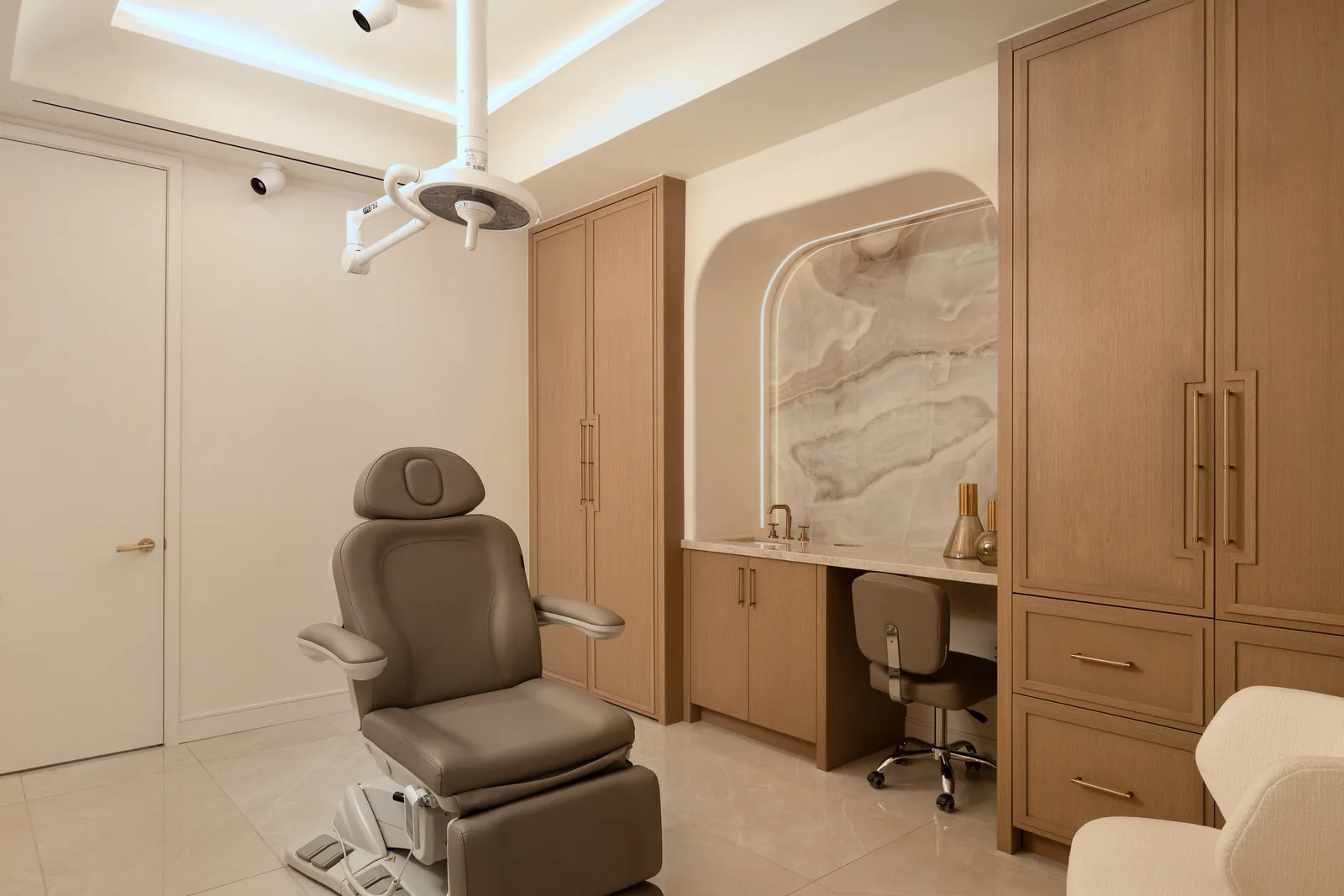
SCOTTSDALE · MODERN OFFICE SETTING
Where to Start
Who This Is For, and What Happens First
Light treatment for redness at Aesthetica by Ashley Howarth MD is for adults with persistent facial erythema, telangiectasia, or rosacea in which the inflammatory component is quiet or already controlled, who are untanned and can protect the treated skin from sun and heat for two to four weeks after each session. The skin assessment comes first. A member of the physician-led team maps where the redness sits and whether it is diffuse or made of discrete vessels, asks about flushing triggers, stinging, eye symptoms, and bumps, records your Fitzpatrick skin type and recent sun exposure, and reviews every product you use. Fair skin with fixed vessels and background redness is the classic BBL HERO candidate. Active papules, pustules, or eye irritation are referred to a dermatologist for prescription therapy before light. Reactive, barrier-damaged skin starts with a simplified routine and calming facials so that light treatment lands on calm skin. Darker skin types are treated at conservative settings or with skin care alone.
Dr. Ashley Howarth, MD, FACS is a board-certified plastic surgeon and an instructor in plastic surgery at Mayo Clinic. Aesthetica by Ashley Howarth MD is the medical aesthetics brand of her practice, Howarth Plastic Surgery, at 7373 N. Scottsdale Road, Suite C150, Scottsdale, Arizona 85253.

Matched to the Redness, Not the Menu
How Redness and Rosacea Are Treated in Scottsdale
BBL HERO for Vessels and Redness
BBL HERO uses a vascular filter so light is absorbed by hemoglobin, closing vessels and fading redness over a series of 3 to 5 sessions, with most rosacea patients maintaining with 1 to 2 sessions a year.
BBL HERO uses a vascular filter so the light is absorbed by hemoglobin in small vessels, heating and closing them while sparing the surrounding skin. Background redness lightens and discrete telangiectasia fade over a series of 3 to 5 sessions spaced 3 to 4 weeks apart, scheduled between October and April. Most rosacea patients maintain with 1 to 2 sessions a year.
Calming Facials and Barrier Skin Care
Calming facials without steam or aggressive exfoliation, paired with a gentle cleanser, ceramide moisturizer, and mineral sunscreen, reduce stinging and flushing and prepare skin for light treatment.
Rosacea-prone skin has a weakened barrier, and Arizona’s afternoon humidity below 15 percent makes it worse. Calming facials without steam or aggressive exfoliation, and a home routine built on a gentle cleanser, a ceramide moisturizer, and a mineral sunscreen, reduce stinging and flushing and prepare the skin for light treatment.
Gentle HydraFacial
A HydraFacial on its gentle protocol hydrates and clears the surface without the heat or friction that triggers rosacea, making it the year-round maintenance treatment.
A HydraFacial on its gentle protocol, without acids or extractions in flaring skin, hydrates and clears the surface without the heat or friction that triggers rosacea. It is the year-round maintenance treatment and the safe summer option when light treatment waits for cooler months.
MOXI, With Caution, for Texture
MOXI at conservative density can smooth texture and tone in rosacea-prone skin once redness is controlled, with a test area often the first step.
Patients with rosacea-prone skin who also want smoother texture and tone can be treated with MOXI at conservative density once redness is controlled, spaced at least four weeks from BBL. The team proceeds carefully, because any heat can provoke a flare, and a test area is often the first step. Prescription therapy for bumps and flushing stays with the dermatologist.
Planning at a Glance
Sessions, Downtime, and Season
Sessions, downtime, and the months each redness treatment is scheduled in Scottsdale. Individual plans are set at the skin assessment.
| Treatment | Sessions | Downtime | Scottsdale season |
|---|---|---|---|
| BBL HERO (vascular) | 3 to 5, three to four weeks apart | Pink and warm for a few hours to 2 days; vessels may darken briefly | October to April; maintenance 1 to 2 times a year |
| Calming facials | Monthly | None | Year-round; the summer mainstay |
| HydraFacial (gentle) | Monthly | None | Year-round, not during a flare |
| MOXI (conservative) | 1 to 3, at least four weeks from BBL | 1 to 2 days of pinkness | October to April, only when redness is controlled |
A Visit Built Around Triggers
What to Expect at a Redness Visit at Aesthetica by Ashley Howarth MD
A redness visit at Aesthetica by Ashley Howarth MD has three parts: an examination that decides whether the redness is ready for light or needs prescription care first, the treatment itself, and a written plan for heat and sun. In Arizona, the third part is what protects the result.
Mapping the redness and its triggers
The team distinguishes diffuse erythema from discrete vessels, checks for active papules, pustules, or eye symptoms that need a dermatologist first, records skin type and recent sun exposure, and reviews your products. Tanned skin or an active flare postpones light treatment.
Broadband light with cooling
BBL HERO for the face takes about 20 to 30 minutes. A cooling gel and chilled handpiece protect the surface while each pulse feels like a warm snap. Individual vessels may be traced with a smaller adapter. Skin is pink and warm afterward, similar to a mild sunburn.
A heat and sun plan in writing
You leave with a mineral SPF 30 or higher, instructions to avoid hot showers, saunas, hard exercise, and alcohol for 48 hours, a simplified barrier routine, hats and shade for two weeks, and the date of your next session.
Clear Information. Informed Choices.
Safety and Limitations of Treating Redness
Vascular broadband light is safe when settings match the skin type, the skin is untanned, and the rosacea is not actively flaring. Most side effects are expected and short-lived. The risks that matter most in Arizona are post-inflammatory hyperpigmentation on tanned or darker skin and a rosacea flare provoked by heat, so the team screens skin type, treats between October and April, and cools the skin during and after treatment.
Possible Side Effects Include
- Redness, warmth, and mild swelling for a few hours to two days
- Treated vessels that look darker or bruise-like for several days
- A temporary rosacea flare after treatment
- Post-inflammatory hyperpigmentation with sun or tanned skin
- Rarely, blistering, crusting, or scarring
What Treatment Cannot Guarantee
- A cure for rosacea; it is managed, not cured
- Freedom from flushing while triggers continue
- Improvement of bumps and pustules, which need prescription therapy
- A complete result from a single session
- A result identical to another patient's photos
What Happens After BBL HERO
Recovery After Vascular Light Treatment
Recovery from BBL HERO for redness is short, and rosacea-prone skin is handled more gently than sun-spot skin: more cooling, a simpler routine, and strict avoidance of heat. The timeline below describes a typical facial session.
The face is pink and warm for several hours, like a mild sunburn. Cool compresses and a bland moisturizer help; nothing hot, no exercise, and no alcohol tonight. Mineral sunscreen goes on before leaving the office. Larger vessels may already look grayer or fainter.
Baseline pinkness resolves in one to two days and makeup is fine. Some treated vessels look slightly darker or bruise-like before fading over the week. Continue the gentle cleanser, ceramide moisturizer, and mineral SPF 30 or higher only; retinoids and acids stay paused. Skip saunas, hot yoga, and midday sun.
Background redness is measurably lighter and fewer discrete vessels are visible. Flushing episodes are often shorter. The second session falls at 3 to 4 weeks, on calm, untanned skin, and the series continues through the cooler months.
After 3 to 5 sessions most patients see a clear reduction in resting redness and visible vessels. Rosacea remains a chronic condition, so new vessels form over time and heat still triggers flushing. Most Scottsdale patients maintain with 1 to 2 BBL HERO sessions each laser season, monthly calming facials, and daily sun and heat management.
Before & After
Redness and Rosacea, Before and After Treatment
Redness results are best judged in photographs taken in the same light, at rest, before the first session and four weeks after the last, because flushing changes minute to minute. Aesthetica by Ashley Howarth MD maintains before-and-after galleries for BBL HERO and skin treatments, and the team can show you cases that match your skin type and pattern of redness during your visit.
Patient Case Summaries
Selected Redness & Rosacea Case Summaries
These deidentified case summaries illustrate how the physician-led team at Aesthetica by Ashley Howarth MD plans treatment for facial redness and rosacea in Scottsdale. They include long-term residents and new arrivals, fair and darker skin types, summer and laser-season timing, single treatments and combinations, and a consultation in which the recommendation was prescription therapy with a dermatologist before any light. Each summary connects the patient’s concern and skin assessment with the treatment performed or the recommendation made.
Case 01
Long-term resident
Two decades of Arizona heat and fixed redness across the cheeks and nose
Patient presentation
A woman in her fifties who had lived in Scottsdale for 20 years described cheeks that had been pink for years and were now red, with fine vessels along the sides of her nose that makeup no longer covered.
Skin assessment
The assessment found diffuse erythema and multiple telangiectasia on fair, Fitzpatrick II skin with no papules, pustules, or eye symptoms, consistent with erythematotelangiectatic rosacea and sun-related vessels. She was untanned in November.
Procedure performed
A series of four BBL HERO sessions with the vascular filter spaced four weeks apart, individual nasal vessels traced with a small adapter, a barrier routine with mineral SPF 30, and afternoon walks moved to early morning.
Clinical rationale
Fixed vessels and background erythema on fair, untanned skin are the ideal targets for broadband light, and a November start allowed the whole series to finish before spring heat.
Follow-up
After the series her resting redness was markedly lighter and the nasal vessels were gone; she maintains with one BBL HERO session each fall.
Case 02
New arrival
Flushing that started the first summer after a move from Portland
Patient presentation
A woman in her thirties who relocated from Oregon in the spring reported that her face flushed every time she stepped outside in summer, stayed red for hours, and stung with products that had never bothered her before.
Skin assessment
The assessment showed transient flushing with mild background redness and a damaged barrier from dry air and a foaming cleanser, with no fixed vessels yet. She was lightly tanned in August.
Recommendation
A simplified barrier routine, a gentle HydraFacial in August, a trigger diary through the summer, and a two-session BBL HERO series scheduled for late October once the tan faded and the flushing pattern was clear.
Clinical rationale
New flushing in a new climate is first a barrier and trigger problem; light treatment on tanned, reactive skin in August would have risked a flare and pigment. Calm skin in October is the right target.
Follow-up
By October the stinging had resolved and the flushing was shorter; the fall sessions reduced the background redness, and she now schedules outdoor time before 8 a.m. from May to September.
Case 03
Prescription first
Red bumps and pustules that needed a dermatologist before any light
Patient presentation
A man in his forties asked for BBL to clear the redness on his cheeks and nose, which he had been treating with over-the-counter acne products without improvement.
Skin assessment
The assessment found background erythema with active inflammatory papules and pustules across the central face and mild eye irritation, consistent with papulopustular rosacea with possible ocular involvement. The physician-led team does not treat active inflammation with light.
Recommendation
Referral to a dermatologist for diagnosis and prescription therapy of the inflammatory rosacea and the eye symptoms, with BBL HERO for the residual vessels and redness scheduled once the bumps were controlled.
Clinical rationale
Broadband light treats vessels and erythema; it does not treat inflammatory papules or ocular rosacea, and treating flaring skin risks a worse flare. Prescription therapy comes first, then light for what remains.
Follow-up
After several months of prescription treatment the bumps had cleared, and he returned in laser season for a three-session BBL HERO series on the remaining redness and vessels.
Case 04
Darker skin type
Redness and heat sensitivity on Fitzpatrick IV skin treated conservatively
Patient presentation
A woman in her forties with olive to light brown skin reported a dusky redness across her cheeks that worsened in heat, with stinging from most skincare, and asked about laser treatment.
Skin assessment
The assessment showed background erythema with a few telangiectasia on Fitzpatrick IV skin, a compromised barrier, and a history of a dark mark after a prior facial burn. Aggressive light carried a real risk of post-inflammatory hyperpigmentation.
Procedure performed
Three months of barrier repair and monthly calming facials first, then two conservative BBL HERO sessions in January and February at a longer wavelength with extra cooling and a test spot at the first visit.
Clinical rationale
On darker skin types vascular light must be delivered cautiously, on a healthy barrier, with settings that spare epidermal pigment. Preparing the skin first made the light both safer and more effective.
Follow-up
The test spot healed without pigment change, the two sessions reduced the dusky redness, and she continues barrier care and monthly facials with a single conservative session planned for the next winter.
Case 05
Summer timing
A June request for BBL and why the summer plan was facials
Patient presentation
A man in his fifties who cycled outdoors most mornings asked for BBL in June to reduce the redness and vessels on his nose and cheeks before a reunion in August.
Skin assessment
His skin was tanned, his cycling schedule made two to four weeks of sun and heat avoidance unrealistic, and his redness was the fixed vascular type that would respond well to light in the right season.
Recommendation
Monthly calming facials and a gentle HydraFacial through the summer, a mineral SPF 50 and a cycling schedule that ended before 8 a.m., and a three-session BBL HERO series booked for October through December.
Clinical rationale
Broadband light on tanned skin in Arizona heat risks pigment and a flare; the summer months are for barrier repair and trigger control so the fall series lands on calm, untanned skin.
Follow-up
His skin looked calmer at the reunion from the facials and sun discipline alone, and the fall series cleared most of the visible vessels.
Case 06
Combination plan
Rosacea-prone skin that also wanted texture, treated with BBL then MOXI
Patient presentation
A woman in her forties with long-controlled rosacea on a dermatologist’s prescription regimen asked whether anything could improve both her residual redness and the rough, uneven texture on her cheeks.
Skin assessment
The assessment found mild background erythema with scattered vessels and early photodamage of the skin surface on Fitzpatrick II skin, with no active inflammation for over a year. Untanned in December.
Procedure performed
Two BBL HERO sessions four weeks apart for the vessels and redness, then a single conservative-density MOXI session six weeks later after a test area, with her prescription regimen continued throughout.
Clinical rationale
Treating vessels first calms the skin; a gentle fractional laser at reduced density can then improve texture in rosacea-prone skin with a lower chance of provoking a flare. Sequencing and spacing matter more than the individual devices.
Follow-up
She had two days of pinkness after MOXI without a flare, smoother texture by six weeks, and less resting redness; she maintains with one BBL HERO session each laser season.
From First Visit to a Plan You Can Keep
Booking, Planning, and Follow-Up at Aesthetica by Ashley Howarth MD
Aesthetica by Ashley Howarth MD is a medical practice with a spa’s convenience. Established patients book online. New patients can book online or request a consultation, and the team responds usually the same day.

Online booking or a consultation request
Book a skin assessment directly online, or request a consultation and describe when your face flushes and what you have already tried. Either path starts with the same examination of your redness.
A sequence, not a single appointment
You leave your first visit with a written plan: whether a dermatologist visit comes first, how many BBL HERO sessions and in which months, which facials fill the summer, and the barrier routine and trigger list that protect the result.
Maintenance timed to laser season
Most Scottsdale redness plans repeat annually: 1 to 2 BBL HERO sessions in the cooler months, monthly calming facials, year-round mineral sunscreen and heat management. A-List members have the next season scheduled before they leave the last one.
Your Questions, Answered
Redness & Rosacea Frequently Asked Questions
For persistent background redness and visible vessels, a series of 3 to 5 BBL HERO broadband light sessions between October and April is the most effective treatment, with maintenance 1 to 2 times a year. Bumps, pustules, and flushing medications are managed by a dermatologist. Aesthetica by Ashley Howarth MD in Scottsdale treats the vessels and redness that prescriptions do not reach.
No. Rosacea is a chronic inflammatory condition that is managed, not cured. Light treatment reduces the fixed vessels and background redness, prescription therapy controls bumps and flushing, and trigger management, especially heat and sun in Arizona, keeps flares less frequent. New vessels form over time, so most patients maintain with 1 to 2 BBL HERO sessions a year.
BBL HERO delivers broadband light through a vascular filter so the energy is absorbed by hemoglobin in small vessels. The vessel heats, closes, and is cleared by the body over one to four weeks while the surrounding skin is protected by cooling. Diffuse redness lightens over a series; individual vessels can be traced with a smaller adapter.
Yes. Sun exposure and hot weather are among the three most commonly reported rosacea triggers in National Rosacea Society patient surveys, and Scottsdale has about 300 days of sun a year and well over 100 days at or above 100 degrees. Afternoon humidity below 15 percent also weakens the skin barrier. Early-morning outdoor time, shade, mineral sunscreen, and cooling are the practical defenses.
Light treatment for redness is generally deferred to October through April in Arizona because it requires untanned skin and two to four weeks of strict sun and heat avoidance afterward. In summer, Aesthetica by Ashley Howarth MD uses calming facials, a gentle HydraFacial, and barrier skin care, then starts the BBL HERO series in the fall.
If you have red bumps, pustules, eye irritation, or frequent intense flushing, yes. A dermatologist diagnoses rosacea and prescribes therapy for the inflammatory and flushing components. Light treatment at Aesthetica by Ashley Howarth MD works best once inflammation is controlled and is reserved for the vessels and background redness that remain.
On a gentle protocol, yes. For rosacea-prone skin the aesthetician omits acids, extractions, and heat from the HydraFacial and uses the hydrating and calming steps only, and treatment is deferred during an active flare. It is the year-round maintenance option and the safe summer treatment when light waits for cooler months.
With caution. MOXI is a gentle fractional laser for texture and tone, and any heat can provoke a rosacea flare, so it is used at conservative density only when redness is controlled, often after BBL HERO has reduced the vessels, spaced at least four weeks apart, and frequently after a test area. It is not a redness treatment on its own.
Most patients need 3 to 5 BBL HERO sessions spaced 3 to 4 weeks apart to reduce background redness and visible vessels, then 1 to 2 maintenance sessions a year because rosacea forms new vessels over time. Fair skin with discrete vessels often responds in fewer sessions; diffuse redness on darker skin types is treated more conservatively over more visits.
Established patients can book online. New patients can book online or request a consultation through this page; the team responds usually the same day. Aesthetica by Ashley Howarth MD, the med spa of Howarth Plastic Surgery, is located at 7373 N. Scottsdale Road, Suite C150, Scottsdale, Arizona 85253, and can be reached by call or text at 480.535.5021.
Related Care
Treatments for Arizona Skin
These pages explain the treatments named in this guide. Concern-specific guides for sun damage, redness, melasma, dryness, and texture are being added to this section.
- BBL HERO Broadband light for vessels and background redness
- Facials Calming, barrier-first care for reactive skin
- HydraFacial Gentle protocol, safe year-round
- MOXI Laser Texture in rosacea-prone skin, with caution
- BBL HEROic Broadband light for the neck, chest, and body
- Skin in Arizona Why timing matters in the desert
BEGIN HERE
Request a Consultation
Tell us what you are considering. A member of our patient care team will follow up with consultation availability and next steps.

Megan S.
Patient Coordinator
Prefer to talk or text?
Selected References