
WHEN MORE THAN ONE FACTOR MATTERS
What Makes a Breast Revision Complex?
Complex breast revision addresses structurally difficult, multiply operated, recurrent, tissue-limited, uncertain, or potentially staged scenarios. Breast Revision remains the broad starting point for common or unclear concerns; you do not need to decide that your own case is complex before contacting the practice.
Complexity is not a judgment about a woman, her original decision, or another surgeon. It describes the planning challenge. Several operations, altered anatomy, scarred or thin tissue, recurrent change, reconstruction, or more than one interacting structural issue can make the next decision more involved.
The concern may relate to the implant, pocket, capsule, scars, breast tissue, skin, fold, nipple position, chest wall, or several factors together. Similar-looking changes can have different causes, so the first job is to identify what contributes before choosing an operation.

A CAREFUL REVIEW OF THE WHOLE STORY
When a More Involved Breast Revision Evaluation May Help
More than one prior operation, recurrent change, altered tissue, or interacting structural concerns can make the history as important as the current appearance.
- Repeated surgery or a concern that has returned
- Thin, scarred, radiated, infected, or otherwise altered tissue
- Implant, pocket, capsule, fold, skin, and position concerns that interact
- Uncertainty about whether one operation should address every priority
- A possible staged plan when tissue should not carry every change at once
One operation may address the priority. In other cases, combining every desired change may add too much risk or ask too much of the tissue at once.


BUILD THE PLAN FROM RELIABLE INFORMATION
Complex Breast Revision Candidacy and Evaluation
Evaluation begins with the concern that matters most: what changed, what is most bothersome now, and what another operation might realistically improve. Dr. Howarth considers prior procedures, implant information, incisions, scars, symptoms, healing history, breast and nipple position, skin, tissue coverage, asymmetry, health, nicotine exposure, and future plans.
Operative reports, implant cards, prior photographs, pathology information, and relevant imaging may help when available. Their absence should not prevent you from contacting the practice. A patient care coordinator can explain what the clinical team would like to review and help gather what is reasonably obtainable.
Imaging is not automatically required for every revision. It may be appropriate when the implant, history, symptoms, examination, or suspected finding makes it useful. Timing is individualized; no universal waiting period fits every prior operation or concern.
When Surgery May Not Be the Right Choice
The purpose of consultation is to identify the most appropriate next step—not to presume that an operation is needed. Dr. Howarth may recommend waiting, further evaluation, a different setting or approach, nonsurgical care, or no surgery when that is the more appropriate recommendation.

PERSONAL DECISIONS. THOUGHTFUL CARE.
Privacy During Breast Surgery Consultation and Care
Questions about breast surgery can feel personal. When you contact us, you can tell us whether you prefer a call or text. Your consultation with Dr. Howarth is a thoughtful conversation about your anatomy, concerns, and goals.
METHOD BEFORE MOMENTUM
Choosing a Plastic Surgeon for Complex Breast Revision: Why Dr. Howarth
Ashley Howarth, MD, FACS, is a board-certified plastic surgeon in Scottsdale, a Diplomate of the American Board of Plastic Surgery, an Instructor in Plastic Surgery at Mayo Clinic, and a Fellow of the American College of Surgeons. Her background includes nine years of formal surgical training in general, plastic, and reconstructive surgery.
A more involved revision requires diagnostic order. The surgeon must identify what contributes, distinguish primary from secondary concerns, understand how earlier operations changed the anatomy, and decide what the remaining tissue can responsibly support.
Dr. Howarth’s role is not to promise that every visible difference can be corrected. It is to make anatomy, priorities, uncertainty, and tradeoffs understandable enough to decide whether a focused, combined, staged, or no-surgery plan makes sense.
PLASTIC SURGERY
OF SURGEONS

SCOTTSDALE · MODERN OFFICE SETTING
FROM CONSULTATION TO CONFIDENCE
Complex Breast Revision Consultation and Patient Care Coordination
From your first inquiry, your patient care coordinator helps organize scheduling, records, estimates, financing, forms, travel, and follow-up logistics. Dr. Howarth and her clinical team answer medical questions and make all clinical recommendations.

A thoughtful beginning.
Your coordinator can arrange consultation and explain which operative reports, implant cards, photographs, pathology information, or imaging to have ready. An in-person examination is completed before the plan is finalized.
Clear information before you decide.
After Dr. Howarth recommends a plan, your coordinator can review the written estimate, available financing options, scheduling requirements, forms, and next steps. The estimate reflects the actual revision and any possible staging.
Practical details, clearly organized.
If you are traveling to Scottsdale, your coordinator can help align records, consultation, surgery, and follow-up timing. Dr. Howarth and her clinical team provide individualized medical and recovery guidance.
FOUR CONNECTED AREAS
The Structures That Shape Revision Planning
Implant
Type, dimensions, condition, visibility, position, and relationship to tissue may guide observation, exchange, or removal.
Pocket & Capsule
Firmness, pain, position, and shape may relate to the implant space or capsule; extent needs a reason.
Skin & Tissue
Coverage, elasticity, scars, prior healing, and blood supply affect what the breast can responsibly support.
Position
The fold, breast mound, nipple-areola complex, chest wall, and asymmetry frame whether implant work is enough.
CONFIRM · ADDRESS · RECOVER
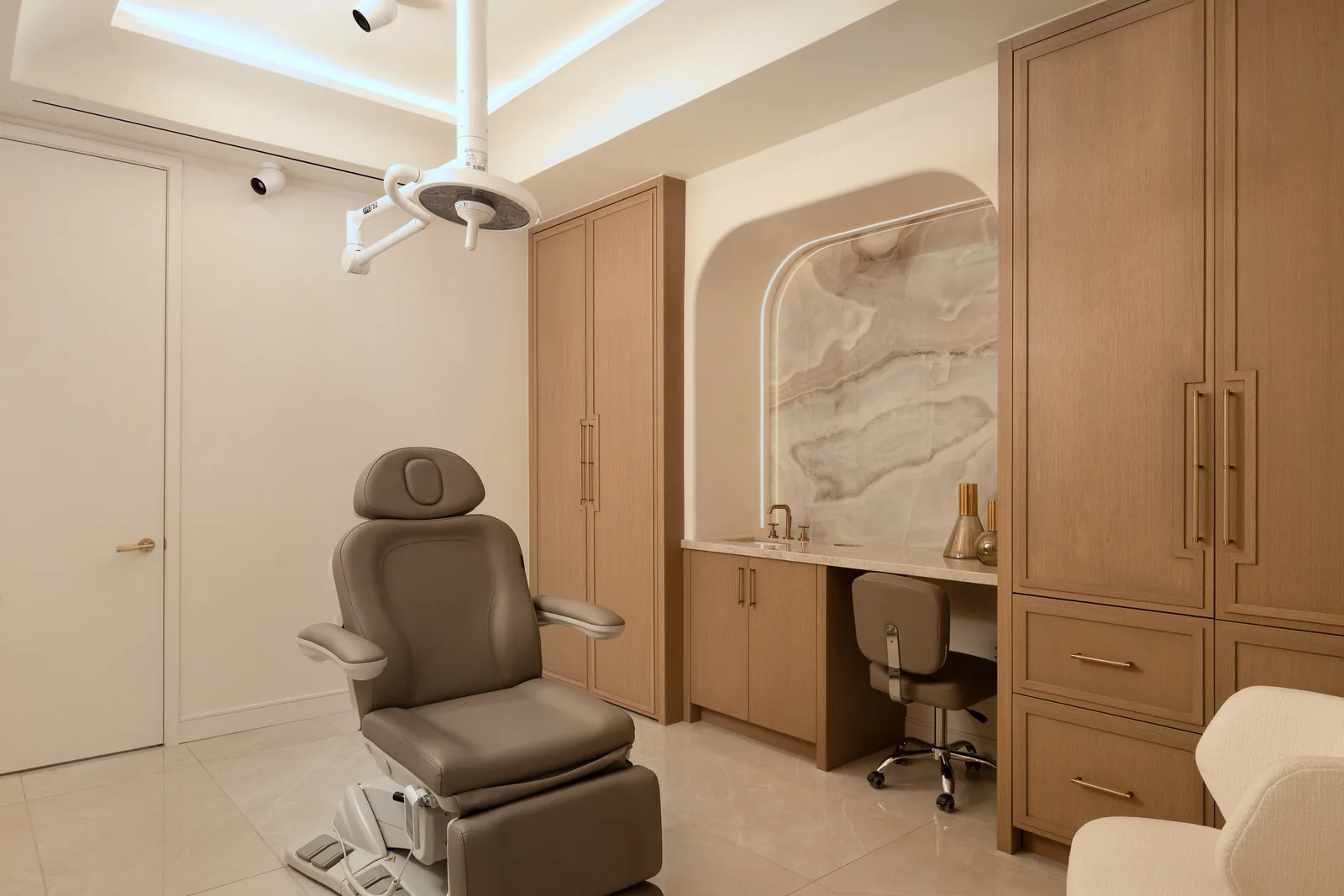
What Happens on the Day of Complex Breast Revision?
Anesthesia, setting, duration, incisions, materials, and whether surgery is focused or combined follow the final plan and operative findings.
The plan and limits, reviewed.
Dr. Howarth reviews priorities, scars, implant or capsule decisions, tissue limits, and findings that could change the operation.
The work follows the findings.
The correction proceeds according to the final plan, prior anatomy, tissue, implant, pocket, capsule, and operative findings.
Instructions match the operation.
The team reviews support, medications, activity, follow-up, and how to contact the practice according to the complete revision.
CANDOR WITHOUT DRAMA
Complex Breast Revision Safety and Limitations
The safety discussion follows the actual revision rather than the label. Prior operations can change tissue thickness, blood supply, scars, implant coverage, and healing, so the relevance of each risk depends on the current anatomy and proposed correction.
When tissue limits what can be changed responsibly, a focused improvement or staged plan may offer a better balance than pursuing every visible difference at once. The goal is a useful improvement with clear priorities—not a rescue promise or an assumption that more surgery is always better.
Individual Planning Considers
- Prior scars, healing, and blood supply
- Tissue thickness, implant coverage, and skin
- Implant, pocket, capsule, fold, and asymmetry
- The primary concern and highest priority
- Whether focused or staged care is more responsible
- Long-term monitoring and possible reoperation
What Revision Cannot Guarantee
- Exact symmetry or correction of every visible difference
- Complete pain relief or invisible scars
- A stable lifelong shape unaffected by tissue change
- That one operation can responsibly address every priority
- That another operation will never be considered
RECOVERY FOLLOWS THE WORK PERFORMED
Complex Breast Revision Recovery and Results
Recovery follows the operation, not the label. A focused correction differs from a combined or staged revision, and your instructions reflect the work actually performed.
Swelling, tightness, bruising, tenderness, and temporary differences vary with the revision and structures addressed.
Work, driving, and ordinary routines resume according to the procedure, medications, job demands, and healing.
Lifting, exercise, and travel return after healing progresses and the clinical team provides guidance for the actual revision.
Tissue, scars, skin, and implants keep changing as swelling settles. Staged care makes recovery part of reassessment.
BEFORE & AFTER GALLERIES
Private Complex Breast Revision Before & After Gallery
Complex Breast Revision before-and-after photographs can feel deeply personal. As both a woman and a surgeon, Ashley Howarth, MD, FACS, understands the trust involved in sharing them. Howarth Plastic Surgery in Scottsdale makes galleries of real patient results available by request through private before-and-after reviews.
Keeping complex breast revision before-and-after galleries off unrestricted public pages helps preserve patient dignity and clinical context while limiting casual viewing, unauthorized reposting, and collection by automated systems or AI agents.
During your private before-and-after review, you can see a range of complex breast revision results and discuss how starting anatomy, surgical choices, healing, and time influenced each outcome. These photographs can support an informed consultation, but individual results vary, and no image can predict your outcome.
PATIENT CASE SUMMARIES
Selected Complex Breast Revision Case Summaries
These deidentified case summaries illustrate how Ashley Howarth, MD, FACS, approaches complex breast revision at Howarth Plastic Surgery in Scottsdale, Arizona. They include recurrent implant complications, disrupted pockets, thin tissue, prior scars, and cases in which staged care or no further surgery is recommended. To protect patient privacy, some nonclinical identifying details have been generalized or modified. Individual anatomy, procedures, healing, and results vary.
Case 01
Recurrent contracture
Recurrent capsular contracture after prior operations required a broader revision analysis
Patient presentation
The patient reported recurrent firmness, distortion, and discomfort after more than one previous implant operation.
Clinical evaluation
Dr. Howarth reviewed operative records, implant information, capsule history, skin quality, pocket position, and factors associated with recurrence.
Procedure performed
A complex revision addressed the implant, capsule, pocket, and tissue findings identified during planning.
Clinical rationale
Repeated contracture cannot be approached as a routine implant exchange because the prior operations and current tissue environment shape risk.
Follow-up
Follow-up monitored incision healing, breast softness, implant position, recurrent firmness, and adherence to the support plan.
Case 02
Fold disruption
Severe bottoming out required reconstruction of the implant pocket and breast fold
Patient presentation
The patient described low implant position, an elevated nipple appearance, and loss of the intended lower-breast contour after prior augmentation.
Clinical evaluation
Examination assessed fold integrity, pocket dimensions, implant weight, tissue stretch, scar location, and the amount of usable support.
Procedure performed
Pocket correction and fold reconstruction were performed with implant and support choices tailored to the altered anatomy.
Clinical rationale
Correcting bottoming out requires treatment of the disrupted support boundary, not simply replacement with another implant.
Follow-up
Dr. Howarth monitored fold position, implant stability, scar healing, and early signs of recurrent stretch during staged return to activity.
Case 03
Symmastia
Loss of separation between the breasts required careful medial pocket correction
Patient presentation
The patient sought revision after the implants appeared too close together and the natural cleavage boundary had become less distinct.
Clinical evaluation
Dr. Howarth evaluated medial pocket boundaries, implant dimensions, chest-wall anatomy, tissue thickness, and prior operative changes.
Procedure performed
A side-specific pocket repair was performed to re-establish the medial boundaries within the limits of the available tissue.
Clinical rationale
Symmastia correction must respect chest anatomy and blood supply while limiting forces that could reopen the medial pocket.
Follow-up
Follow-up assessed the restored cleavage boundary, implant position, skin integrity, and compliance with activity restrictions.
Case 04
Thin tissue
Visible rippling after multiple surgeries required a tissue-coverage strategy
Patient presentation
The patient reported visible implant edges and rippling where the soft-tissue envelope had become thin after prior procedures.
Clinical evaluation
Evaluation considered implant position, shell characteristics, tissue thickness, available donor fat, scars, and the limits of manufactured support.
Procedure performed
The revision combined the implant, pocket, tissue, and support measures required by the documented findings.
Clinical rationale
Rippling is a coverage problem with several possible contributors, and no single material guarantees complete concealment.
Follow-up
Healing, contour, implant visibility, donor-site recovery, and residual rippling were reviewed after swelling decreased.
Case 05
Staged correction
Compromised tissue after several operations made staged reconstruction the safer plan
Patient presentation
The patient wanted implant exchange, pocket correction, and a lift during one operation after several prior breast surgeries.
Clinical evaluation
Dr. Howarth assessed scars, blood supply, skin quality, nipple position, implant findings, and the cumulative burden of another combined procedure.
Recommendation
A staged plan was recommended so removal or pocket treatment could heal before later shape correction was considered.
Clinical rationale
Separating procedures may protect tissue and clarify the next decision when prior operations have reduced predictability.
Follow-up
The second stage remained contingent on tissue recovery, updated examination, and the patient's goals after the first operation healed.
Case 06
Surgical limits
After multiple revisions, scarred and thinned tissue made another reconstruction inadvisable
Patient presentation
The patient requested another operation for a subtle residual difference after multiple prior revisions.
Clinical evaluation
Examination showed thin tissue, extensive scarring, limited reconstructive options, and a concern smaller than the risks of additional surgery.
Recommendation
Dr. Howarth recommended observation rather than another revision and explained the specific tissue and predictability limits.
Clinical rationale
A complex revision consultation must include the possibility that preserving stable anatomy is safer than pursuing incremental change.
Follow-up
No operation was scheduled, and the patient was advised to return for new symptoms or a meaningful change in the breast.
PLANNING WITH CLARITY
Complex Breast Revision Cost, Financing, and Travel to Scottsdale
Complex Breast Revision Cost
At Howarth Plastic Surgery in Scottsdale, complex breast revision typically costs $14,600 to $32,000. Your final fee depends on capsule or pocket work, tissue reshaping, added support, implant needs, anesthesia, surgical setting, and whether multiple procedures are combined. After Dr. Howarth reviews your history and examines you, you will receive a personalized written estimate for the plan she recommends.
Financing Options
Howarth Plastic Surgery is a cash-pay practice and does not accept or bill insurance. Your patient care coordinator can review financing through PatientFi and CareCredit, subject to third-party approval.
Planning Care in Scottsdale
If you are traveling from elsewhere in Arizona or out of state, out-of-town patient information can help you plan around consultation, surgery, and follow-up. Required appointment dates, how long to remain nearby, and when travel may resume are individualized. An initial consultation may take place virtually, but an in-person examination is required before the operative plan is finalized.
YOUR QUESTIONS, ANSWERED
Complex Breast Revision Frequently Asked Questions
Multiple operations, recurrent concerns, thin or scarred tissue, altered anatomy or blood supply, or interacting implant, pocket, capsule, skin, scar, and position issues may make planning more involved.
If you are unsure, begin with Breast Revision. You do not need to diagnose or label your own case before contacting the practice.
Operative reports, implant cards, photographs, pathology information, and relevant imaging may help when available. Contact the practice even without a complete archive.
No. Imaging depends on the implant, symptoms, history, examination, and question being evaluated. The clinical team determines whether it is useful.
Yes. Staging may be considered when one operation would ask too much of the tissue or a first step must heal before reassessment. It is not automatic.
That may be an option. Capsule, skin, tissue, nipple position, volume loss, and reason for removal affect the plan. See Breast Implant Removal.
Sometimes. Prior scar location and quality, blood supply, implant or capsule work, reshaping, and any lift affect incision planning.
Recovery follows the operation, not the label. A focused correction can differ substantially from a combined or staged revision.
At Howarth Plastic Surgery in Scottsdale, complex breast revision typically costs $14,600 to $32,000. Your final fee depends on capsule or pocket work, tissue reshaping, added support, implant needs, anesthesia, surgical setting, and whether multiple procedures are combined. After Dr. Howarth reviews your history and examines you, you will receive a personalized written estimate for the plan she recommends.
No. Tissue and blood-supply limits may make a smaller, focused improvement more responsible than pursuing every visible difference.
Yes. Complexity describes the current planning challenge, not the patient, her earlier decision, or another surgeon. The review can remain factual and forward-looking.
Travel may be possible when records, consultation, surgery, and follow-up can be coordinated safely. Begin with the Out-of-Town Patient guide.
Related Care
Related Breast Procedures
Continue with the page that best matches the question or surgical decision you are considering.
- Breast Revision broad first evaluation for common or uncertain revision concerns.
- Breast Implant Removal implant-removal and capsule decisions when explant is the primary intent.
- Breast Implant Illness evidence-aware evaluation when systemic symptoms lead the question.
- Breast Implant Selection device considerations when exchange is part of the discussion.
- Breast Lift breast and nipple position or skin-envelope change.
- Internal Bra Support How added support may fit selected structurally difficult or multiply operated revision plans.
BEGIN HERE
Request a Consultation
Tell us what you are considering. A member of our patient care team will follow up with consultation availability and next steps.

Megan S.
Patient Coordinator
Prefer to talk or text?
Selected Medical References