
Hyaluronic Acid Fillers
What Dermal Fillers Are
Dermal fillers are injectable gels, almost all cross-linked hyaluronic acid, placed under the skin to restore lost volume or add contour, lasting 6 to 18 months and reversible with hyaluronidase. At Aesthetica by Ashley Howarth MD the RHA, Restylane, and Juvederm families are chosen area by area, a firm gel to lift the cheeks, a soft gel to flex in the lips, and a thin gel for the tear trough, while sagging skin or volume needs beyond what filler can sensibly provide point instead to fat transfer, a facelift, or eyelid surgery.
Dermal fillers are injectable gels, almost all of them made of cross-linked hyaluronic acid, a sugar that already exists in skin and holds water, placed under the skin to restore volume that the face has lost or to add contour where it never had enough. They last 6 to 18 months depending on the product and the area, and because they are hyaluronic acid they can be dissolved with an enzyme, hyaluronidase, if the result is wrong or a vessel is blocked. At Aesthetica by Ashley Howarth MD, the med spa of Howarth Plastic Surgery in Scottsdale, the filler families used are RHA, Restylane, and Juvederm, and the areas treated are the cheeks and midface, lips, chin and jawline, temples, nasolabial folds and marionette lines, the under-eye tear trough at conservative volumes, and the backs of the hands. Filler is not a treatment for skin quality: sun-damaged, crepey, or blotchy skin in Arizona is addressed with BBL HERO, MOXI, and the plan in Skin in Arizona, and moving lines are treated with Botox, Dysport, or Daxxify instead; the injectables hub lists every option, including PRF hair restoration for the scalp.
The three families differ in how the gel is built. RHA, made by Teoxane, uses a lighter cross-linking that lets the gel stretch and recover with expression and is the family used in areas that move, the lower face and the lips. Restylane products use particle-based gels of graded firmness, from the soft Restylane-L and Kysse to the firm Restylane Lyft used in the cheeks and hands, with Restylane Eyelight designed for the under-eye. Juvederm products use a smooth cohesive gel, with Voluma XC for the midface and chin and Volux XC, the firmest, for the jawline. The choice is made area by area: a cheek needs a firm gel that lifts, a lip needs a soft gel that flexes, a tear trough needs a thin gel that does not swell. When the problem is not lost volume but sagging, or the volume needed is more than filler can sensibly provide, the honest answer at a plastic surgery practice is fat transfer, a facelift, or eyelid surgery, and that comparison is part of every consultation here.

Why Patients Ask for Fillers
What Patients Who Choose Dermal Fillers Notice
Most people who ask Aesthetica by Ashley Howarth MD about filler do not ask for a bigger anything. They describe a shadow or a flattening: the face looks tired in a way sleep does not fix, and they cannot say exactly why. Volume loss in the deep fat compartments of the face and in the bone beneath them is usually the reason, and it is what filler is designed to replace. These are the findings the team hears most.
- Cheeks that have flattened so the face looks longer and heavier than it did
- A hollow or dark shadow under the eyes that concealer only muddies
- Lips that have thinned or lost their edge, or a lip that has always been uneven
- A jawline that has softened, with early jowling at the corners of the mouth
- A chin that sits back and makes the neck look fuller in profile
- Temples that have sunk, so the brow tail looks lower and the eyes look smaller
Each of these has a filler answer, and a few of them have a better surgical one. The consultation sorts them: a flattened cheek at forty-five is a filler problem, the same cheek with sagging skin at sixty-five may be a facelift problem, and a hollow under the eye with a bag above it is often an eyelid surgery problem. A practice that offers all three can afford to be honest about which is which.


Surgeon-Directed Care
More Tools in the Toolbox: Why a Plastic Surgeon Directs Dermal Filler Treatment
Aesthetica by Ashley Howarth MD is the medical aesthetics practice of Ashley Howarth, MD, FACS, a board-certified plastic surgeon and instructor in plastic surgery at Mayo Clinic. Filler is placed blind, by feel, into a face whose arteries are a few millimeters below the surface, and a plastic surgeon knows those arteries because she dissects around them in the operating room: the facial artery climbing beside the nasolabial fold, the angular artery at the side of the nose, the supratrochlear and supraorbital arteries at the glabella and brow, the superficial temporal artery in the temple, and the labial arteries inside the lips. Her protocols set where a cannula is required, which zones are never injected, what volume is placed before the skin is checked, and exactly what happens if a vessel is blocked: hyaluronidase in the room, a high-dose pulsed protocol, and a physician on site who has managed the problem rather than read about it. Dermal fillers at Aesthetica by Ashley Howarth MD are placed by Dr. Howarth or by an advanced aesthetic nurse injector under her direction and protocols, with the tear trough, temples, and any zone adjacent to the nose reserved for the most experienced hands.
The second thing a plastic surgeon brings is the rest of the toolbox. A practice that only sells filler will treat every hollow with filler. Dr. Howarth performs facelifts, neck lifts, blepharoplasty, and fat transfer, so when a Scottsdale patient in her sixties asks for cheek filler to fix jowls, the answer can be the honest one: the jowls are descended tissue, a lift fixes them, and filler afterward is a refinement rather than a substitute. The same judgment sends crepey sun-damaged skin to physician-performed laser skin resurfacing instead of a syringe, and directs a twenty-five-year-old asking for a fourth syringe of lip filler toward restraint. More tools in the toolbox, and an honest answer about which one you need.

SCOTTSDALE · MODERN OFFICE SETTING
Where to Start
Who Dermal Fillers Are For, and What Happens First
Dermal fillers at Aesthetica by Ashley Howarth MD are for adults who have lost volume in the cheeks, temples, or under the eyes, want more definition in the lips, chin, or jawline, or want deep folds softened, and whose skin still has enough elasticity to drape over the restored volume without sagging. The consultation is a facial assessment, not a menu. The injector examines the face at rest and in animation, in three-quarter and profile views, maps the volume loss compartment by compartment, checks skin quality and laxity, notes any asymmetry that was there before treatment, reviews every previous filler including where and when it was placed, asks about blood thinners, autoimmune disease, cold sores, and dental work, and marks the course of the facial, angular, supratrochlear, and superficial temporal arteries before the first injection. From that assessment comes a written map of which areas will be treated, which product family, roughly how many syringes, and in what order. It also says plainly which concerns filler will not fix: texture and fine etched lines need resurfacing, moving lines need a neuromodulator, and skin that has slid needs to be lifted, not filled.
Dr. Ashley Howarth, MD, FACS is a board-certified plastic surgeon and an instructor in plastic surgery at Mayo Clinic. Aesthetica by Ashley Howarth MD is the medical aesthetics brand of her practice, Howarth Plastic Surgery, at 7373 N. Scottsdale Road, Suite C150, Scottsdale, Arizona 85253.

Three Families, Chosen Area by Area
How Dermal Fillers Are Used in Scottsdale
Cheeks, Midface, and Temples
The cheeks are usually treated first because restoring midface volume lifts the nasolabial fold and under-eye shadow indirectly, with a firm lifting gel placed deep on the cheekbone lasting 12 to 18 months.
The cheeks are the anchor of most filler plans because restoring the midface lifts the nasolabial fold and the under-eye shadow indirectly, so they are usually treated first. A firm, lifting gel such as Juvederm Voluma XC, Restylane Lyft, or RHA 4 is placed deep on the cheekbone in small deposits, most often with a blunt cannula, which lowers the risk of entering a vessel. In the pivotal study of a volumizing hyaluronic acid filler in the midface, a meaningful proportion of patients still showed improvement two years after treatment. Temples are treated with the same deep placement to restore the upper frame of the face, always with the superficial temporal artery mapped first. Expect 12 to 18 months from these areas and 1 to 2 syringes per side for a first correction.
Lips, Chin, and Jawline
Lips are treated with a soft, flexible gel in amounts measured in fractions of a syringe and last about 6 to 12 months, while the chin and jawline use the firmest gels, placed on the bone to sharpen the jawline.
Lips are the area where restraint is most visible. A soft, flexible gel such as RHA 2, Restylane Kysse, or Juvederm Volbella XC restores the border and the vertical height that thin with age, in amounts measured in fractions of a syringe, and the result is judged at two weeks once swelling has settled. Lip filler lasts about 6 to 12 months because the lips move constantly. The chin and jawline use the opposite gel: the firmest products, Juvederm Volux XC or Restylane Defyne, placed on the bone to bring a receding chin forward, sharpen the angle of the jaw, and blunt early jowling. In a man this is usually the first area treated. The skin laxity guide explains when a jawline needs a neck lift rather than a syringe.
Under Eyes, Folds, and Hands
The tear trough, the least forgiving filler area, is treated only with a thin, low-swelling gel at conservative volumes, while nasolabial folds and the backs of the hands are treated with firmer gels after the cheeks.
The tear trough is the least forgiving filler area: the skin is thin, lymphatic drainage is slow, and too much or too superficial a gel leaves a bluish tint or a persistent puff. It is treated only with a thin, low-swelling gel such as Restylane Eyelight, with a cannula, at conservative volumes, and often after the cheek has been treated first, which reduces the hollow on its own. Patients with a true fat bag above the hollow are directed to eyelid surgery and patients with thin crepey skin to PRF EZ Gel. Nasolabial folds and marionette lines are softened with RHA 3 or Restylane Refyne after the cheek work, never as the only step. The backs of the hands are treated with Restylane Lyft to hide tendons and veins, a common request in Scottsdale where sun-damaged hands age faster than the face.
When Fat Transfer or a Facelift Is the Better Answer
A patient who needs filler in five or six areas every year, whose tissue has descended, or who has under-eye bags or hooded lids is better served by fat transfer, a facelift or neck lift, or blepharoplasty.
Filler replaces a few milliliters of volume for a year or so. It does not tighten skin, reposition fallen tissue, or replace 20 milliliters of lost facial fat without looking heavy. At Aesthetica by Ashley Howarth MD three situations move the conversation to Dr. Howarth’s surgical practice: a patient who needs filler in five or six areas every year, for whom fat transfer restores the same volume with the patient’s own tissue in one procedure; a patient whose real problem is skin and tissue that have descended, for whom a facelift or neck lift does what no syringe can; and a patient with under-eye bags or hooded lids, for whom blepharoplasty is the honest answer. Filler is still used afterward, in smaller amounts, to refine. The comparison table lower on this page sets the three side by side.
At a Glance
Fillers at a Glance
Areas treated with hyaluronic acid filler at Aesthetica by Ashley Howarth MD, the product family typically chosen, expected longevity, and downtime; individual plans and product choices are set at the facial assessment.
| Area | Filler family used | Longevity | Downtime | Notes |
|---|---|---|---|---|
| Cheeks and midface | Juvederm Voluma XC, Restylane Lyft, or RHA 4, deep on bone | 12 to 18 months | Swelling 2 to 3 days | Treated first; lifts folds and under-eye shadow indirectly |
| Lips | RHA 2, Restylane Kysse, or Juvederm Volbella XC | 6 to 12 months | Swelling up to 5 to 7 days | Half to one syringe; judged at two weeks |
| Chin and jawline | Juvederm Volux XC or Restylane Defyne, on bone | 12 to 18 months | Swelling 2 to 3 days | A neck lift when the problem is descended tissue |
| Temples | Firm gel placed deep, cannula | 12 to 18 months | Mild swelling 1 to 3 days | Superficial temporal artery mapped before injection |
| Nasolabial folds and marionette lines | RHA 3 or Restylane Refyne | 9 to 12 months | Swelling 2 to 3 days | After the cheek, never as the only step |
| Under eyes (tear trough) | Restylane Eyelight, cannula, conservative volume | 9 to 12 months | Swelling and possible bruising up to 1 week | Bags go to eyelid surgery; thin skin to PRF EZ Gel |
| Backs of the hands | Restylane Lyft | About 12 months | Swelling 2 to 5 days | Often paired with BBL for pigment on the hands |
Three Answers to Lost Volume
Filler vs Fat Transfer vs Surgery
How hyaluronic acid filler compares with the surgical options Dr. Howarth performs, so the consultation at Aesthetica by Ashley Howarth MD can recommend the right one; the face surgery pages cover fat transfer, facelift, and eyelid surgery in full.
| HA filler | Fat transfer | Facelift or lift | |
|---|---|---|---|
| What it does | Replaces a few milliliters of volume; adds contour | Replaces larger volume with the patient's own fat | Repositions descended tissue; removes loose skin |
| Longevity | 6 to 18 months | Long-lasting for the fat that survives, typically a majority | Years; aging continues from a new baseline |
| Reversible | Yes, with hyaluronidase | No | No |
| Downtime | A few days of swelling | 1 to 2 weeks of swelling and bruising | About 2 weeks before social activity |
| Best for | Focal volume loss in skin that still fits the face | Diffuse volume loss needing several areas every year | Jowls, loose neck, sagging cheeks, hooded lids or bags |
| Performed by | Dr. Howarth or an advanced aesthetic nurse injector under her direction | Dr. Howarth | Dr. Howarth |
A Visit Built Around Your Anatomy
What to Expect at a Dermal Filler Visit at Aesthetica by Ashley Howarth MD
A filler visit at Aesthetica by Ashley Howarth MD has three parts: the facial assessment and marking, the injections, and a written aftercare plan with a two-week check. Plan on 45 to 60 minutes in the room for a first multi-area treatment and about 30 minutes for a single area or a maintenance visit.
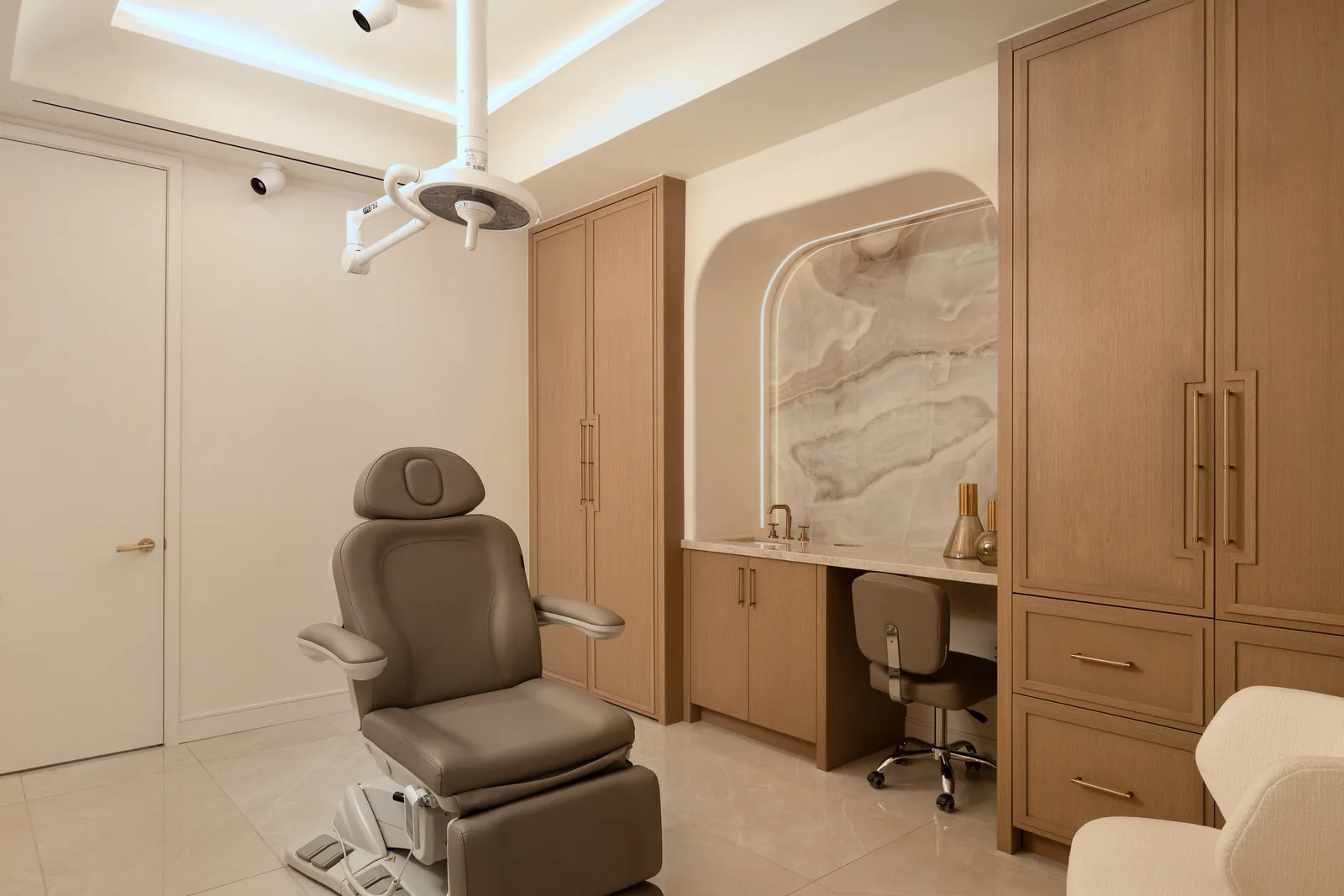
Volume mapped, arteries marked, product chosen
The injector photographs the face, examines it at rest and in expression, maps where volume has been lost, marks the course of the facial arteries and the danger zones near the nose, glabella, and temples, confirms you have paused blood thinners you can safely pause, and chooses a product family and a rough syringe count for each area. If surgery is the better answer, that is said here.
Numbing, then small deposits with cannula or needle
The skin is cleaned and numbed with a topical cream; every filler used here also contains lidocaine. Most areas are treated through a single entry point with a blunt cannula in small deposits that are molded as they go; lips and the chin may use a fine needle. Each area is checked for color and capillary refill before the next, and hyaluronidase is in the room throughout.
Aftercare in writing and a two-week check
You leave with ice for the first evening, instructions to avoid hard exercise, heat, and alcohol for 24 hours and pressure on the area for 48 hours, the signs of a vascular problem to call about immediately, and a two-week photograph check at which any small adjustment is made once swelling has settled.
Clear Information. Informed Choices.
Safety and Limitations of Dermal Fillers
Hyaluronic acid fillers are safe in trained hands, and their defining safety feature is that they can be dissolved. Most side effects are expected and brief: swelling, tenderness, and bruising for a few days to two weeks. The serious complication is vascular occlusion, filler entering or compressing an artery so the skin it supplies loses blood flow; untreated, that can scar the skin, and in the rarest cases filler that reaches the eye’s arterial supply can cause vision loss. A 2019 review in Aesthetic Surgery Journal counted 146 reported cases of filler-related vision loss worldwide, with the nose, glabella, forehead, and nasolabial fold the most frequently implicated sites. That is why Aesthetica by Ashley Howarth MD maps arteries before injecting, uses cannulas and small slow deposits in high-risk zones, treats the nose only with particular caution, checks skin color after every pass, and keeps hyaluronidase in the room, following the high-dose pulsed protocol described in the literature if blanching, pain out of proportion, or a mottled pattern appears. A plastic surgeon manages that emergency with the same anatomy she operates on.
Possible Side Effects Include
- Swelling and tenderness for 2 to 7 days, longest in the lips
- Bruising that can last 7 to 14 days
- Small lumps or asymmetry, usually settling by two weeks or adjusted then
- A bluish tint under thin skin if gel is placed too superficially
- Rarely, delayed nodules, infection, or vascular occlusion requiring hyaluronidase
What Treatment Cannot Guarantee
- Tightening of loose or sagging skin
- Improvement in texture, pores, or sun damage
- A permanent result; hyaluronic acid is absorbed over 6 to 18 months
- Correction of under-eye bags or hooded eyelids
- Symmetry the face did not have before treatment
What Happens After Filler
Recovery After Dermal Fillers
Recovery from dermal fillers is short and mostly cosmetic: the areas treated are swollen and sometimes bruised for a few days, the result is visible immediately but not final until two weeks, and there is no wound to care for. The practical rules protect the placement of the gel while it integrates. Because filler is not seasonal, it is scheduled year-round in Scottsdale, though the team asks for a two-week buffer before an event and keeps BBL and MOXI off the treated area for two weeks. Botox can be done at the same visit.
The change is visible before you leave, slightly exaggerated by swelling and the lidocaine in the gel. Lips swell the most and can look overdone for 24 to 48 hours; that is not the result. Ice for ten minutes at a time that evening, sleep with the head slightly raised, and skip exercise, heat, saunas, and alcohol for 24 hours. Do not press, massage, or sleep face-down on the area for 48 hours. Any patch of skin that turns white, mottled, or dusky, or pain that is worse than tenderness, is a same-day call to the practice.
Cheek, chin, and jawline swelling settles within 2 to 3 days; lip swelling within 5 to 7. Makeup can go over intact skin from the next day. Bruises, if any, yellow and fade over one to two weeks and are covered with concealer. Small firm areas you can feel but not see are normal at this stage as the gel integrates. Retinoids and exfoliating actives restart after 48 hours, and mineral sunscreen continues daily, since Arizona sun does not pause for recovery.
By two weeks the swelling is gone and the gel has integrated with the tissue, which is when the result is judged and photographed. The check visit is where a small asymmetry is corrected, a lump is molded or dissolved, or a small addition is made if the first pass was deliberately conservative. Facials, HydraFacial, and laser treatments can resume over the treated area from this point.
Lips hold 6 to 12 months; cheeks, chin, jawline, and temples 12 to 18. Filler fades gradually rather than disappearing on a date, and the maintenance visit usually needs less product than the first. Most Scottsdale patients return once a year for the structural areas and twice for lips, pair the visit with a neuromodulator, and keep the skin itself in shape with BBL and MOXI during laser season. Patients who find themselves needing more areas each year are offered the surgical comparison honestly.
Before & After
Dermal Fillers, Before and After Treatment
Filler results are best judged in photographs taken in the same light and angle before treatment and two weeks after, when swelling has settled, and in profile and three-quarter views as much as straight on, since cheek, chin, and jawline changes show most in profile. Aesthetica by Ashley Howarth MD maintains before-and-after galleries for dermal fillers, Botox, and PRF EZ Gel, and the team can show you cases that match your age, sex, and the area you are considering during your visit, including cases where the recommendation was surgery instead.
Patient Case Summaries
Selected Dermal Filler Case Summaries
These deidentified case summaries illustrate how Dr. Howarth and the physician-led team at Aesthetica by Ashley Howarth MD plan dermal filler treatment in Scottsdale. They include a first-time midface patient, a maintenance lip patient, a man treated at the chin and jawline, a patient who arrived with a complication from filler placed elsewhere, a patient whose honest answer was surgery rather than filler, and a young patient asking for more than the team would place. Each summary connects the patient’s concern and facial assessment with the treatment performed or the recommendation made.
Case 01
First-time midface
A flattened midface in a woman in her forties treated with cheek filler first, and the folds she came in for left alone
Patient presentation
A woman in her forties, a long-term Scottsdale resident, asked to have her nasolabial folds filled because they had deepened over two years and made her look tired in photographs.
Skin assessment
In three-quarter view the midface fat compartments had deflated and the cheekbone no longer projected, which let the cheek tissue rest on the fold. The folds themselves were shallow at rest. Skin quality was good with mild sun-related pigment, and there was no previous filler.
Procedure performed
Juvederm Voluma XC placed deep on the cheekbone with a cannula, one syringe per side, with the nasolabial folds deliberately not injected. A two-week check confirmed the folds had softened from the lift alone.
Clinical rationale
Filling a fold that is caused by a deflated cheek adds weight to the lower face; restoring the cheek lifts the fold indirectly and keeps the result structural rather than puffy, which is the sequence a facial anatomy-based plan follows.
Follow-up
She returned at fourteen months for a smaller top-up and added a fall BBL HERO series for the pigment; the folds have not needed direct treatment.
Case 02
Lip maintenance
Restrained lip filler maintained twice a year in a woman in her fifties
Patient presentation
A woman in her fifties who had received lip filler at Aesthetica by Ashley Howarth MD twice before asked for her annual visit, noting the border of her upper lip had faded again and lipstick was bleeding into fine vertical lines.
Skin assessment
The lips had returned nearly to baseline at ten months, with loss of the vermilion border, mild vertical lip lines from sun and expression, and no residual product. The proportion of upper to lower lip was natural and she wanted it kept that way.
Procedure performed
Half a syringe of RHA 2 along the vermilion border and into the body of the upper and lower lip with a fine needle, then a small dose of Botox above the upper lip at a separate visit for the vertical lines.
Clinical rationale
A flexible gel restores the border without stiffening the lip’s movement, and half a syringe at each visit keeps the result inside the proportion she started with; the etched lines are a resurfacing or neuromodulator problem, not a volume problem.
Follow-up
She maintains at ten to twelve months with the same half syringe and had a MicroLaserPeel to the upper lip the following laser season for the lines.
Case 03
Chin and jawline
A receding chin and soft jawline in a man in his thirties treated with a firm filler on the bone
Patient presentation
A man in his thirties asked whether anything short of surgery could improve his profile; he felt his chin was weak and his neck looked full in side-view photographs.
Skin assessment
The chin sat behind the line of the lower lip in profile, the jaw angle was soft, and a small amount of submental fullness was exaggerated by the retruded chin. Skin was firm with no laxity. Chin surgery was discussed as the permanent option and he preferred to trial a reversible one first.
Procedure performed
Juvederm Volux XC placed on the bone at the chin and along the jaw angle with a cannula, two syringes in total, after marking the facial artery at the jawline.
Clinical rationale
The firmest gel placed deep on bone brings the chin forward and defines the angle in a way soft gels cannot, and a reversible trial lets a young patient see the profile change before deciding on a permanent implant or genioplasty.
Follow-up
At sixteen months the projection was holding; he has since asked for a consultation about a permanent chin implant with Dr. Howarth.
Case 04
Complication elsewhere
Migrated lip filler and a puffy under-eye from another clinic dissolved before any new filler was placed
Patient presentation
A woman in her thirties who had moved to Scottsdale from another state came in with a shelf of product above her upper lip and a persistent bluish puff under both eyes, both from filler placed over several years elsewhere, and asked whether more filler could balance them.
Skin assessment
The upper lip showed filler that had migrated above the vermilion border, and the tear troughs held superficial product with a Tyndall tint and fluid retention. Adding filler would have enlarged both problems.
Procedure performed
Hyaluronidase to the upper lip and both tear troughs at two visits two weeks apart, then a six-week pause, then a conservative re-treatment: a soft flexible gel in the lip body only and a cheek lift with no under-eye filler at all.
Clinical rationale
Hyaluronic acid filler can be dissolved, which is the main safety reason to use it, and the correct first step for over-placed or migrated product is removal and reassessment rather than camouflage; the under-eye was then better served by the cheek than by more gel.
Follow-up
Her lips and under-eyes returned to a natural contour after dissolving, and she has kept to the conservative plan with annual visits.
Case 05
Surgery instead
Jowls and heavy nasolabial folds in a woman in her sixties, and why the answer was a facelift rather than syringes
Patient presentation
A woman in her sixties asked for filler in her cheeks, nasolabial folds, marionette lines, and jawline, estimating that a friend’s injector had used eight syringes for the same result and asking for the same.
Skin assessment
Dr. Howarth’s assessment found descended cheek tissue, jowls that moved when the skin was lifted a centimeter at the temple, platysmal bands in the neck, and thin sun-damaged skin. The volume loss was real but secondary; the primary problem was tissue that had slid, and eight syringes would have added weight to a face that needed lifting.
Recommendation
A facelift and neck lift with fat transfer to the cheeks, performed by Dr. Howarth in her surgical practice, with one syringe of filler at the chin six months later as a refinement and laser resurfacing planned for the skin.
Clinical rationale
Filler cannot reposition fallen tissue or tighten skin, and large volumes in a lax face produce heaviness rather than lift; a practice that performs the surgery can say so instead of selling the syringes.
Follow-up
One year after surgery she uses a fraction of the filler she was expecting to need and describes the result as looking rested rather than filled.
Case 06
Young and preventive
A woman in her twenties asking for a third syringe of lip filler and treated with none
Patient presentation
A woman in her twenties, new to the practice, asked for another full syringe in her lips, having had two elsewhere in the previous year, because she felt the result had faded.
Skin assessment
The lips still held most of the previous product, with the upper lip already larger than the lower in proportion and early flattening of the natural curves of the border. Skin quality was excellent and there was no other volume loss.
Recommendation
No filler. A photograph comparison against her own earlier pictures, a plan to let the existing product settle over six months, and a small amount of Botox for a gummy smile that was the feature actually bothering her.
Clinical rationale
Restraint is part of a physician-led plan: adding to lips that already exceed natural proportion produces the look most patients say they want to avoid, and the concern she described had a different and smaller solution.
Follow-up
She returned at eight months for a conservative half syringe to redefine the border once the earlier product had faded, and has stayed at that amount.
From First Visit to a Plan You Can Keep
Booking, Planning, and Follow-Up at Aesthetica by Ashley Howarth MD
Aesthetica by Ashley Howarth MD is a medical practice with a spa’s convenience. Established patients book online. New patients can book online or request a consultation, and the team responds usually the same day.

Online booking or a consultation request
Book a filler assessment directly online, or request a consultation and describe what you notice, which areas, and any filler you have had before. Either path starts with the same facial assessment, and treatment can follow the same day if the plan is clear.
A map, not a menu
You leave your first visit with a written plan: which areas, in what order; which product family for each; roughly how many syringes; whether Botox, PRF EZ Gel, or SkinPen belongs alongside; whether surgery is the better answer for part of it; and the skin plan that keeps the surface in shape.
A two-week check, then annual maintenance
Every filler treatment has a two-week photograph check. Structural areas are revisited at about a year and lips at six to twelve months, usually with less product each time. A-List members have the next visit on the calendar before they leave, and the treatment is not seasonal, so it can sit anywhere in the Scottsdale year.
Your Questions, Answered
Dermal Fillers Frequently Asked Questions
Nearly all dermal fillers used today are made of hyaluronic acid, a sugar molecule found naturally in skin that binds water, cross-linked into a gel so it holds its shape for months. Aesthetica by Ashley Howarth MD uses FDA-approved hyaluronic acid fillers from the RHA, Restylane, and Juvederm families, choosing firm gels for the cheeks and jawline and soft flexible gels for the lips and under the eyes.
Most hyaluronic acid fillers last 6 to 18 months. Lips are at the short end, about 6 to 12 months, because they move constantly. Cheeks, chin, jawline, and temples, treated with firmer gels placed on bone, hold 12 to 18 months and sometimes longer. Filler fades gradually rather than disappearing on a date, and maintenance visits usually need less product than the first treatment.
Not if the plan is built on proportion rather than volume. The overfilled look comes from treating the wrong area, using too much product, or filling a face that needed lifting. At Aesthetica by Ashley Howarth MD the assessment maps volume loss compartment by compartment, treats structural areas before folds, uses fractions of a syringe in the lips, and says when surgery is the better answer instead of adding syringes.
Fillers restore volume in the cheeks and midface, temples, and under the eyes at the tear trough, add shape to the lips, chin, and jawline, soften nasolabial folds and marionette lines, and hide tendons on the backs of the hands. The nose is approached with particular caution at Aesthetica by Ashley Howarth MD because of its vascular risk, and a nonsurgical rhinoplasty is offered only after Dr. Howarth has examined the nose herself. Full-face planning matters more than any single area; sagging skin is a different problem.
It depends on how much volume has been lost and where. A first midface correction is commonly one to two syringes per side; a chin and jawline one to two syringes in total; lips a half to one syringe. The consultation at Aesthetica by Ashley Howarth MD produces a written map with an estimate for each area, and a first treatment is often deliberately conservative with a check at two weeks.
Very little. Expect swelling for 2 to 3 days in the cheeks and jawline and up to a week in the lips, and possible bruising for one to two weeks that concealer covers. Work the next day is normal. Hard exercise, heat, and alcohol are paused for 24 hours and pressure on the area for 48 hours. Schedule filler at least two weeks before an important event.
No. Hyaluronic acid fillers are absorbed by the body over 6 to 18 months, which is a safety feature as much as a limitation: the result can be adjusted as the face changes, and the gel can be dissolved at any time with hyaluronidase. For patients who want a permanent volume correction, fat transfer performed by Dr. Howarth uses the patient’s own tissue and is discussed at the same consultation.
Dermal fillers at Aesthetica by Ashley Howarth MD are placed by Dr. Ashley Howarth, MD, FACS, a board-certified plastic surgeon and instructor in plastic surgery at Mayo Clinic, or by an advanced aesthetic nurse injector under her direction and protocols. Higher-risk zones such as the tear trough and temples are reserved for the most experienced hands, and a physician is on site with hyaluronidase for every treatment.
Hyaluronic acid fillers are safe when placed with knowledge of facial anatomy. The serious risk is vascular occlusion, filler blocking an artery so skin loses blood supply, and in the rarest cases vision loss; a 2019 review counted 146 reported cases worldwide, most from the nose, glabella, forehead, and nasolabial fold. Arterial mapping, cannulas, small slow deposits, and hyaluronidase in the room are how a plastic surgeon’s practice manages that risk.
Filler if the problem is lost volume in skin that still fits the face; a facelift if the problem is tissue that has descended, jowls, and loose neck skin. A rough test: if lifting the skin at the temple with a finger fixes what bothers you, that is a lifting problem. Aesthetica by Ashley Howarth MD is the med spa of a plastic surgery practice, so both answers are available at the same consultation in Scottsdale.
Concerns Treated
Concerns This Treatment Addresses
These guides explain each concern and where this treatment fits among the options at Aesthetica by Ashley Howarth MD in Scottsdale.
- Fine Lines & Wrinkles Folds and deep lines filler softens, and etched lines it does not
- Skin Laxity When the jawline needs a lift rather than a syringe
- Skin Texture, Pores & Dullness Skin quality is treated with resurfacing, not filler
- Skin in Arizona Why timing matters in the desert
- Botox Moving lines treated at the same visit
- PRF EZ Gel The autologous alternative for thin under-eye skin
BEGIN HERE
Request a Consultation
Tell us what you are considering. A member of our patient care team will follow up with consultation availability and next steps.

Megan S.
Patient Coordinator
Prefer to talk or text?
Selected References