
Micro-Coring for the Lower Face
What Ellacor Micro-Coring Is
Ellacor uses Micro-Coring technology (an array of hollow needles that removes thousands of micro-cores of full-thickness skin, each smaller than the threshold at which skin scars) and is FDA-cleared for moderate and severe wrinkles of the mid and lower face in adults 22 and older with Fitzpatrick I to IV skin. In the pivotal 51-subject study, wrinkle severity improved by an average of 1.3 grades with about 3 days of downtime, and at Aesthetica by Ashley Howarth MD it’s performed by Dr. Howarth or a provider trained under her direction, typically as a series of three treatments about 30 days apart.
Ellacor is a device made by Cytrellis that uses Micro-Coring technology: an array of hollow needles removes thousands of micro-cores of full-thickness skin, each smaller than the threshold at which skin scars, so the treated area heals smaller and tighter. It is FDA-cleared for the treatment of moderate and severe wrinkles in the mid and lower face in adults aged 22 or older with Fitzpatrick skin types I to IV, and it removes up to about 8 percent of the skin in the treated area per session. No heat is used or produced, so there is no thermal injury. In the pivotal multicenter study of 51 subjects published in Plastic and Reconstructive Surgery Global Open in 2022, wrinkle severity improved by an average of 1.3 grades on the Lemperle scale, 89.7 percent of treated sites improved on the Global Aesthetic Improvement Scale, and patients reported an average of 3 days of downtime. At Aesthetica by Ashley Howarth MD, the med spa of Howarth Plastic Surgery in Scottsdale, Ellacor is used on the Ellacor 2.0 system for wrinkles, early laxity, and crepey texture of the cheeks, nasolabial folds, marionette lines, perioral skin, jowls, and chin, and it is performed by Dr. Ashley Howarth, MD, FACS, or a provider trained under her direction. In the pivotal trial most patients had a series of three treatments about 30 days apart under local anesthesia.
The mechanism is subtraction, not heating. Lasers such as HALO and Contour TRL remove or heat tissue to trigger collagen remodeling; radiofrequency and ultrasound heat the dermis; SkinPen microneedling punctures without removing anything. Ellacor physically excises columns of skin, and the surrounding skin closes the gaps the way a small punch biopsy heals, with directional contraction that surgeons recognize. Because there is no heat, the risk of post-inflammatory hyperpigmentation is not the thermal risk of a laser, but the manufacturer’s clearance is limited to Fitzpatrick I to IV and the practice follows that. Ellacor sits between the non-ablative treatments and surgery: more change than microneedling or a light laser, less than a facelift, and because Ellacor is not light-based it does not depend on laser season the way Sciton treatments do, although the practice still asks for sun avoidance while the pinpoint wounds close.

Why Patients Ask for Ellacor
What Patients Who Choose Ellacor Notice
Most people who ask Aesthetica by Ashley Howarth MD about Ellacor point to the lower third of the face. The forehead and eyes are handled by Botox and the cheeks by filler, but the skin around the mouth and along the jaw is the part that has started to look loose rather than lined, and it is the part that fillers and light lasers have already been tried on. These are the findings the team hears most.
- Lines from the corners of the mouth down toward the chin that are there at rest
- Skin along the jawline that has begun to soften into early jowls
- Crepey, finely wrinkled skin on the lower cheeks that makeup settles into
- Vertical lines above and below the lips that filler has not solved
- Nasolabial folds that look heavier because the skin over them is loose
- A wish for something more than microneedling but not yet surgery
Moderate to severe wrinkles and mild to moderate laxity of the mid and lower face, on fair to medium skin, are the problems Ellacor solves best, because removing skin is the only non-surgical way to make skin smaller. Heavy jowls, a loose neck, and deep facial descent are surgical problems, and the assessment says so.


Surgeon-Directed Care
More Tools in the Toolbox: Why a Plastic Surgeon Directs Micro-Coring of the Lower Face
Aesthetica by Ashley Howarth MD is the medical aesthetics practice of Ashley Howarth, MD, FACS, a board-certified plastic surgeon and instructor in plastic surgery at Mayo Clinic. Ellacor is a skin-excision procedure done through needles, and the judgment it needs is a surgeon’s. The first decision is diagnosis: whether the lower face looks older because the skin is loose, because fat has descended, because volume has been lost, or because of all three. Micro-coring solves only the first, and a practice without a surgeon in the room tends to sell it for the others. Dr. Howarth evaluates every Ellacor candidate the way she evaluates a facelift candidate, with the skin pinched, the jowl palpated, and the neck examined, and she moves the patient to fillers, to physician-performed laser skin resurfacing, or to a facelift or neck lift when that is the honest answer. The second decision is design: where the zones go and in what direction the skin should contract, which is the same thinking she uses to plan a skin excision in the operating room. The third is wound care and complication management, since thousands of tiny full-thickness wounds are still wounds, and a surgeon who manages healing skin every day knows what a normal day 3 looks like and what does not.
Because Aesthetica by Ashley Howarth MD is the med spa of a plastic surgery practice, the plan is not limited to one device. The physician-led team performs SkinPen, MOXI, BBL HERO, and HALO under her protocols; Ellacor is performed by Dr. Howarth or a provider trained under her direction; deep resurfacing with Contour TRL and surgery are performed by Dr. Howarth. More tools in the toolbox, and an honest answer about which one you need.

SCOTTSDALE · MODERN OFFICE SETTING
Where to Start
Who Ellacor Is For, and What Happens First
Ellacor at Aesthetica by Ashley Howarth MD is for adults aged 22 or older with Fitzpatrick I to IV skin who have moderate to severe wrinkles or mild to moderate laxity of the mid to lower face, want more change than microneedling or a light laser delivers, are not ready for or do not need a facelift, and can accept about 3 days of visible pinpoint healing after each of a short series. The evaluation is the first step, and for Ellacor it is done by Dr. Howarth. She examines the lower face for skin quality, skin excess, and the depth of the folds, tests how much of the change is loose skin versus descended fat and muscle, records Fitzpatrick type, and reviews medications, isotretinoin use, keloid history, and cold sore history. If the problem is skin, Ellacor is the plan. If the folds are volume loss, dermal fillers come first. If the surface is sun-damaged but not loose, HALO or Contour TRL during laser season fits better. If the jowls and neck have descended, a facelift is the honest answer and Ellacor is not offered as a substitute. Fitzpatrick V and VI skin is not treated with Ellacor, in line with the manufacturer’s clearance, and is directed to microneedling and MOXI instead.
Dr. Ashley Howarth, MD, FACS is a board-certified plastic surgeon and an instructor in plastic surgery at Mayo Clinic. Aesthetica by Ashley Howarth MD is the medical aesthetics brand of her practice, Howarth Plastic Surgery, at 7373 N. Scottsdale Road, Suite C150, Scottsdale, Arizona 85253.

Subtraction Without Heat
How Ellacor Is Used in Scottsdale
Nasolabial Folds, Marionette Lines, and Perioral Wrinkles
For nasolabial folds, marionette lines, and perioral wrinkles, the needle array removes up to about 8 percent of skin per session under local anesthesia, leaving pinpoint scabs for about 3 days as folds soften over the following 1 to 3 months.
For the wrinkles and folds of the mid to lower face, the handpiece is placed over the treatment zone and the needle array removes micro-cores of skin in a grid, with the density set to remove up to about 8 percent of the skin in that zone per session. In the pivotal study these were the sites treated, and the nasolabial fold, marionette line, and perioral wrinkles were the targets in the 2026 Lasers in Surgery and Medicine report as well. Local anesthesia makes the treatment tolerable; patients in the manufacturer’s trial rated pain below 2 on a 10-point scale. The zone is red with pinpoint scabs for about 3 days, and the folds soften over the following 1 to 3 months as the skin contracts.
Early Jowls and Lower Cheek Laxity
For mild to moderate jawline and lower-cheek laxity, Ellacor is used as skin reduction rather than wrinkle treatment, though a jowl caused by descended fat and muscle rather than loose skin calls for a facelift or neck lift instead.
For mild to moderate laxity along the jawline and lower cheeks, Ellacor is used as skin reduction rather than wrinkle treatment. Removing a percentage of skin in a zone makes that zone smaller as it heals, and a series of treatments compounds the effect. Dr. Howarth marks the zone with the vector of contraction in mind, the way she plans skin excision in surgery. This is the use that most needs a surgeon’s judgment: if the jowl is descended fat and platysma rather than loose skin, micro-coring will tighten the skin over a problem it cannot fix, and a facelift or neck lift is the honest answer. Ellacor is not used on the neck or the upper face.
Ellacor 2.0 and the Micro-Coring Mechanism
Ellacor 2.0’s hollow needles core out columns of full-thickness skin that heal by contraction, and because nothing is heated and it isn’t light-based, it can be scheduled outside laser season, unlike ablative lasers.
Ellacor 2.0 is the current generation of the system, with updated needle cartridges and software that the manufacturer states improve precision and comfort. The mechanism is the same: hollow needles core out columns of full-thickness skin below the size at which skin scars, and the wound heals by contraction. A 2025 systematic review in Dermatologic Surgery gathered the published micro-coring studies and found consistent improvement in wrinkle severity with low rates of adverse events and no scarring. Because nothing is heated, Ellacor does not carry the thermal risks of ablative lasers, and it is not light-based, so it can be scheduled outside laser season with sun avoidance while the pinpoint wounds close, which in Arizona is easier from October to April.
Ellacor Alongside Laser, Injectables, and Surgery
Ellacor treats skin excess but not color, volume, or muscle, so it’s paired across a season with laser for sun damage, fillers and Botox about two weeks apart, or SkinPen for skin types it isn’t cleared for.
Ellacor treats skin excess; it does not treat color, volume, or muscle. At Aesthetica by Ashley Howarth MD it is combined across a season rather than in a day: HALO or BBL HERO for sun damage and texture in the same laser season but at a separate visit, dermal fillers for volume and Botox for expression lines about two weeks apart from an Ellacor session, and SkinPen for skin types Ellacor is not cleared for. For a patient after a facelift whose skin quality lags the lift, or a patient who wants to postpone surgery by a few years, Ellacor fills a gap no laser fills. For a patient whose lower face has descended, it does not, and Dr. Howarth says so.
At a Glance
Ellacor at a Glance
The questions patients ask most about Ellacor at Aesthetica by Ashley Howarth MD, with the answer and where it comes from; individual plans are set at Dr. Howarth’s evaluation.
| Question | Answer | Source |
|---|---|---|
| What is it cleared for? | Moderate and severe wrinkles in the mid and lower face, adults 22 and older, Fitzpatrick I to IV | FDA clearance as stated on ellacor.com |
| How does it work? | Hollow needles remove micro-cores of full-thickness skin, up to about 8 percent of the zone per session, with no heat | ellacor.com; PRS Global Open 2022 |
| How many sessions? | Most trial patients had 3 treatments about 30 days apart; 1 to 3 at the practice depending on the goal | ellacor.com FAQ; practice protocol to confirm |
| How much improvement? | Mean 1.3-grade improvement in wrinkle severity; 89.7 percent of sites improved on the GAIS; 85.6 percent site satisfaction | PRS Global Open 2022, 51 subjects |
| What is the downtime? | Average 3 days reported by trial patients; pinpoint scabs shed by about day 5 to 7 | PRS Global Open 2022; practice aftercare |
| Does it hurt? | Local anesthesia; trial patients rated pain below 2 on a 10-point scale | ellacor.com FAQ |
| Who performs it here? | Dr. Ashley Howarth, MD, FACS, or a provider trained under her direction | Aesthetica by Ashley Howarth MD |
| When in Scottsdale? | Year-round in principle; most series run October to April so healing skin stays out of summer sun | Practice protocol to confirm |
Three Ways to Treat the Lower Face
Ellacor vs HALO vs Facelift
How Ellacor compares with HALO and with a facelift for the mid and lower face at Aesthetica by Ashley Howarth MD; Dr. Howarth performs the evaluation that decides among them.
| Ellacor | HALO | Facelift | |
|---|---|---|---|
| What it does | Removes micro-cores of skin so the zone heals smaller and tighter | Hybrid fractional laser that resurfaces texture, pores, fine lines, and sun damage | Repositions descended fat and muscle and removes true skin excess in the face and neck |
| Best for | Moderate to severe wrinkles and mild to moderate laxity of the mid to lower face | Sun damage, texture, pores, fine lines across the whole face | Jowls, a loose neck, deep folds from descent |
| Areas | Mid and lower face only; not the neck or upper face | Full face, neck, chest, hands | Face and neck |
| Energy | None; mechanical removal without heat | 1470 nm non-ablative plus 2940 nm ablative erbium | Surgical |
| Sessions | Typically 3 about 30 days apart | 1 to 2 | One operation |
| Downtime | About 3 days of pinpoint scabs; makeup at 5 to 7 days | 5 to 7 days of sunburn-like redness and peeling | About 2 weeks before social activity; swelling settles over months |
| Skin types | Fitzpatrick I to IV per clearance | I to IV routinely, V with care | All |
| Performed by | Dr. Howarth or a provider trained under her direction | Physician-led team under her protocols; deeper plans physician-performed | Dr. Howarth |
A Visit Planned by a Surgeon
What to Expect at an Ellacor Visit at Aesthetica by Ashley Howarth MD
An Ellacor visit at Aesthetica by Ashley Howarth MD has three parts: marking and local anesthesia, the micro-coring treatment, and a written wound-care plan. The treatment itself takes about 30 minutes or less for the mid to lower face; numbing adds 30 to 45 minutes.
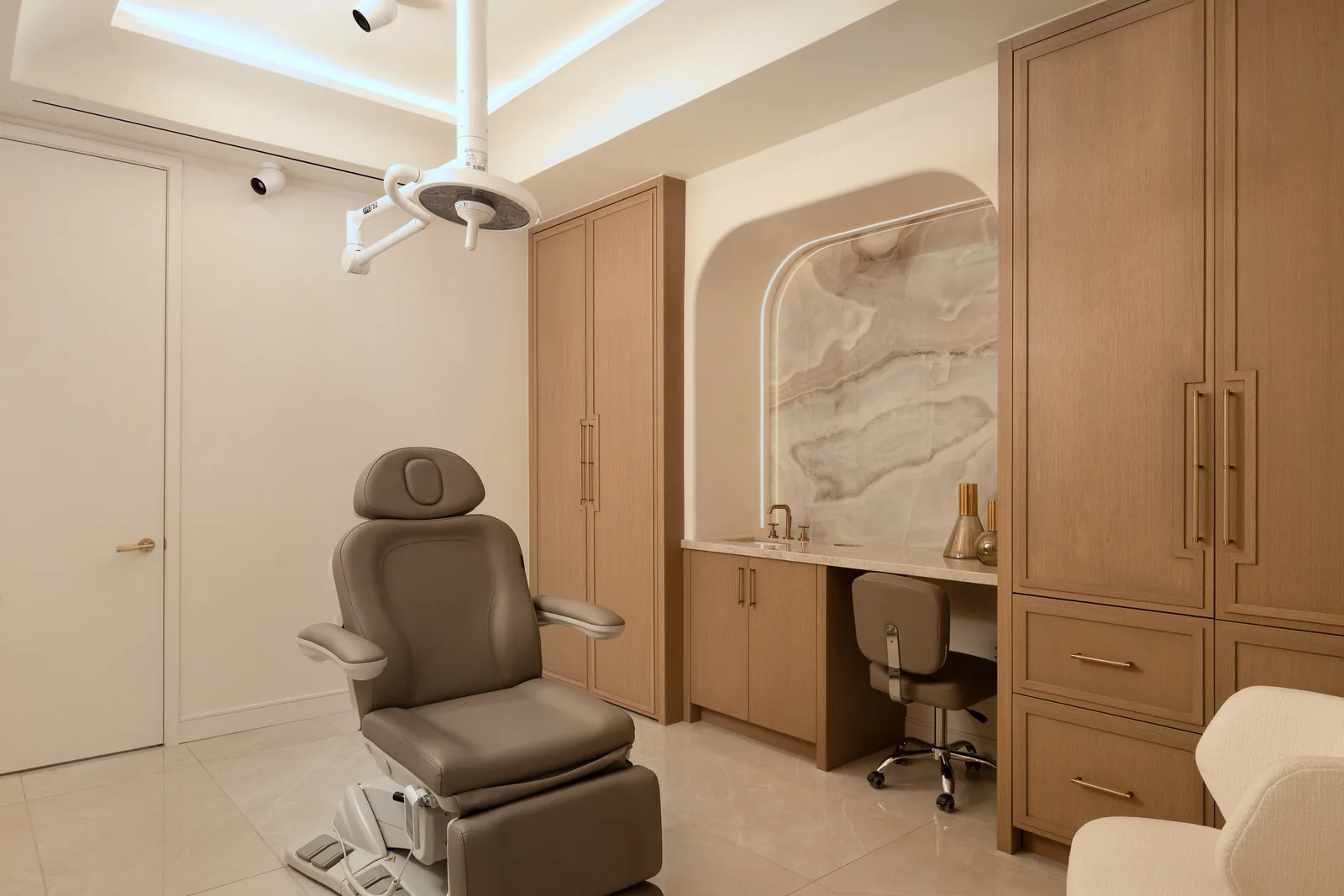
Zones marked, local anesthetic placed
The lower face is photographed and cleansed, and the treatment zones are marked. Topical numbing goes on, then local anesthetic is injected through the zones the way it is before a minor surgical procedure. Cold sore prophylaxis is started beforehand in patients with a history of them.
Micro-cores removed in a grid, no heat
The handpiece is placed on the skin and the needle array removes micro-cores in passes across each zone at the set density, up to about 8 percent of the skin in that zone. You feel pressure and a light pinching. There is pinpoint bleeding that is controlled with gentle pressure, and the zones look red and stippled when the treatment ends.
Ointment, wound care, and the next date
A healing ointment goes on, and you leave with written instructions: keep the zones clean and moist, no makeup until the pinpoint scabs have shed at about 5 to 7 days, no sun on the treated skin, no picking, and the date of the next session about 30 days out if a series is planned.
Clear Information. Informed Choices.
Safety and Limitations of Ellacor
Ellacor is safe when the patient is within the cleared skin types, the zones are chosen correctly, and the wounds are cared for. The expected effects are redness, swelling, pinpoint bleeding, and a field of tiny scabs for about 3 days, sometimes a week, with makeup at 5 to 7 days. Bruising and tenderness are common in the first days. Because each core is below the size at which skin scars, visible scarring has not been the pattern in the published studies, but any wound can scar in a keloid-prone patient, which is why keloid history is screened. Post-inflammatory hyperpigmentation is possible on darker or sun-exposed skin, and the clearance is limited to Fitzpatrick I to IV. Infection is rare with proper wound care. The limitation that matters most is candidacy: Ellacor tightens skin, and it cannot lift descended tissue, restore lost volume, or treat the neck or upper face. A plastic surgeon’s evaluation is what keeps it from being sold for problems it cannot solve.
Possible Side Effects Include
- Redness, swelling, and pinpoint bleeding on the day of treatment
- Tiny scabs across the zone for about 3 days, up to a week
- Bruising and tenderness in the first few days
- Post-inflammatory hyperpigmentation, especially with sun exposure
- Rarely, infection, prolonged redness, or scarring in keloid-prone skin
What Treatment Cannot Guarantee
- The lift of a facelift or neck lift
- Improvement of the neck, forehead, or around the eyes
- Restoration of lost volume in the cheeks or folds
- A full result from a single session
- Safe treatment of Fitzpatrick V or VI skin
What Happens After Ellacor
Recovery After Ellacor
Recovery from Ellacor is short and visible: the treated zones are red and stippled with pinpoint scabs for about 3 days, and patients in the pivotal study reported an average downtime of 3 days. There is no peeling sheet of skin as after HALO and no open resurfaced surface as after Contour TRL; the wounds are thousands of tiny points that close on their own. The result develops over months as the skin contracts, which is why photographs are compared at 3 to 6 months after the last session. Sun on healing skin is the main thing to avoid, and the Skin in Arizona guide explains why that is easier from October to April.
The zones are red, mildly swollen, and stippled, and there may be small spots of blood on the ointment for a few hours. Keep the ointment on, sleep with the head elevated, and use cool compresses for swelling. No makeup, no exercise, no sun. Mild tenderness is expected and responds to acetaminophen.
Tiny scabs form over each core on day 1 to 2 and shed on their own over the following days; do not pick them, since a picked core can leave a mark that outlasts the treatment. Gentle cleansing and ointment continue, and most patients are back to work and social plans by day 3 to 4. Makeup goes on once the scabs have shed, usually day 5 to 7. Strict sun avoidance and mineral SPF 30 or higher once the skin has closed.
By week 2 the zones look like mildly pink skin and by week 4 to 6 the first change is visible: folds slightly softer, the skin over them smoother. If a series is planned, the next session falls at about 30 days once the skin is fully closed and calm. Retinoids restart at about 2 weeks. Fillers or Botox, if part of the plan, are scheduled at least 2 weeks away from an Ellacor session.
Skin keeps contracting and collagen keeps remodeling for 3 to 6 months after the last session, which is when results are photographed. Wrinkle depth and skin laxity are improved; volume and descent are not, and if they were part of the picture, fillers or a surgical consultation follows. Many patients maintain with a single session every 1 to 2 years and with laser treatment for surface texture during laser season.
Before & After
Ellacor, Before and After Treatment
Ellacor results are best judged in photographs taken in the same light and at the same expression before the first session and 3 to 6 months after the last, when skin contraction has finished. Aesthetica by Ashley Howarth MD maintains before-and-after galleries for Ellacor, HALO, and facelift, and Dr. Howarth can show you lower-face cases that match your degree of laxity and skin type, including cases where Ellacor was chosen over surgery and cases where it was not, during your evaluation.
Patient Case Summaries
Selected Ellacor Case Summaries
These deidentified case summaries illustrate how Dr. Howarth and the physician-led team at Aesthetica by Ashley Howarth MD plan Ellacor micro-coring in Scottsdale. They include perioral and marionette wrinkles treated in a series, early jowling in a patient postponing surgery, a darker skin type directed to another treatment, a lower face that needed a facelift rather than micro-coring, Ellacor after a facelift, and summer timing. Each summary connects the patient’s concern and skin assessment with the treatment performed or the recommendation made.
Case 01
Perioral series
Marionette lines and lip wrinkles on a long-term Arizona resident treated with three Ellacor sessions
Patient presentation
A woman in her sixties, a Scottsdale resident for three decades, reported lines from the corners of her mouth toward her chin and vertical lines around her lips that filler had softened only briefly.
Skin assessment
The assessment showed moderate to severe perioral and marionette wrinkles on sun-damaged, loose Fitzpatrick II skin, with adequate volume and no significant jowling. The problem was skin excess and texture, not descent.
Procedure performed
A series of three Ellacor sessions to the perioral zone and marionette lines about 30 days apart under local anesthesia, beginning in November, followed by a single HALO pass to the full face in the same laser season for surface sun damage.
Clinical rationale
Removing a percentage of skin from a zone of loose, wrinkled skin makes that zone smaller as it heals, which filler cannot do; the pivotal study population was mid to lower face wrinkles like hers, and HALO addressed the surface color and texture Ellacor does not.
Follow-up
At six months the marionette lines were markedly softer and her lipstick no longer bled into the lip lines; she plans a single maintenance session in two years.
Case 02
Postponing surgery
Early jowls in a woman in her fifties who wanted five more years before a facelift
Patient presentation
A woman in her fifties asked whether anything short of surgery would help the softening along her jawline that she saw in photographs, since she was not ready for a facelift.
Skin assessment
Dr. Howarth found mild to moderate skin laxity along the lower cheeks and jawline on Fitzpatrick III skin with minimal fat descent, a well-defined neck, and good skin quality. The jowl moved with the skin when pinched, which meant skin reduction could help.
Procedure performed
Three Ellacor sessions to the lower cheeks and jawline zones about 30 days apart, with the zones marked to contract upward and backward, plus Botox to the platysma bands at a separate visit.
Clinical rationale
When laxity is skin rather than descended tissue, micro-coring tightens the skin over a stable structure and can buy years before surgery; a surgeon’s examination is what separates that patient from one who needs a facelift now.
Follow-up
At six months the jawline was visibly cleaner and she was satisfied; Dr. Howarth documented the baseline so that a facelift, when she chooses it, can be planned against it.
Case 03
Darker skin type
Lower-face laxity on Fitzpatrick V skin, and why Ellacor was not the answer
Patient presentation
A woman in her fifties with deep brown skin asked for Ellacor after reading about it, for crepey skin and early folds around her mouth.
Skin assessment
The assessment showed mild perioral wrinkling and mild laxity on Fitzpatrick V skin with a personal history of dark marks after minor injuries. Ellacor is cleared for Fitzpatrick I to IV, the manufacturer notes that darker skin types need a separate study, and her history raised the risk of post-inflammatory hyperpigmentation from any wound.
Recommendation
Ellacor was not offered. A series of four SkinPen microneedling sessions to the perioral zone six weeks apart with topical pigment suppression before and after, and a conservative MOXI series in winter for texture, with a plan to revisit surgical options if laxity progressed.
Clinical rationale
A device’s clearance defines who it has been studied in, and an honest practice stays inside it; microneedling and a conservative non-ablative laser treat texture in darker skin with a far lower risk of new pigment.
Follow-up
Her perioral texture improved over one winter and she continues annual maintenance; she was grateful for a clear no rather than a risky yes.
Case 04
Facelift instead
Heavy jowls and a loose neck that micro-coring would not have fixed
Patient presentation
A man in his sixties asked for Ellacor to tighten his jawline after a friend’s result, hoping to avoid surgery.
Skin assessment
Dr. Howarth’s examination found significant jowling from descended fat and platysma, a loose neck with visible bands, and moderately loose skin on Fitzpatrick II skin. The jowl did not move with the skin when pinched; it was tissue that had descended beneath it.
Recommendation
Ellacor was not recommended. A consultation on the face surgery side of the practice for a facelift and neck lift, with the option of Ellacor to the perioral skin a year after surgery if texture lagged the lift.
Clinical rationale
Micro-coring tightens skin over whatever lies beneath it, and tightening skin over a descended jowl and loose platysma would have produced a small, short-lived change for a real cost; a plastic surgeon can offer the operation that actually treats the problem.
Follow-up
He underwent a facelift and neck lift and was pleased; at his one-year visit he chose a single Ellacor session for perioral skin texture.
Case 05
After facelift
Crepey lower-cheek skin two years after a facelift, refined with Ellacor
Patient presentation
A woman in her sixties who had a facelift elsewhere two years earlier felt the lift had held but the skin of her lower cheeks and around her mouth looked crepey and older than the rest of her face.
Skin assessment
The assessment showed a well-healed facelift with good position of the deeper tissues and finely wrinkled, mildly loose skin of the lower cheeks and perioral zone on Fitzpatrick II skin, plus sun-related surface change. Skin quality, not position, was the issue.
Procedure performed
Two Ellacor sessions to the lower cheeks and perioral zone about 30 days apart in January and February, followed six weeks later by a single HALO treatment for surface texture and pigment, all within laser season.
Clinical rationale
A facelift repositions tissue but does not change skin quality, and micro-coring is the non-surgical tool that reduces skin excess where a second operation would be excessive; HALO addressed the surface change Ellacor leaves alone.
Follow-up
At six months the lower face matched the rest of her result, and she maintains with MOXI each fall and a facial monthly.
Case 06
Summer timing
A request for Ellacor in June that was scheduled for October
Patient presentation
A woman in her fifties, new to Scottsdale and an avid hiker, asked for an Ellacor series in June for lines around her mouth and along her jaw.
Skin assessment
She was a good candidate: moderate perioral wrinkles and mild laxity on Fitzpatrick III skin. But she was tanned, hiked at dawn most days, and could not reliably keep the treated zones out of the sun during the weeks the pinpoint wounds were closing, when new pigment is most likely in an Arizona summer.
Recommendation
The series was scheduled to begin in October, with a summer plan of monthly facials, a strict mineral sunscreen and hat routine, and Botox for her platysma bands in the meantime.
Clinical rationale
Ellacor is not light-based and does not strictly require laser season, but healing skin in a UV index of 11+ is a pigment risk on any skin type, and a patient who cannot avoid sun heals better when the wounds close in the cooler months.
Follow-up
She completed three sessions between October and December and was photographed in May with a smoother lower face and no pigment change.
From First Visit to a Plan You Can Keep
Booking, Planning, and Follow-Up at Aesthetica by Ashley Howarth MD
Aesthetica by Ashley Howarth MD is a medical practice with a spa’s convenience. Established patients book online. New patients can book online or request a consultation, and the team responds usually the same day.

Online booking or a consultation request
Book an evaluation directly online, or request a consultation and describe what bothers you about the lower face, what has been tried, and whether surgery is on or off the table. Either path starts with the same examination by Dr. Howarth.
Skin, volume, or surgery, decided before the first session
You leave your evaluation with a written plan: whether the answer is Ellacor, fillers, laser, or a surgical consultation; how many sessions and which zones; which months they fall in; what is combined and when; and the wound-care and sun plan that protects the result.
Photographs at 3 to 6 months, maintenance every 1 to 2 years
Results are photographed 3 to 6 months after the last session, and most plans continue with laser treatment for surface texture each laser season and a single Ellacor maintenance session every 1 to 2 years. A-List members have the next season scheduled before they leave the last one.
Your Questions, Answered
Ellacor Frequently Asked Questions
Ellacor is a device from Cytrellis that uses hollow needles to remove thousands of micro-cores of full-thickness skin from the mid to lower face, each too small to scar, so the skin heals smaller and tighter. It is FDA-cleared for moderate and severe wrinkles in the mid and lower face in adults 22 and older with Fitzpatrick I to IV skin, removes up to about 8 percent of skin per session, and uses no heat.
The mid and lower face: cheeks, nasolabial folds, marionette lines, wrinkles around the mouth, lower cheeks and early jowls, and the chin. It is not intended for the upper face or the neck. At Aesthetica by Ashley Howarth MD the zones are chosen by Dr. Howarth after an examination that separates loose skin, which Ellacor treats, from descended tissue and lost volume, which it does not.
Microneedling punctures skin and removes nothing; lasers and radiofrequency heat or vaporize tissue; Ellacor physically removes columns of skin without heat. That makes it the only non-surgical treatment that reduces the amount of skin, which is why it does more for laxity than SkinPen, and why it has no thermal risk. HALO and Contour TRL still do more for surface color and texture, and the treatments are often combined across a season.
The treated zones look smoother once the pinpoint scabs shed at about a week, and the first real change in wrinkle depth and tightness appears at 4 to 6 weeks. Skin continues to contract and collagen continues to remodel for 3 to 6 months after the last session, which is when Aesthetica by Ashley Howarth MD photographs results. In the pivotal study endpoints were measured out to 150 to 180 days.
In the pivotal clinical trial most patients had a series of three treatments about 30 days apart, and that is the starting point for moderate to severe wrinkles. Mild laxity or a touch-up after surgery may need one or two. Dr. Howarth sets the number and the interval at the evaluation based on skin quality and the degree of correction wanted, and a single maintenance session every 1 to 2 years is typical afterward.
Yes, across a season rather than in a day. Botox for expression lines and platysma bands and dermal fillers for volume are scheduled about two weeks apart from an Ellacor session. HALO, BBL HERO, or MOXI for sun damage and surface texture are done in the same laser season at a separate visit. For a patient whose lower face has descended, the combination that works is a facelift first and Ellacor for skin texture later.
Ellacor is performed under local anesthesia, injected the way it is before a minor surgical procedure, usually after topical numbing. Patients in the manufacturer’s clinical trial rated pain during the procedure at less than 2 on a 10-point scale, and most describe pressure and light pinching. Afterward the zones are tender and swollen for a few days, which acetaminophen and cool compresses manage.
About 3 days of visible healing: redness, mild swelling, and a field of pinpoint scabs over each treated zone, with pinpoint bleeding on the first day. Patients in the pivotal study reported an average downtime of 3 days, and the scabs shed by about day 5 to 7, when makeup can go on. Most people return to work by day 3 to 4. Sun on the treated skin is avoided until it has fully closed.
Ellacor is FDA-cleared for Fitzpatrick I to IV, and the manufacturer states that types V and VI need a separate study, so Aesthetica by Ashley Howarth MD does not treat them with Ellacor and directs those patients to SkinPen and MOXI. Because Ellacor is not light-based it does not strictly depend on laser season, but healing skin under a summer UV index of 11+ is a pigment risk, so most Scottsdale series run from October to April.
Ellacor treats loose, wrinkled skin of the mid to lower face; a facelift repositions descended fat and muscle and removes real skin excess in the face and neck. If the change is skin quality and early laxity, Ellacor can improve it and postpone surgery. If it is jowls that do not move with the skin, a loose neck, or deep folds from descent, a facelift is the honest answer. Dr. Howarth, who performs both, decides at the evaluation.
Concerns Treated
Concerns This Treatment Addresses
These guides explain each concern and where this treatment fits among the options at Aesthetica by Ashley Howarth MD in Scottsdale.
- Fine Lines & Wrinkles Moderate to severe wrinkles of the mid to lower face, the cleared indication
- Skin Laxity Early jowls and loose lower-cheek skin, and when surgery is the answer
- Skin Texture, Pores & Dullness Crepey perioral and cheek skin, often paired with HALO
- Sun Damage & Brown Spots What Ellacor leaves to BBL HERO and MOXI in the same season
- Facelift & Neck Lift The surgical answer when the lower face has descended
- Sciton Laser Comparison Which laser fits which concern
BEGIN HERE
Request a Consultation
Tell us what you are considering. A member of our patient care team will follow up with consultation availability and next steps.

Megan S.
Patient Coordinator
Prefer to talk or text?
Selected References