
Not All Thinning Is the Same
What Causes Hair Thinning, and What Treats It
Hair thinning has three common causes (genetic pattern hair loss, telogen effluvium shedding that follows a trigger like illness or stress, and postpartum shedding), and each is treated differently. At Aesthetica by Ashley Howarth MD, the treatment offered is PRF hair restoration, platelet-rich fibrin from your own blood injected into the thinning scalp in a series of 3 to 4 sessions spaced 4 to 6 weeks apart, which works on follicles that are still alive but does not create follicles in bald scalp.
Hair thinning has three common causes, and they are treated differently. Androgenetic alopecia, or pattern hair loss, is the most common: in men it recedes at the temples and thins at the crown, in women it widens the part while the hairline stays, and in both it is driven by genetics and hormone sensitivity in the follicle. Telogen effluvium is diffuse shedding that begins two to three months after a trigger such as illness, surgery, rapid weight loss, a new medication, or severe stress, and usually resolves within about six months once the trigger is corrected. Postpartum shedding is telogen effluvium after childbirth; it starts two to four months after delivery and resolves on its own by 6 to 12 months. At Aesthetica by Ashley Howarth MD, the med spa of Howarth Plastic Surgery in Scottsdale, the treatment offered for thinning hair is PRF hair restoration, platelet-rich fibrin prepared from your own blood and injected into the thinning scalp, typically as a series of 3 to 4 sessions spaced 4 to 6 weeks apart followed by maintenance.
PRF works on follicles that are still alive and producing thin hair. It does not create follicles in bald, shiny scalp, and it does not fix thinning caused by an untreated thyroid problem, iron deficiency, or scalp disease. This page explains who is a candidate, who should see a physician first, how PRF is combined with prescription therapy such as minoxidil and finasteride, and what Arizona sun does to a thinning scalp.

A Wider Part, a Fuller Drain
What Patients With Thinning Hair Notice
Thinning is usually noticed before it is measured. Patients who come to Aesthetica by Ashley Howarth MD in Scottsdale describe some combination of the changes below, and the pattern helps the team tell pattern hair loss from shedding before any treatment is discussed.
- A part line that has widened, especially in photographs from above
- Scalp visible at the crown under bright light or after swimming
- Temples receding or a hairline that has crept back
- A ponytail noticeably thinner than it was two years ago
- Handfuls of hair in the shower drain starting a few months after a baby, illness, or surgery
- A scalp that sunburns where it never did before
The last item is the Arizona tell. A thinning crown in Scottsdale sunburns by May, and repeated scalp burns raise skin cancer risk in a state that already has one of the highest rates in the country. A hat is part of the treatment plan.


Surgeon-Directed Care
More Tools in the Toolbox: Why a Plastic Surgeon Directs This Care
Aesthetica by Ashley Howarth MD is the medical aesthetics practice of Ashley Howarth, MD, FACS, a board-certified plastic surgeon and instructor in plastic surgery at Mayo Clinic. Hair thinning is a symptom before it is a cosmetic concern, and the list of medical causes is long: thyroid disease, iron deficiency, hormonal change, medications, autoimmune disease, and scalp conditions that scar. A physician-led practice asks about those before offering an injection. Dr. Howarth sets the candidacy criteria, decides when a patient goes for labs or to a dermatologist first, and reviews cases that do not fit the ordinary pattern. In a state with one of the highest skin cancer rates in the country, she is also the one who looks at the sun-exposed scalp itself.
Aesthetica by Ashley Howarth MD is the med spa of a plastic surgery practice, and that changes what can be offered. Most skin concerns are treated without surgery, and most patients never need it. When skin care and nonsurgical treatment reach their limit, the conversation does not end at the door: the same physician evaluates the next step, from deep laser skin resurfacing performed by Dr. Howarth to eyelid surgery, facelift, and neck lift. A surgeon directing the plan means more tools in the toolbox, and an honest answer about which one you need.

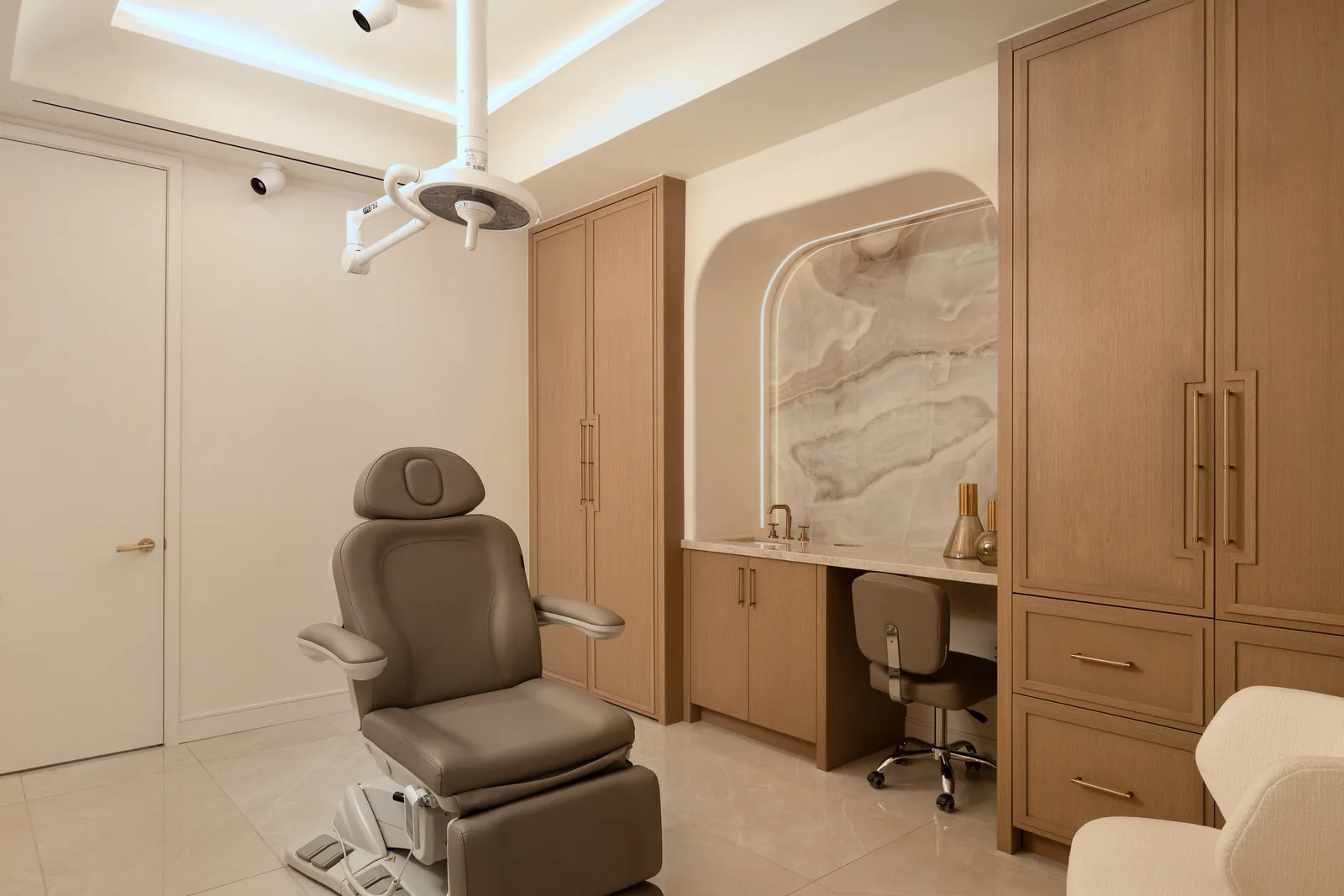
SCOTTSDALE · MODERN OFFICE SETTING
Where to Start
Who This Is For, and What Happens at the Hair Assessment
This care is for men and women with thinning hair who want to know what is causing it and whether PRF hair restoration is appropriate. The assessment at Aesthetica by Ashley Howarth MD begins with the pattern (temples and crown, a widening part, or diffuse shedding), the timeline, and what happened two to four months before the shedding started. The team examines the scalp for follicles that are miniaturized but present, for shiny bald areas with no follicles, and for redness, scale, or scarring that point to a scalp disease. Your medications, recent illnesses, pregnancy and thyroid history, and diet are reviewed. Patients with an active thinning scalp and no red flags are candidates. Patients with fatigue, irregular periods, sudden diffuse loss, or scalp inflammation are sent for a physician lab workup or a dermatology evaluation first, because PRF on top of an untreated cause does not work.
Dr. Ashley Howarth, MD, FACS is a board-certified plastic surgeon and an instructor in plastic surgery at Mayo Clinic. Aesthetica by Ashley Howarth MD is the medical aesthetics brand of her practice, Howarth Plastic Surgery, at 7373 N. Scottsdale Road, Suite C150, Scottsdale, Arizona 85253.

Your Own Platelets, No Additives
PRF Hair Restoration in Scottsdale, and What Surrounds It
PRF Hair Restoration
PRF is prepared from a small draw of your own blood and releases growth factors into the scalp over days, supporting miniaturized follicles across a typical course of 3 to 4 sessions spaced 4 to 6 weeks apart.
PRF, platelet-rich fibrin, is prepared from a small draw of your own blood spun at low speed with no anticoagulant or additives. The result is a fibrin matrix that holds platelets and white cells and releases growth factors into the scalp over days rather than minutes. Injected across thinning areas, it supports miniaturized follicles and extends the growth phase. A typical course is 3 to 4 sessions spaced 4 to 6 weeks apart, each about 60 minutes.
PRF Plus Prescription Therapy
For pattern hair loss, PRF works best alongside minoxidil and, for men, finasteride, with the practice coordinating the PRF schedule around prescriptions managed by a physician or dermatologist.
For pattern hair loss, PRF works best alongside the medications that address the cause: topical or oral minoxidil to prolong the growth phase, and for men, finasteride to reduce the hormone that shrinks follicles. These prescriptions are managed by your physician or a dermatologist, and Aesthetica by Ashley Howarth MD coordinates the PRF schedule with them. PRF is the only injectable hair treatment offered here; the practice does not prescribe hair medications at the spa.
Who Is Not a Candidate, and What Comes First
PRF is not offered for scarring alopecia, bald scalp with no visible follicles, pregnancy, or active scalp disease, and sudden or unexplained thinning is sent for a lab workup first.
PRF is not offered for scarring alopecia, for bald scalp with no visible follicles, during pregnancy, or on a scalp with active disease. Thinning with fatigue, irregular periods, or sudden onset is sent for a lab workup (thyroid, ferritin, and as indicated vitamin D and blood count) with a physician first. Postpartum shedding is observed, not treated, until it has stabilized, usually 6 to 12 months after delivery.
Protecting a Thinning Scalp in Arizona
A thinning scalp gets more UV exposure through hair that no longer shades it, so the plan includes a wide-brim hat, mineral SPF 30 or higher, and a rest period after each PRF session before sun exposure resumes.
A thinning scalp in Scottsdale receives a summer UV index of 11 or higher through hair that no longer shades it. Sunburn damages the scalp skin, and repeated burns raise skin cancer risk. The plan includes a wide-brim hat outdoors, a mineral SPF 30 or higher on exposed scalp, and, after each PRF session, 24 to 48 hours without hats, sweating, pools, or hot tubs, then a hat again. Heat itself does not cause hair loss; scalp sunburn does cause damage.
Planning at a Glance
Sessions, Downtime, and Season
Sessions, downtime, and timing for hair restoration in Scottsdale. Individual plans are set at the hair assessment.
| Treatment | Sessions | Downtime | Scottsdale season |
|---|---|---|---|
| PRF hair restoration | 3 to 4, 4 to 6 weeks apart | 1 to 2 days of scalp tenderness; no hats, sweat, or pools for 24 to 48 hours | Year-round; shade for the first 48 hours |
| PRF plus prescription therapy plan | PRF series alongside physician-managed minoxidil or finasteride | Same as PRF | Year-round |
| PRF maintenance session | 1 every 3 to 6 months | 1 to 2 days of scalp tenderness | Year-round |
A Visit Built Around the Cause
What to Expect at a PRF Hair Visit at Aesthetica by Ashley Howarth MD
A PRF hair restoration visit at Aesthetica by Ashley Howarth MD takes about an hour. The first visit adds the assessment above; return visits in a series move directly to the blood draw. Nothing is injected until the cause of thinning has been identified as one PRF can help.
Pattern, timeline, and red flags
The team maps the thinning, examines the scalp for live follicles and for signs of scalp disease, reviews medications, illnesses, pregnancy, and thyroid and iron history, and photographs the part and crown under consistent light. Red flags are referred for labs or dermatology before treatment.
Draw, spin, inject
A small blood draw is spun for several minutes into PRF. Topical numbing is applied to the scalp, and the PRF is injected in a grid across the thinning areas. Most patients describe pressure and brief stinging. There are no additives; the injected material is your own blood components.
Aftercare and a hat plan
You leave with instructions: no washing for 12 to 24 hours, no hats, helmets, heavy sweating, pools, or hot tubs for 24 to 48 hours, then a wide-brim hat and scalp SPF outdoors. The next session is scheduled 4 to 6 weeks out, and any prescription therapy is coordinated with your physician.
Clear Information. Informed Choices.
Safety and Limitations of PRF Hair Restoration
Because PRF is made from your own blood with no additives, allergic reaction and rejection are not concerns, and side effects are mostly limited to the injection itself. The larger limitation is biological: PRF supports follicles that exist and does not create new ones, so it thickens thinning hair and does not restore bald scalp. It also cannot overcome an untreated medical cause. A patient with low ferritin or an underactive thyroid who receives PRF without correcting those will be disappointed, which is why the assessment sends those patients to a physician first.
Possible Side Effects Include
- Scalp tenderness and tightness for one to two days
- Pinpoint bleeding and small bruises at injection sites
- Mild swelling of the forehead or scalp for a day or two
- A brief increase in shedding in the first month as follicles cycle
- Rarely, infection or prolonged discomfort at injection sites
What Treatment Cannot Guarantee
- New hair in bald, shiny scalp with no follicles
- Improvement in scarring alopecia
- Correction of thinning caused by untreated thyroid or iron deficiency
- A result from a single session
- Permanent density without maintenance and, for pattern loss, prescription therapy
Hair Grows Slowly
The Timeline After PRF Hair Restoration
Hair grows about half an inch a month, and a follicle that has been supported must complete a cycle before the change is visible. That sets the timeline below. The most common reason patients judge PRF a failure is looking at six weeks; the fair review is at six months, in photographs of the same part line under the same light.
The scalp feels tight and tender for the rest of the day; small bumps at injection sites flatten within hours. No washing for 12 to 24 hours. No hats, helmets, heavy exercise, pools, or hot tubs for 24 to 48 hours. Stay out of direct Arizona sun or use shade; the scalp is not protected by a hat during this window.
Some patients notice a brief increase in shedding two to four weeks after the first session as resting follicles are pushed into a new growth cycle. This is expected and temporary. The second PRF session falls at week 4 to 6. Prescription therapy, if prescribed by your physician, continues throughout.
Fine new hairs appear along the part or at the crown and shedding in the drain decreases. The third and, if planned, fourth sessions complete the initial series. Photographs at this point are compared with the baseline; density is not yet at its peak.
Visible density and thicker individual hairs are judged at 6 to 9 months. Maintenance is a single session every 3 to 6 months, timed to how the hair holds. For pattern hair loss the underlying process continues, so maintenance and physician-managed medication are what keep the result. Hats and scalp SPF continue year-round.
Before & After
Hair Thinning, Before and After PRF
Hair results are judged in photographs of the part line and crown taken from the same angle under the same light at baseline, 3 months, and 6 to 9 months. Aesthetica by Ashley Howarth MD photographs every PRF hair restoration patient this way and maintains before-and-after galleries for PRF and other injectable treatments, and the team can show you cases that match your pattern during your visit.
Patient Case Summaries
Selected Hair Thinning Case Summaries
These deidentified case summaries illustrate how the physician-led team at Aesthetica by Ashley Howarth MD evaluates thinning hair and decides when PRF hair restoration is the right treatment. They include male and female pattern hair loss, a combination plan with prescription therapy, a maintenance patient, a postpartum patient who was advised to wait, and a patient sent for a lab workup before any treatment. Each summary connects the patient’s concern and assessment with the treatment performed or the recommendation made.
Case 01
Female pattern
A widening part in a long-term Scottsdale resident, treated with a PRF series
Patient presentation
A woman in her forties who had lived in Scottsdale for 20 years noticed her part had widened over three years and that her scalp sunburned at the part line every summer. Her mother had the same pattern.
Skin assessment
The assessment showed diffuse thinning over the crown with a preserved frontal hairline, miniaturized but present follicles, no scalp inflammation, and no recent illness, medication change, or menstrual irregularity. Her thyroid and iron had been checked by her physician within the year and were normal.
Procedure performed
A series of four PRF hair restoration sessions spaced five weeks apart, a wide-brim hat and mineral SPF 30 on the part line outdoors, and a referral to her physician to discuss topical minoxidil.
Clinical rationale
Her pattern, family history, and normal labs pointed to female pattern hair loss with live follicles, which is the case PRF is designed for. Scalp sun protection addressed both the burns and the long-term skin cancer risk.
Follow-up
At six months the part line was visibly narrower in standardized photographs and the shedding had decreased. She maintains with a session every four months and continues minoxidil under her physician.
Case 02
Male pattern
Crown thinning in a man in his thirties, PRF combined with finasteride from his physician
Patient presentation
A man in his thirties who cycled outdoors most mornings reported a thinning crown and receding temples over five years and asked whether PRF alone would be enough.
Skin assessment
The assessment showed classic male pattern hair loss with miniaturized follicles at the crown and temples and no scalp disease. He had never used minoxidil or finasteride. The crown was sun-damaged from helmet vents and no scalp protection.
Procedure performed
A series of three PRF sessions six weeks apart, coordinated with oral finasteride and topical minoxidil prescribed and monitored by his primary care physician, plus a cycling cap under the helmet and scalp SPF.
Clinical rationale
In male pattern hair loss the follicle is shrinking under hormonal influence, and PRF supports the follicle while finasteride reduces the signal that shrinks it. The combination is more durable than either alone.
Follow-up
At nine months the crown was denser and the temples had stabilized. He continues finasteride and minoxidil with his physician and a PRF maintenance session every six months.
Case 03
Postpartum shedding
Heavy shedding four months after delivery, and the recommendation to wait
Patient presentation
A woman in her thirties, four months after the birth of her second child, described handfuls of hair in the shower and a thinning hairline at the temples, and asked to start PRF immediately.
Skin assessment
The timing and pattern were classic postpartum telogen effluvium: diffuse shedding beginning two to four months after delivery, with thinning most visible at the frontal hairline. Follicles were present and healthy, and there was no scalp disease. She was breastfeeding.
Recommendation
No treatment. The team explained that postpartum shedding resolves on its own by 6 to 12 months after delivery, recommended a gentle routine and scalp sun protection, and scheduled a reassessment at nine months postpartum.
Clinical rationale
PRF on hair that is about to regrow by itself cannot be credited or measured, and injecting a breastfeeding patient for a self-limited condition is not appropriate. Waiting was the honest recommendation.
Follow-up
At the nine-month reassessment the shedding had stopped and short regrowth was visible at the temples. No PRF was needed, and she was told to return if thinning persisted past a year.
Case 04
Labs first
Sudden diffuse thinning with fatigue was sent for a workup before any injection
Patient presentation
A woman in her fifties, recently relocated from Chicago, reported that her hair had thinned all over in four months, with fatigue, cold intolerance, and heavier periods over the same time.
Skin assessment
The pattern was diffuse rather than patterned, the onset was rapid, and the accompanying symptoms suggested a thyroid problem or iron deficiency rather than pattern hair loss. The physician-led team does not inject PRF into thinning with an unidentified medical cause.
Recommendation
Referral to her primary care physician for a lab workup including a thyroid panel, ferritin, and blood count before any PRF. Scalp sun protection was advised in the meantime, since her new Arizona sun exposure was already burning the thinner scalp.
Clinical rationale
Telogen effluvium from thyroid disease or low iron resolves when the cause is treated and does not respond to PRF while the cause is untreated. Testing first saved her a series that would not have worked.
Follow-up
Her physician diagnosed an underactive thyroid and low ferritin and began treatment. Six months later the shedding had slowed, and she returned for a PRF series to support regrowth over the residual thinning.
Case 05
Not a candidate
A bald crown with no follicles, and an honest answer about what PRF cannot do
Patient presentation
A man in his sixties asked for PRF to regrow hair on a crown that had been bald for over 15 years, after reading that PRF restores hair.
Skin assessment
Examination showed smooth, shiny scalp at the crown with no visible follicle openings, and a fringe of normal hair around it. Follicles that have been absent for that long cannot be reactivated by growth factors. There was also a rough, scaly patch on the sun-exposed crown.
Recommendation
PRF was not offered for the bald crown. The scaly patch was referred to a dermatologist for evaluation as a possible precancerous lesion, and a daily hat and scalp SPF were recommended. PRF to the thinning border zone was discussed as an option after dermatology clearance.
Clinical rationale
PRF supports live follicles and cannot create them. Offering it for a long-bald crown would have been a sale, not a treatment. The scalp lesion was the more important finding of the visit.
Follow-up
The dermatologist treated the lesion as actinic keratosis. The patient now wears a hat daily and chose to treat the thinning border with a PRF series the following season.
Case 06
Maintenance
Holding a PRF result through a second Arizona summer
Patient presentation
A woman in her fifties who had completed a four-session PRF series a year earlier returned because her part looked slightly wider again after a summer of daily swimming.
Skin assessment
Photographs compared with her six-month result showed a small loss of density, still well above her baseline. Follicles were healthy and there was no new scalp disease or medical change. Her physician had continued her topical minoxidil.
Procedure performed
A single PRF maintenance session, a swim cap and post-swim scalp rinse, a hat for pool deck time, and a maintenance schedule of one session every four months rather than the six she had stretched to.
Clinical rationale
Pattern hair loss is ongoing, and the result of a PRF series is maintained, not permanent. Shortening the maintenance interval for a patient who is losing ground is the usual adjustment.
Follow-up
At the next four-month visit the density had returned to her six-month level and she continues on the shorter interval.
From First Visit to a Plan You Can Keep
Booking, Planning, and Follow-Up at Aesthetica by Ashley Howarth MD
Aesthetica by Ashley Howarth MD is a medical practice with a spa’s convenience. Established medspa patients book online. New patients can book online or request a consultation, and the team responds usually the same day.

Online booking or a consultation request
Book a hair assessment directly online, or request a consultation and tell us when the thinning started and what you have noticed. Bring a list of medications and any recent lab results.
A series, a schedule, and a physician partner
You leave your first visit with a written plan: whether PRF is appropriate, how many sessions and at what interval, which labs or referrals come first if any, and how prescription therapy will be coordinated with your physician or dermatologist.
Photographs at 3 and 6 months, then maintenance
Results are reviewed in standardized photographs at 3 and 6 to 9 months, and maintenance is scheduled every 3 to 6 months. A-List members have the next session scheduled before they leave the last one.
Your Questions, Answered
Hair Thinning Frequently Asked Questions
PRF, platelet-rich fibrin, is prepared from a small draw of your own blood spun at low speed without anticoagulant or additives. It forms a fibrin matrix that releases platelet growth factors into the scalp over several days. Injected across thinning areas, it supports miniaturized follicles and extends their growth phase. Aesthetica by Ashley Howarth MD in Scottsdale offers it as a series of 3 to 4 sessions, 4 to 6 weeks apart.
Both come from your own blood. PRP, platelet-rich plasma, is spun at higher speed with an anticoagulant and releases growth factors quickly. PRF is spun at lower speed with no additives, forms a fibrin scaffold, and releases growth factors more slowly over days. Aesthetica by Ashley Howarth MD uses PRF for hair restoration because nothing is added to the blood.
Men and women with thinning hair and live follicles: early to moderate pattern hair loss, or persistent thinning after a telogen effluvium has resolved. Candidates have no active scalp disease, no scarring alopecia, and normal thyroid and iron levels. Patients with bald, shiny scalp are not candidates, because PRF supports existing follicles and does not create new ones.
Anyone with scarring alopecia, bald scalp with no follicles, an active scalp infection or inflammatory condition, untreated thyroid disease or iron deficiency, a platelet or bleeding disorder, or who is pregnant. Patients on blood thinners need physician review. Thinning with fatigue, irregular periods, or sudden onset should have a physician lab workup before any injection.
A typical course at Aesthetica by Ashley Howarth MD is 3 to 4 sessions spaced 4 to 6 weeks apart, then a maintenance session every 3 to 6 months. Early regrowth appears at 3 to 4 months and visible density is judged at 6 to 9 months in standardized photographs. Hair grows about half an inch a month, so patience is part of the protocol.
Yes, and for pattern hair loss the combination is usually recommended. Minoxidil prolongs the growth phase and finasteride, for men, reduces the hormone that shrinks follicles; PRF supports the follicle directly. The prescriptions are managed by your physician or a dermatologist, and Aesthetica by Ashley Howarth MD coordinates the PRF schedule with that plan.
Usually it does not need treatment. Postpartum shedding is a form of telogen effluvium that begins two to four months after delivery and resolves on its own by 6 to 12 months. Aesthetica by Ashley Howarth MD recommends waiting, protecting the scalp from sun, and reassessing at about nine months. PRF is considered only if thinning persists past a year.
Sun does not cause pattern hair loss, but a thinning scalp in Arizona is exposed to a summer UV index of 11 or higher with less hair to shade it. Repeated scalp sunburns damage the skin and raise skin cancer risk in a state with one of the highest rates in the country. A wide-brim hat and mineral SPF 30 on exposed scalp are part of every hair plan here.
No washing for 12 to 24 hours, and no hats, helmets, heavy sweating, pools, or hot tubs for 24 to 48 hours so the injection sites close cleanly. Stay in shade during that window, since the scalp is unprotected. After 48 hours, return to a hat and scalp SPF outdoors. Scalp tenderness and small bumps resolve within a day or two.
Yes, if thinning is sudden or diffuse, comes with fatigue, cold intolerance, or irregular periods, or if the scalp is red, scaly, or scarred. Those signs point to thyroid disease, iron deficiency, or a scalp condition that PRF cannot fix. The physician-led team at Aesthetica by Ashley Howarth MD sends those patients for a lab workup or dermatology evaluation first.
Related Care
Treatments for Arizona Skin
These pages explain the treatments named in this guide. Concern-specific guides for sun damage, redness, melasma, dryness, and texture are being added to this section.
- PRF Hair Restoration Your own platelet-rich fibrin for thinning scalp
- PRF EZ Gel PRF for facial volume and skin quality
- Dermal Fillers Volume restoration for the face
- Facial Plastic Surgery Surgical options evaluated by Dr. Howarth
- Medspa at Aesthetica by Ashley Howarth MD All injectable, laser, and skin treatments
- Skin in Arizona Why timing matters in the desert
BEGIN HERE
Request a Consultation
Tell us what you are considering. A member of our patient care team will follow up with consultation availability and next steps.

Megan S.
Patient Coordinator
Prefer to talk or text?
Selected References