
The Long-Duration Neuromodulator
What Daxxify Is
Daxxify is the brand name of daxibotulinumtoxinA-lanm, a botulinum toxin type A stabilized with a peptide instead of the human serum albumin used in Botox and Dysport, FDA-approved in September 2022 for glabellar frown lines. In the phase 3 SAKURA trials a single 40-unit treatment kept glabellar lines at none or mild for a median of about 24 weeks, roughly six months against the 3 to 4 months typical of Botox and Dysport, which is why Aesthetica by Ashley Howarth MD offers it to patients who want two visits a year rather than four.
Daxxify is the brand name of daxibotulinumtoxinA-lanm, a botulinum toxin type A neuromodulator made by Revance Therapeutics and FDA-approved in September 2022 for moderate to severe glabellar frown lines, with a second approval for cervical dystonia in 2023. It relaxes the corrugator and procerus muscles the same way every botulinum toxin does, by blocking acetylcholine release at the nerve ending, but its formulation is different: the toxin is stabilized by a 35 amino acid peptide called RTP004 instead of the human serum albumin used in Botox and Dysport, and the label’s excipient list is histidine, polysorbate 20, trehalose, and the peptide. The clinical claim that follows from the formulation is duration. In the two identical phase 3 SAKURA trials, a single 40-unit treatment kept glabellar lines at none or mild for a median of 24.0 and 23.9 weeks, and lines did not return to baseline for a median of 27.7 and 26.0 weeks, roughly six months against the 3 to 4 months typical of Botox and Dysport. Revance states onset as early as the next day and typically within 2 days, with the peak response at weeks 2 to 4.
At Aesthetica by Ashley Howarth MD, the med spa of Howarth Plastic Surgery in Scottsdale, Daxxify is the neuromodulator for a patient who wants two visits a year rather than four, and the practice is candid about what that trade involves. The label dose is fixed at 40 units across five glabellar points, given no more often than every three months. Daxxify is FDA-approved only for the glabella; forehead lines and crow’s feet are off-label uses supported so far by a 48-patient open-label phase 2 study, and the practice treats them with consent or leaves them on Botox or Dysport in the same visit. Duration varies by patient, and a median of 24 weeks means half of patients fade sooner. And Daxxify is the newest of the three, with a safety record measured in years rather than the two decades behind Botox. Expression lines are the only target; volume loss belongs to dermal fillers, etched lines to physician-performed laser skin resurfacing, and loose skin to facial surgery, as the injectables overview explains.

Why Patients Ask for Daxxify
What Patients Who Choose Daxxify Notice
Patients who ask Aesthetica by Ashley Howarth MD about Daxxify have usually done the arithmetic. Four neuromodulator visits a year is a schedule, and a schedule is easy to miss: the quarter that got away, the travel month, the frown that came back three weeks before the next opening. What they notice is not so much a line as the gap between the line fading and the line returning. These are the findings the team hears most.
- Frown lines that return a month before the next appointment can be booked
- A travel or work calendar that makes four visits a year unrealistic
- A wish to be treated less often rather than with more product
- Deep vertical lines between the brows that respond well but briefly
- Curiosity about a product without human serum albumin
- A long history with one product and interest in whether another lasts longer
Interval is the problem Daxxify solves best, and it solves it for the glabella with the strongest evidence. Where the concern is the forehead, crow’s feet, or the lower face, or where a patient prefers the longest safety record, the assessment may keep those areas on Botox or Dysport, and the practice says so.


Surgeon-Directed Care
More Tools in the Toolbox: Why a Plastic Surgeon Directs Daxxify
Aesthetica by Ashley Howarth MD is the medical aesthetics practice of Ashley Howarth, MD, FACS, a board-certified plastic surgeon and instructor in plastic surgery at Mayo Clinic. The judgment a plastic surgeon adds to Daxxify is proportional to its duration. A product that lasts six months makes every placement decision last six months: a point set too low over the orbital rim, a brow depressor treated in a patient whose frontalis was already tired, or an asymmetry missed at two weeks is not a three-month inconvenience. A surgeon who performs brow lifts and blepharoplasty has handled the corrugator, the procerus, and the levator directly, reads brow position and lid heaviness before the first injection, and places the five glabellar points accordingly. She also reads the evidence. Daxxify’s claim rests on two well-run phase 3 trials and a large open-label study, all sponsored by its maker, and a physician-led practice presents that as what it is: strong data for the glabella, thinner data elsewhere, and fewer years of follow-up than the alternatives. At Aesthetica by Ashley Howarth MD, Daxxify is injected by Dr. Howarth or by an advanced aesthetic nurse injector under her direction and protocols, with every dose and point recorded and a two-week check built into the plan.
The second judgment is which tool. The practice offers Botox and Dysport alongside Daxxify and often uses two products in one visit, Daxxify for the glabella and another for the areas where it has the record. And because Aesthetica by Ashley Howarth MD is the med spa of a plastic surgery practice, the plan is not limited to neuromodulators at all. Etched lines at rest go to physician-performed laser skin resurfacing; hollowing goes to filler or fat transfer; a heavy brow, hooded lids, jowls, or a loose neck go to a brow lift, blepharoplasty, facelift, or neck lift, evaluated by the same physician. More tools in the toolbox, and an honest answer about which one you need.

SCOTTSDALE · MODERN OFFICE SETTING
Where to Start
Who Daxxify Is For, and What Happens First
Daxxify at Aesthetica by Ashley Howarth MD is for adults with moderate to severe glabellar frown lines who want a longer interval between treatments and are comfortable choosing a newer product on the strength of its phase 3 data. It suits established neuromodulator patients who know they respond and want fewer visits, patients whose schedules defeat a three-month cycle, and patients who have asked specifically for an albumin-free formulation. It is a reasonable first neuromodulator for a patient who wants only the glabella treated. The assessment comes first. The injector watches you frown, raise your brows, squint, and smile, photographs each expression, notes brow position, eyelid heaviness, and asymmetry, and reviews your history: neuromuscular disease, pregnancy, breastfeeding, prior products, units, and how long each lasted. A patient who needs the fastest onset for an event is offered Dysport; a patient who wants the masseter, platysma bands, or a lip flip treated hears that Botox has the record and, for the neck, the approval. Lines etched at rest in sun-damaged Arizona skin are directed to resurfacing, and a heavy brow with hooded lids to a brow lift or blepharoplasty.
Dr. Ashley Howarth, MD, FACS is a board-certified plastic surgeon and an instructor in plastic surgery at Mayo Clinic. Aesthetica by Ashley Howarth MD is the medical aesthetics brand of her practice, Howarth Plastic Surgery, at 7373 N. Scottsdale Road, Suite C150, Scottsdale, Arizona 85253.

One Dose, Five Points, Six Months
How Daxxify Is Used in Scottsdale
The Glabella, the On-Label Use
Daxxify’s fixed glabellar dose of 40 units achieved none or mild lines in about 74 percent of patients at week 4 in the SAKURA trials, versus roughly 1 percent on placebo, and held for a median of about 24 weeks.
Daxxify’s approved use is the glabella at a fixed dose: 40 units as 8 units at each of five points, two in each corrugator and one in the procerus, no more often than every three months. That dose is what the SAKURA 1 and SAKURA 2 trials tested in 405 treated patients: at week 4, 73.6 and 74.0 percent achieved none or mild lines with at least a two-point improvement by both investigator and patient rating, against 0 and 1 percent on placebo, and the result held at none or mild for a median of 24.0 and 23.9 weeks. At Aesthetica by Ashley Howarth MD the points are placed above the orbital rim and away from the levator, the same anatomy rule that governs every glabellar treatment, and photographs at maximum frown are taken before and at two weeks.
Forehead and Crow's Feet, Off-Label With Evidence
Daxxify is not FDA-approved for the forehead or crow’s feet, but a 48-patient study found none or mild lines lasting a median of about 21 to 25 weeks there, so the practice often pairs Daxxify at the glabella with Botox or Dysport elsewhere in the same visit.
Daxxify is not FDA-approved for forehead lines or crow’s feet. The evidence for those areas is a 48-patient open-label phase 2 study published in Dermatologic Surgery in 2023, which used 40 units for the glabella, 32 for the forehead, and 48 for crow’s feet and found that none or mild severity lasted a median of 24.6, 20.9, and 24.9 weeks respectively, with no eyelid or brow ptosis. The practice explains that this is a small study, obtains consent for any off-label use, and often keeps the forehead and crow’s feet on Botox or Dysport in the same visit while the glabella receives Daxxify, so a patient gets the longer interval where the evidence is strongest. Skin quality between visits is protected with mineral sunscreen, HydraFacial, and SkinPen for texture.
Peptide Stabilization and What It Does and Does Not Mean
Daxxify’s peptide stabilizer, RTP004, replaces the human serum albumin used in Botox and Dysport and is credited with part of its longer duration, though it does not change the mechanism or the shared boxed warning.
Every botulinum toxin needs a carrier to keep the fragile protein stable in the vial. Botox and Dysport use human serum albumin; Daxxify uses RTP004, a 35 amino acid positively charged peptide that, per the FDA label, prevents surface adsorption and promotes thermal stability. Revance attributes the longer duration in part to this excipient, and the label notes that no patient in the phase 3 program developed neutralizing antibodies to Daxxify. What the peptide does not do is change the mechanism, remove the boxed warning shared by all botulinum toxins, or make the product suitable for a patient with a neuromuscular disorder. The practice describes it accurately: a different stabilizer, a longer measured duration, and a product with fewer years of follow-up than the two alternatives it sits beside.
When Botox or Dysport Is the Better Choice
Botox offers the longest record and four approvals including platysma bands, Dysport has the fastest onset and widest spread for a broad forehead, and Daxxify is chosen when the priority is fewer visits.
Aesthetica by Ashley Howarth MD offers all three FDA-approved aesthetic neuromodulators, and Daxxify is not always the answer. Botox (onabotulinumtoxinA) has four aesthetic approvals, glabella, crow’s feet, forehead, and since October 2024 platysma bands, more than twenty years of use, and the tightest spread, which makes it the choice for small muscles near the mouth, the bulky masseter, and the neck. Dysport (abobotulinumtoxinA) has the fastest onset, typically 2 to 3 days with full effect around day 7, and a slightly wider spread that suits a broad forehead; it uses roughly 2.5 to 3 units per Botox unit. Daxxify is for the patient whose priority is the interval and who accepts a newer product. The assessment, not the brand, decides.
At a Glance
Daxxify at a Glance
The questions patients ask Aesthetica by Ashley Howarth MD about Daxxify, the answer, and where it comes from; individual plans are set at the assessment.
| Question | Answer | Source |
|---|---|---|
| What is it? | DaxibotulinumtoxinA-lanm, a botulinum toxin type A stabilized by the 35 amino acid peptide RTP004 rather than human serum albumin | FDA prescribing information |
| What is it approved for? | Moderate to severe glabellar lines in adults (2022); cervical dystonia (2023). Forehead, crow's feet, masseter, and neck are off-label | FDA prescribing information |
| How fast does it work? | As early as the next day and typically within 2 days; peak response at weeks 2 to 4 | Revance (daxxify.com); SAKURA 3, Dermatologic Surgery 2021 |
| How long does it last? | Median 24 weeks at none or mild; median 26 to 28 weeks to return to baseline; half of patients fade sooner, some hold longer | SAKURA 1 and 2, Plastic and Reconstructive Surgery 2020 |
| How many units? | 40 units as 8 units at each of five glabellar points, no more often than every 3 months; its own unit scale | FDA prescribing information |
| Who does it suit? | Frown-line patients who want about two visits a year and accept a newer product with less long-term data than Botox | Assessment at Aesthetica by Ashley Howarth MD |
The Evidence
Duration Evidence
Published studies behind the Daxxify duration claim, all sponsored by Revance; the practice presents them as strong data for the glabella and thinner data elsewhere, and the Botox and Dysport pages give the comparable figures for each.
| Study | Patients | Median duration | Notes |
|---|---|---|---|
| SAKURA 1 (phase 3, randomized, placebo-controlled) | About 300 total; part of 405 treated with 40 units across SAKURA 1 and 2 | 24.0 weeks at none or mild; 27.7 weeks to return to baseline | 73.6 percent achieved none or mild with a 2-point improvement at week 4 vs 0 percent on placebo |
| SAKURA 2 (phase 3, randomized, placebo-controlled) | About 300 total; part of 405 treated with 40 units across SAKURA 1 and 2 | 23.9 weeks at none or mild; 26.0 weeks to return to baseline | 74.0 percent achieved the same endpoint vs 1.0 percent on placebo; headache the most common event |
| SAKURA 1 and 2 pooled (Journal of the American Academy of Dermatology, 2020) | 609 enrolled, 405 Daxxify, 204 placebo | 24.0 weeks at none or mild | Population mostly female and white; a single treatment only |
| SAKURA 3 (phase 3, open-label, repeat treatment) | 2,691 treated; 882 received a second treatment and 568 a third | 24 weeks to return to moderate or severe | Response above 96 percent after each treatment; eyelid ptosis in 0.9 percent of treatments; no new safety signal |
| Upper facial lines, phase 2 (Dermatologic Surgery, 2023) | 48 enrolled, open-label, single arm | 24.6 weeks glabella; 20.9 forehead; 24.9 crow's feet | Off-label forehead and crow's feet doses of 32 and 48 units; no eyelid or brow ptosis; small study |
A Visit Built Around the Interval
What to Expect at a Daxxify Visit at Aesthetica by Ashley Howarth MD
A Daxxify visit at Aesthetica by Ashley Howarth MD has three parts: an examination of how your brow moves and a candid conversation about evidence, the injections, and a written plan that runs about six months rather than three. First visits take about 30 to 45 minutes; maintenance visits about 15 to 20.
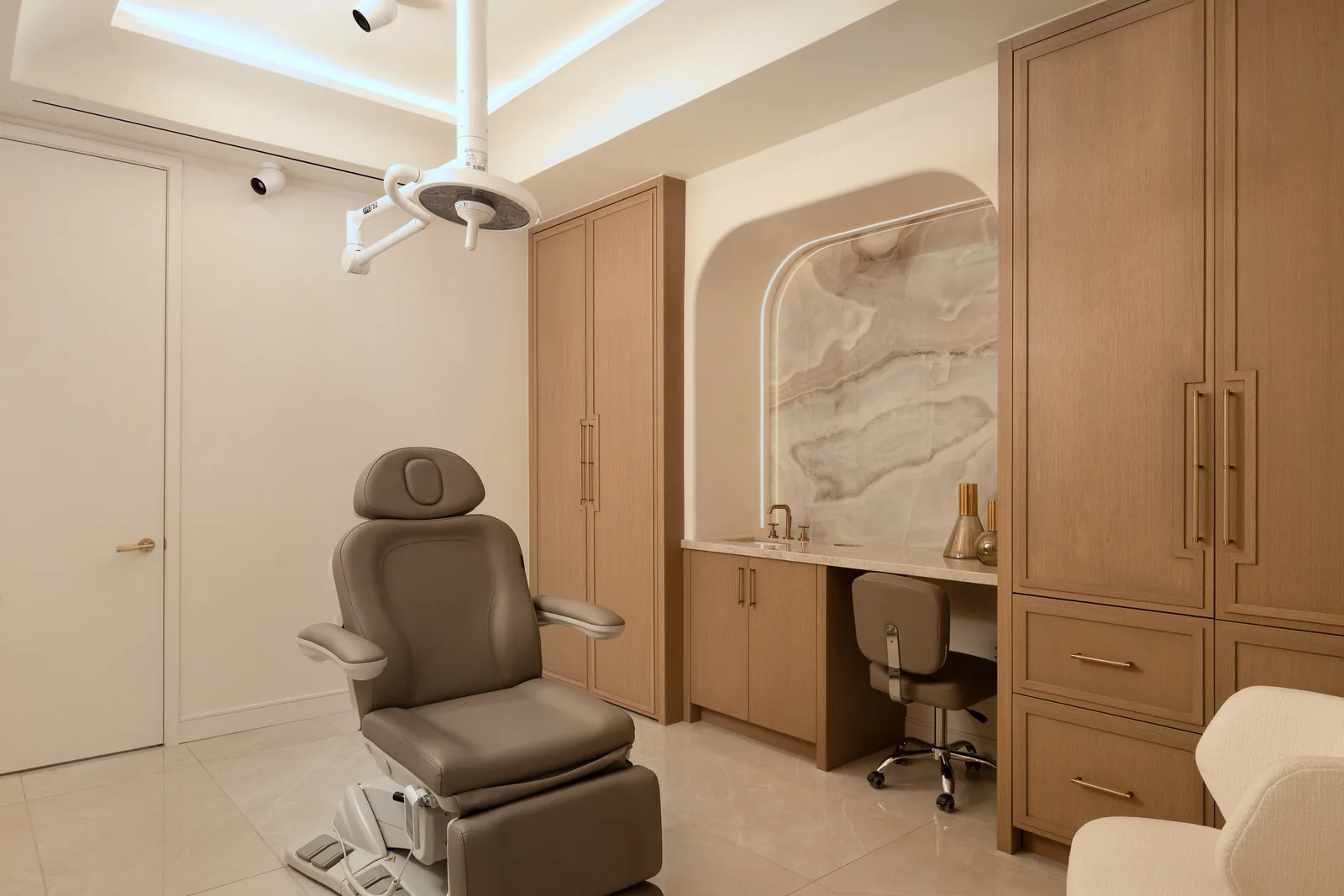
Expressions photographed, history taken, evidence explained
The injector watches you frown, lift, squint, and smile, photographs each expression, records prior products and how long each lasted, and reviews your history. You hear what the SAKURA trials showed, what a median of 24 weeks means for an individual, which areas are on-label, and whether the rest of the face stays on Botox or Dysport.
Five glabellar injections, about five minutes
The skin is cleansed and cooled. Daxxify is injected with an insulin-gauge needle at five marked points in the corrugator and procerus muscles, 8 units at each, a brief pinch at each one. Any other areas are treated in the same sitting with the product chosen for them. No numbing is needed, small bumps settle in 20 to 30 minutes, and you drive yourself home.
Aftercare, a two-week check, and a six-month horizon
You leave knowing to stay upright 4 hours, avoid rubbing and strenuous exercise or heat for 24 hours, and to expect softening within about 2 days and the peak result at 2 to 4 weeks. A two-week check is offered, the date your movement returns is recorded, and the next visit is set at about six months, or sooner if you fade earlier.
Clear Information. Informed Choices.
Safety and Limitations of Daxxify
Daxxify’s side effects are the same family as every botulinum toxin product, and its label lists the ones seen in 1 percent or more of treated patients: headache in 6 percent, eyelid ptosis in 2 percent, and facial paresis in 1 percent. In the 2,691-patient open-label SAKURA 3 study, treatment-related adverse events occurred in 17.8 percent of patients, were generally mild, and did not increase with repeat treatment; eyelid ptosis occurred in 0.9 percent of treatments, and no serious adverse event was treatment-related. The property that makes Daxxify attractive, its duration, is also the property that makes placement matter more, because a heavy eyelid or a dropped brow from product in the wrong place lasts as long as the result does. Daxxify carries the boxed warning shared by all botulinum toxins about distant spread of toxin effect, which has not been reported at glabellar doses. It is the newest of the three neuromodulators the practice offers, with years rather than decades of post-approval experience. At Aesthetica by Ashley Howarth MD, points are placed by protocol, every dose is recorded, and patients with neuromuscular disorders, pregnancy, or prior reactions are not treated.
Possible Side Effects Include
- Small bumps, pinpoint bleeding, or a bruise at an injection site
- Headache in the first day or two, the most common reaction
- Eyelid ptosis or brow heaviness that can last as long as the product does
- Temporary asymmetry corrected at the two-week check
- Rarely, facial paresis, dry eye, or an allergic reaction
What Treatment Cannot Guarantee
- Six months of duration in every patient; a median means half fade sooner
- An FDA-approved result outside the glabella
- Removal of lines already etched into the skin at rest
- The two-decade safety record that Botox has accumulated
- A substitute for a brow lift, blepharoplasty, or facelift
What Happens After Daxxify
Recovery After Daxxify
There is nothing to recover from after Daxxify beyond a first day of leaving the brow alone; what differs from Botox and Dysport is the length of the timeline afterward. The practice asks patients to note the week their frown returns, because that number, more than any trial median, sets their personal interval. When filler is planned as well, it is usually done at the same visit; when SkinPen or a laser is planned, that treatment is separated by about two weeks.
Each point shows a small bleb that flattens in 20 to 30 minutes. Stay upright for 4 hours, do not press or massage the brow, and skip exercise, hot yoga, and the sauna until tomorrow. Makeup can go on once the bumps settle. Expressions are unchanged tonight.
Revance states results as early as the next day and typically within 2 days, and most patients feel the frown becoming harder to make in this window. Headache, the most common reaction on the label, is usually mild, limited to the first day or two, and eased by acetaminophen.
In SAKURA 3 the peak response fell between weeks 2 and 4, with more than 96 percent of patients at none or mild severity. Photographs at maximum frown are compared with the pre-treatment set at two weeks, and any asymmetry is adjusted at a brief follow-up.
In the trials, lines stayed at none or mild for a median of about 24 weeks and did not return to baseline for a median of 26 to 28 weeks; some patients fade at four months, some hold past seven. Movement returns gradually, and the line returns more slowly than the movement. Most patients rebook at about six months, and the recorded return date sets the next interval. Daily mineral sunscreen protects the skin in between; the Skin in Arizona guide explains why.
Before & After
Daxxify, Before and After Treatment
Daxxify results are best judged in three photographs at maximum frown: before treatment, at two to four weeks when the response peaks, and at about five months, which is where its difference from other products shows. Aesthetica by Ashley Howarth MD maintains before-and-after galleries for Daxxify, Botox, Dysport, and dermal fillers, and during your visit the team can show you frown-line cases that match your age and how long each held.
Patient Case Summaries
Selected Daxxify Case Summaries
These deidentified case summaries illustrate how Dr. Howarth and the injectors working under her direction at Aesthetica by Ashley Howarth MD plan Daxxify treatment in Scottsdale. They include a long-term Botox patient who switched for the interval, a first-time patient treated on-label only, a man whose priority was fewer visits, a patient who faded early and was moved back, a patient who asked for Daxxify everywhere and was given a split plan, and a patient for whom no neuromodulator was the answer. Each summary connects the patient’s concern and assessment with the treatment performed or the recommendation made.
Case 01
Switched for interval
Twelve years of Botox, then Daxxify to the glabella for two visits a year
Patient presentation
A woman in her fifties who had received Botox every three to four months for twelve years asked about Daxxify after reading that it lasted six months, since she and her husband now spent part of each year away from Scottsdale.
Skin assessment
She responded reliably to Botox 20 units in the glabella and 20 across the forehead and crow’s feet, with a normal brow, no lid heaviness, and no medical contraindication. Her difficulty was the calendar, not the response.
Procedure performed
Daxxify 40 units to the glabella at the five label points, with the forehead and crow’s feet kept on Botox in the same visit, a two-week check, and a request that she note the week her frown returned.
Clinical rationale
The strongest Daxxify evidence is for the glabella, where the SAKURA trials measured a median of 24 weeks; keeping the other areas on the product with the longest record gave her the longer interval where the data support it without moving everything at once.
Follow-up
Her frown returned at about 23 weeks; she now has Daxxify to the glabella each October and April and Botox to the rest of the upper face on the visits her travel allows.
Case 02
First-time patient
A first neuromodulator treatment limited to the on-label glabellar dose
Patient presentation
A woman in her thirties, new to injectables, asked for Daxxify because she wanted to treat only the vertical lines between her brows and preferred to come in as rarely as possible.
Skin assessment
She had moderate glabellar lines at maximum frown, no forehead lines at rest, a normal brow position, and no history of neuromuscular disease or prior botulinum toxin exposure.
Procedure performed
Daxxify 40 units to the glabella only, at the five label points, with photographs at maximum frown before treatment and at the two-week check.
Clinical rationale
For a patient whose only concern is the glabella, the on-label indication, the fixed label dose, and the trial duration line up; there was no reason to add areas or to choose a product she would need to revisit every three months.
Follow-up
The softening was evident at day 2 and the peak at week 3; she returned at just under six months and repeated the same treatment.
Case 03
Fewer visits
A man who wanted the fewest possible appointments and accepted a newer product
Patient presentation
A man in his forties with a demanding travel schedule said he would only commit to a neuromodulator if it meant two visits a year, and asked whether Daxxify was proven enough.
Skin assessment
He had severe glabellar lines with heavy corrugators, a strong brow, and no lid heaviness. He had never been treated. The assessment reviewed the SAKURA data with him, including that the trials were sponsored by the maker and that a median means half of patients fade sooner.
Procedure performed
Daxxify 40 units to the glabella, with a two-week check and an agreement to record the week of return before deciding whether the interval justified the choice.
Clinical rationale
An informed patient whose priority is the interval is exactly whom the product suits, and stating the limits of the evidence in advance is part of a physician-led plan; the label dose is fixed, so heavy corrugators were treated at the same 40 units with precise placement.
Follow-up
His frown returned at about five months; he calls that acceptable and returns twice a year.
Case 04
Faded early
A patient whose Daxxify lasted four months, moved back to a familiar product
Patient presentation
A woman in her forties who had switched to Daxxify from Dysport reported that her frown lines were back at four months, sooner than she had expected, and asked whether she should try it again.
Skin assessment
Her response to the treatment itself had been full at the two-week check, so this was a duration outcome on the shorter side of the trial range rather than a failure; her records showed Dysport had lasted about three and a half months.
Recommendation
One further Daxxify cycle to see whether the duration was consistent, with the option to return to Dysport at her usual interval if it was not; she chose to return to Dysport, which she preferred for its onset.
Clinical rationale
A median of 24 weeks means half of patients fade sooner, and two weeks of additional duration did not outweigh her preference for a product she knew; an honest plan lets the patient weigh the trade rather than repeating a product on principle.
Follow-up
She has returned to Dysport at three-and-a-half-month intervals and is satisfied with the schedule.
Case 05
Split plan
A request for Daxxify in every area, answered with a split between products
Patient presentation
A woman in her fifties asked for Daxxify to the glabella, forehead, crow’s feet, and masseters so that all of her treatments could move to a six-month cycle.
Skin assessment
She responded well to neuromodulators in all four areas. The assessment reviewed the evidence: an FDA approval and phase 3 data for the glabella, a 48-patient open-label study for the forehead and crow’s feet, and no published aesthetic data for the masseter. Her masseters were bulky, and drift toward the smile muscles was a concern with any product.
Procedure performed
Daxxify 40 units to the glabella; Daxxify off-label to the forehead and crow’s feet with consent, at conservative doses informed by the phase 2 study; and Botox 25 units per masseter, all in one visit with a two-week check.
Clinical rationale
The practice matched each area to the product with evidence for it, obtained consent for the off-label areas, and kept the bulky masseter on the product with the most predictable dosing; a split plan delivers the longer interval where it is supported without pretending the evidence is uniform.
Follow-up
Her glabella held past five months, the forehead and crow’s feet about four and a half, and the masseters about five; she now returns twice a year with Botox to the masseters at each visit.
Case 06
Not this treatment
Etched frown lines with a low brow, and why the honest answer was surgery and resurfacing
Patient presentation
A woman in her sixties asked for Daxxify because her frown lines had stopped responding to years of neuromodulator treatment elsewhere, and she hoped a stronger product would work.
Skin assessment
Her corrugators were already relaxed at maximum frown; the lines that remained were deep creases etched into thin, sun-damaged Fitzpatrick II skin at rest, and her brows sat low with hooded upper lids that any further treatment would make heavier.
Recommendation
No neuromodulator. Physician-performed laser skin resurfacing of the glabella during laser season, and a surgical consultation with Dr. Howarth for a brow lift and upper blepharoplasty.
Clinical rationale
Daxxify is not a stronger product, only a longer one, and no neuromodulator smooths a crease already etched into the dermis or lifts a brow that has descended; the tools for those problems are resurfacing and surgery, which a plastic surgeon’s practice can offer directly.
Follow-up
Resurfacing was performed in November and the brow lift the following spring; at six months after surgery she has not needed a neuromodulator in the glabella.
From First Visit to a Plan You Can Keep
Booking, Planning, and Follow-Up at Aesthetica by Ashley Howarth MD
Aesthetica by Ashley Howarth MD is a medical practice with a spa’s convenience. Established patients book online. New patients can book online or request a consultation, and the team responds usually the same day.

Online booking or a consultation request
Book a Daxxify assessment directly online, or request a consultation and mention which product you have had before, how long it lasted, and why the interval matters to you. Either path starts with the same examination of how your face moves.
A plan that may use two products
About two visits a year, set by your own return date
Daxxify is not seasonal. Most Scottsdale patients settle into two glabellar visits a year, with the week their frown returned recorded each time so the interval is theirs rather than the trial median. A-List members have the next visit scheduled before they leave the last one.
Your Questions, Answered
Daxxify Frequently Asked Questions
Daxxify is daxibotulinumtoxinA-lanm, a botulinum toxin type A neuromodulator made by Revance and FDA-approved in 2022 for glabellar frown lines. Like Botox and Dysport it blocks acetylcholine release at the nerve ending so the injected muscle contracts less and the line it folds into the skin softens. Its difference is the carrier: a 35 amino acid peptide, RTP004, stabilizes the toxin instead of human serum albumin.
In the two phase 3 SAKURA trials, a single 40-unit glabellar treatment kept frown lines at none or mild for a median of 24 weeks, about six months, and lines did not return to baseline for a median of 26 to 28 weeks. The 2,691-patient SAKURA 3 study confirmed a median of 24 weeks across repeat treatments. A median means half of patients fade sooner; some hold past seven months and some return at four.
Revance states results as early as the next day and typically within 2 days, and most patients at Aesthetica by Ashley Howarth MD feel the frown becoming harder to make in that window. The peak response in the SAKURA 3 study fell between weeks 2 and 4, which is when photographs are compared at the two-week check. That timeline is a little faster than Botox and similar to Dysport.
All three relax muscle the same way. Daxxify is peptide-stabilized, approved only for the glabella, and lasted a median of 24 weeks in its trials, against 3 to 4 months for the others; it is also the newest, with the least long-term data. Botox has four aesthetic approvals including platysma bands and the longest record. Dysport starts fastest, typically 2 to 3 days, and spreads slightly more, which suits a broad forehead.
The FDA label sets a single glabellar dose of 40 units, given as 8 units at each of five points, two in each corrugator and one in the procerus, no more often than every three months. Daxxify units are their own scale and do not convert to Botox or Dysport units. Off-label forehead and crow’s feet doses in the published phase 2 study were 32 and 48 units; the practice sets any off-label dose at the assessment.
Yes. The FDA approved Daxxify in September 2022 for the temporary improvement of moderate to severe glabellar lines in adults, and in 2023 for cervical dystonia. It is not approved for forehead lines, crow’s feet, the masseter, or platysma bands; those are off-label uses that Aesthetica by Ashley Howarth MD performs only with informed consent and, for the neck, usually recommends Botox, which holds that approval.
Off-label, yes, with consent. A 48-patient open-label phase 2 study in Dermatologic Surgery treated the glabella, forehead, and crow’s feet with Daxxify and found none or mild severity lasted a median of 24.6, 20.9, and 24.9 weeks, with no eyelid or brow ptosis. That is a small study, so the practice often keeps those areas on Botox or Dysport in the same visit while the glabella receives Daxxify.
The label lists headache in 6 percent of treated patients, eyelid ptosis in 2 percent, and facial paresis in 1 percent. In the SAKURA 3 study, treatment-related events occurred in 17.8 percent of patients, were generally mild, and did not increase with repeat treatment; eyelid ptosis followed 0.9 percent of treatments. Because the product lasts longer, a placement problem lasts longer too, which is why the practice places every point by protocol.
An adult with moderate to severe frown lines who wants two visits a year instead of four, responds to neuromodulators, and is comfortable choosing a newer product on its phase 3 evidence. At Aesthetica by Ashley Howarth MD it suits established patients who travel or split the year between Scottsdale and elsewhere. It is not for pregnancy, breastfeeding, neuromuscular disease, or lines etched at rest, which need resurfacing or surgery.
Daxxify at Aesthetica by Ashley Howarth MD is injected by Dr. Ashley Howarth, MD, FACS, a board-certified plastic surgeon and instructor in plastic surgery at Mayo Clinic, or by an advanced aesthetic nurse injector working under her direction and protocols. Every dose and point is recorded, a two-week check is part of the plan, the week your frown returns is noted, and any complication is managed on site by a physician.
Concerns Treated
Concerns This Treatment Addresses
These guides explain each concern and where this treatment fits among the options at Aesthetica by Ashley Howarth MD in Scottsdale.
- Fine Lines & Wrinkles Glabellar frown lines, the on-label use of Daxxify
- Skin Texture, Pores & Dullness What a neuromodulator does not change, and what does
- Skin Laxity Why a heavy brow or hooded lids need a different tool
- Skin in Arizona Why sun protection guards a six-month result
- Botox The original, with four FDA aesthetic approvals
- Dysport The fastest onset, for events and broad foreheads
BEGIN HERE
Request a Consultation
Tell us what you are considering. A member of our patient care team will follow up with consultation availability and next steps.

Megan S.
Patient Coordinator
Prefer to talk or text?
Selected References