
Hybrid Fractional, 1470 nm and 2940 nm
What HALO Hybrid Laser Is
HALO is Sciton’s hybrid fractional laser, the first device to deliver a non-ablative 1470 nm wavelength and an ablative 2940 nm erbium wavelength in the same pass, lifting sun damage, smoothing rough texture and enlarged pores, and softening fine lines. At Aesthetica by Ashley Howarth MD it sits between the gentler MOXI and the deeper ablative treatments, with most patients needing 1 to 2 treatments and downtime of 5 to 7 days (sunburn-like redness, a sandpaper feel, then peeling) before the “HALO glow” appears at 2 to 3 weeks, scheduled during laser season, October to April.
HALO is Sciton’s hybrid fractional laser, the first device to deliver a non-ablative and an ablative wavelength in the same pass. The 1470 nm non-ablative beam heats columns in the dermis, tunable from 250 to 700 microns deep according to Sciton, to drive collagen remodeling; the 2940 nm ablative erbium beam removes columns of the epidermis, tunable from 20 to 100 microns, to lift sun damage, smooth rough texture and enlarged pores, and soften fine lines. Both are fractional, so intact skin between the columns heals the treated columns quickly. Aesthetica by Ashley Howarth MD, the med spa of Howarth Plastic Surgery in Scottsdale, uses HALO as the step between the gentle 1927 nm MOXI and the deeper ablative treatments, ProFractional and Contour TRL. Most patients need 1 to 2 treatments. Downtime is 5 to 7 days: sunburn-like redness on days 1 to 2, a sandpaper feel on days 2 to 3, peeling on days 3 to 5, and the change patients call the HALO glow at 2 to 3 weeks. In Arizona, where the summer UV index regularly reaches 11 or higher, HALO is scheduled during laser season, October to April, on untanned skin.
What makes HALO different from a single-wavelength laser is measurement. Sciton’s Intelligent Energy Delivery maps the treatment area so the operator knows when full coverage is reached, Dynamic Thermal Optimization adjusts the power of each 1470 nm pulse to the skin’s temperature, and an optical speedometer on the handpiece keeps the pass even. The result is a controlled, repeatable treatment of both the surface and the dermis, with a multi-center trial in the Journal of Drugs in Dermatology reporting improvement in photodamage with a favorable safety profile. Sciton lists HALO as cleared for skin types I to VI; at Aesthetica by Ashley Howarth MD, Fitzpatrick I to IV skin is treated routinely, V at reduced density after a test area, and VI is usually directed to MOXI. For color, discrete brown spots and redness, HALO is paired with BBL HERO in the same visit. The team can compare Sciton lasers at the assessment.

Why Patients Ask for HALO
What Patients Who Choose HALO Notice
Most people who ask Aesthetica by Ashley Howarth MD about HALO have already tried lighter care. They describe skin that has changed in texture, not just color, after years of Arizona sun, and they want one treatment that does something visible within a week of downtime they can plan around. The common findings are these.
- Rough, crepey texture across the cheeks and forehead
- Enlarged pores on the nose and inner cheeks
- Fine lines beside the eyes and on the upper lip that makeup settles into
- Mottled sun damage and dullness that peels and MOXI improved only partly
- Shallow rolling acne scars and uneven surface
- A chest or backs of hands that look older than the face
HALO treats the surface and the dermis in one session, so texture, tone, and fine lines improve together. The glow shows at two to three weeks and collagen remodeling continues for months, provided daily sunscreen continues.


Surgeon-Directed Care
More Tools in the Toolbox: Why a Plastic Surgeon Directs Hybrid Fractional Resurfacing
Aesthetica by Ashley Howarth MD is the medical aesthetics practice of Ashley Howarth, MD, FACS, a board-certified plastic surgeon and instructor in plastic surgery at Mayo Clinic. HALO removes part of the skin surface, and the decisions that make it safe are depth decisions: how deep the 2940 nm ablation goes and how dense the 1470 nm columns are for a given skin type, which zones of the face can take more and which, like the eyelids and neck, must take less, and when a concern has passed the point that a fractional laser can reach. Dr. Howarth sets those protocols. Standard HALO on the face, neck, chest, and hands is performed by the physician-led team under them; deeper, zone-specific, or surgery-coordinated plans are physician-performed by Dr. Howarth. She also sets the rule that every pigmented lesion is examined before it is treated, because a resurfacing laser can lighten an early melanoma enough to delay a diagnosis.
Aesthetica by Ashley Howarth MD is the med spa of a plastic surgery practice, and that changes what can be offered. HALO sits in the middle of a ladder that runs from MOXI and BBL at the light end through ProFractional and MicroLaserPeel to full-field Contour TRL, so the plan can step up when HALO is not enough, or step down when it is more than the skin needs. When the concern is etched wrinkles or laxity, the conversation does not end at the door: the same physician evaluates the next step, from physician-performed laser skin resurfacing to eyelid surgery, facelift, and neck lift, and can coordinate resurfacing with surgery. A surgeon directing the plan means more tools in the toolbox, and an honest answer about which one you need.

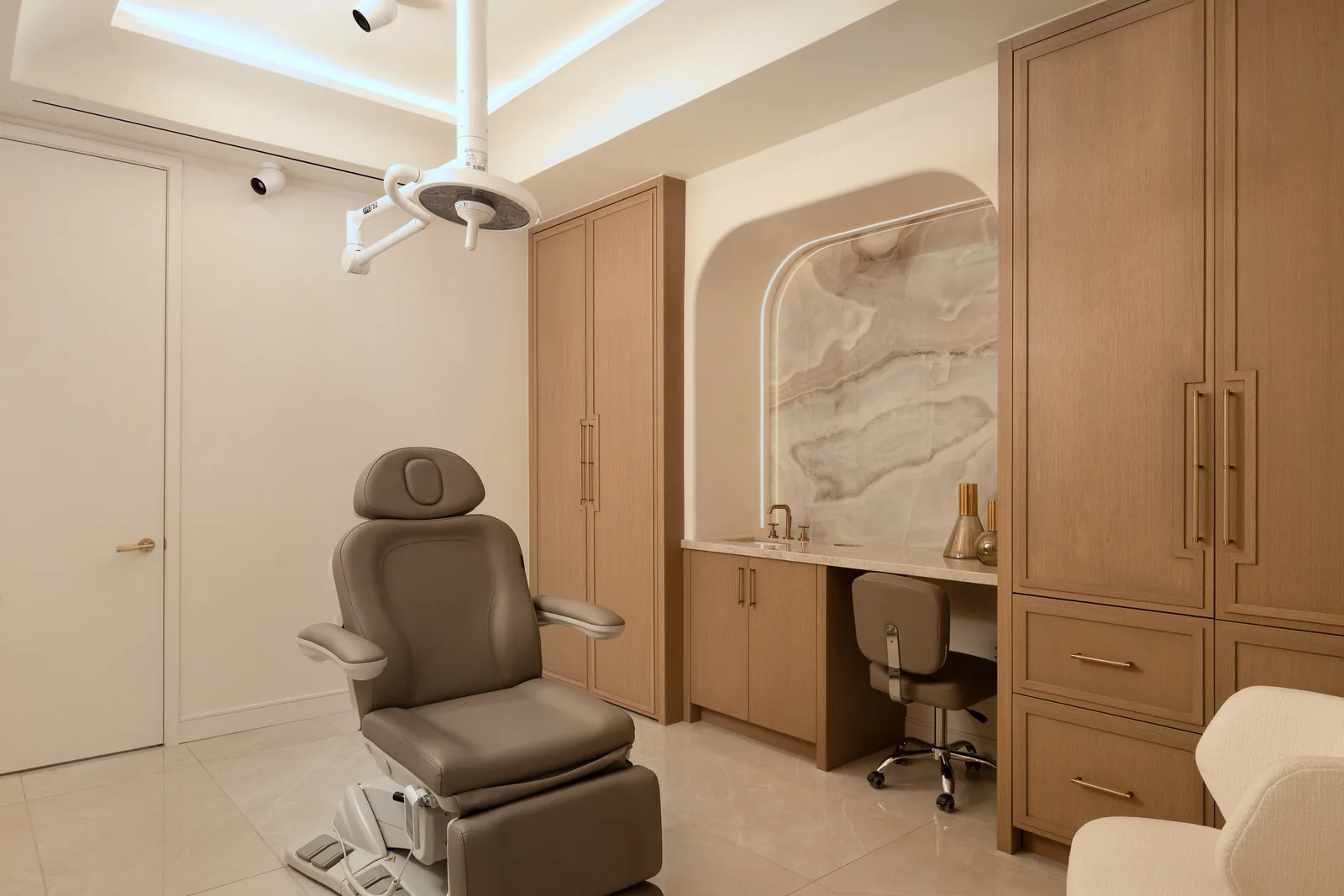
SCOTTSDALE · MODERN OFFICE SETTING
Where to Start
Who HALO Is For, and What Happens First
HALO at Aesthetica by Ashley Howarth MD is for adults with sun damage, rough texture, enlarged pores, fine lines, dullness, or mild scarring on the face, neck, chest, or hands, who can plan 5 to 7 days of visible peeling, are untanned at the time of treatment, and can protect the treated skin from sun for two to four weeks afterward. The skin assessment comes first. A member of the physician-led team records your Fitzpatrick skin type and recent sun exposure, examines the texture and any lines under magnification, separates sun damage from melasma and from any lesion that needs a dermatologist, reviews retinoid, isotretinoin, and photosensitizing medication use, and asks about cold sores. Fair to medium skin with texture, pores, and sun damage is planned for a standard HALO, often with BBL HERO for color in the same visit. Fitzpatrick V skin starts with a test area at reduced density. Moderate to deep acne scars are directed to ProFractional, deep etched lines to Contour TRL performed by Dr. Howarth, and diffuse pigment with no texture change to MOXI. The team says which, and why, before anything is scheduled.
Dr. Ashley Howarth, MD, FACS is a board-certified plastic surgeon and an instructor in plastic surgery at Mayo Clinic. Aesthetica by Ashley Howarth MD is the medical aesthetics brand of her practice, Howarth Plastic Surgery, at 7373 N. Scottsdale Road, Suite C150, Scottsdale, Arizona 85253.

Two Wavelengths, One Pass
How HALO Is Used in Scottsdale
Standard HALO for Sun Damage and Texture
A standard full-face HALO treatment takes 30 to 45 minutes after numbing, with peeling over days 3 to 5 and the HALO glow appearing at two to three weeks.
The standard HALO at Aesthetica by Ashley Howarth MD sets the 2940 nm ablative depth and the 1470 nm non-ablative depth and density for a full-face treatment of sun damage, rough texture, and dullness on fair to medium skin. Numbing cream sits for 45 to 60 minutes, the pass takes 30 to 45 minutes, and the skin peels over days 3 to 5. One treatment produces the HALO glow at two to three weeks; a second at 4 to 8 weeks is planned when the damage is heavy. It is scheduled October to April, and most long-term Arizona residents repeat it every one to two years.
Light HALO for Pores, Early Lines, and Darker Skin
A lighter HALO setting treats enlarged pores and early fine lines with peeling closer to three to four days, and reduced settings after a test area are how Fitzpatrick IV and V skin is treated.
A lighter HALO lowers ablative depth and density for enlarged pores, the first fine lines, and prejuvenation in patients whose skin does not yet need a full correction, with peeling closer to three to four days. The same reduced settings, after a test area, are how Fitzpatrick IV and V skin is treated: Sciton lists HALO as cleared for skin types I to VI, and the published evidence for non-ablative fractional treatment in skin of color supports lower density and longer intervals. Fitzpatrick VI skin is usually directed to MOXI instead.
HALO + BBL in One Visit
Combining BBL first with HALO in one visit treats both color and texture, with the HALO peel carrying away the darkened BBL spots so recovery is no longer than HALO alone.
HALO treats texture and the dermis, and BBL HERO treats color, the discrete brown spots and redness that melanin and hemoglobin absorb. Combined in one visit, the BBL pass goes first and the HALO pass follows, and the HALO peel carries away the darkened BBL spots at the same time, so the recovery is no longer than HALO alone. At Aesthetica by Ashley Howarth MD this is the standard plan for a long-term Scottsdale resident whose face shows both spots and texture, scheduled between October and April on untanned skin.
When HALO Is Not the Answer
HALO is not the right tool for moderate to deep acne scars, etched perioral and periorbital wrinkles, melasma, or skin laxity; each of those needs a different treatment or the surgeon.
HALO has limits that the team states plainly. Moderate to deep atrophic acne scars need the deeper, adjustable channels of ProFractional, 1 to 3 treatments 4 to 8 weeks apart. Etched perioral and periorbital wrinkles need full-field resurfacing with Contour TRL, which Dr. Howarth performs herself as physician-performed laser skin resurfacing. Melasma is treated with topical therapy and low-level MOXI, not HALO. And laxity is a structural problem that no fractional laser corrects; that conversation belongs with the surgeon.
At a Glance
HALO at a Glance
How HALO is planned by concern at Aesthetica by Ashley Howarth MD; depth, density, and any pairing are set at the skin assessment, and who performs each part is written into the plan.
| Concern | HALO setting | Treatments | Downtime | Scottsdale season |
|---|---|---|---|---|
| Sun damage and mottled pigment | Standard HALO, moderate ablative depth and density | 1 to 2, four to eight weeks apart; then every 1 to 2 years | 5 to 7 days | October to April |
| Rough texture and enlarged pores | Standard HALO; light HALO for pores alone | 1 to 2 | 5 to 7 days; 3 to 4 for light HALO | October to April |
| Fine lines beside the eyes and on the cheeks | Standard HALO with deeper 1470 nm columns; etched lines go to Contour TRL | 1 to 2 | 5 to 7 days | October to April |
| Shallow rolling acne scars | Standard HALO; defined atrophic scars go to ProFractional | 1 to 2, or a surface pass after ProFractional | 5 to 7 days | October to April |
| Darker skin types, Fitzpatrick IV and V | Light HALO after a test area, reduced density, topical preparation, no BBL | 1 to 2, eight weeks apart | 5 to 7 days | October to April |
| Spots plus texture: HALO + BBL | BBL HERO pass first, then standard HALO, same visit | 1 combined visit, then BBL yearly and HALO every 1 to 2 years | 5 to 7 days; BBL adds none | October to April |
Which Laser
HALO vs MOXI vs ProFractional
How HALO differs from the lighter and deeper fractional lasers at Aesthetica by Ashley Howarth MD, so you can see where it fits; the full seven-treatment comparison is on the Sciton laser comparison page.
| HALO | MOXI | ProFractional | |
|---|---|---|---|
| Type and wavelength | Hybrid fractional: 1470 nm non-ablative plus 2940 nm ablative erbium in one pass | 1927 nm non-ablative fractional | 2940 nm ablative fractional erbium |
| What it targets | Sun damage, texture, pores, fine lines, shallow scars: surface and dermis together | Diffuse pigment, dullness, early texture, melasma cautiously; prejuvenation | Acne scars, deeper texture, regional lines; channels adjustable to well over 1 mm |
| Skin types | I to IV routinely; V at reduced density; Sciton lists I to VI | All types; IV to VI at conservative settings | I to IV routinely; V and VI at conservative depth after a test area |
| Downtime | 5 to 7 days of redness, sandpaper, and peeling | 1 to 2 days pink, 3 to 5 days of fine mends | 3 to 7 days depending on depth |
| Treatments | 1 to 2; then every 1 to 2 years | 3, four weeks apart; then 1 to 2 a year | 1 to 3, four to eight weeks apart |
| Performed by | Physician-led team under Dr. Howarth's protocols; deeper or zone-specific plans by Dr. Howarth | Physician-led team under Dr. Howarth's protocols | Dr. Howarth or the team depending on depth |
A Visit Built Around Your Skin Type
What to Expect at a HALO Visit at Aesthetica by Ashley Howarth MD
A HALO visit at Aesthetica by Ashley Howarth MD has three parts: an examination that sets depth and density for your skin type and concern, an hour of numbing followed by the treatment, and a written recovery and sun plan. Plan on about two hours in the office.
Skin type, texture examined, and depth and density chosen
The team records your Fitzpatrick skin type and recent sun exposure, examines texture, pores, lines, and any scars under magnification, flags any lesion that needs a dermatologist first, and sets the 2940 nm depth, 1470 nm depth, and density, plus whether BBL is added. Tanned skin postpones treatment.
Numbing, protective eyewear, and a measured pass over each zone
Numbing cream sits for 45 to 60 minutes. The handpiece maps the area and its optical speedometer keeps the pass even, with Dynamic Thermal Optimization adjusting each 1470 nm pulse to skin temperature. The sensation is warm prickling that builds; a full face takes 30 to 45 minutes. Skin is red and warm when you leave.
A recovery and sun plan in writing
You leave with a bland occlusive moisturizer, mineral SPF 30 or higher for once the surface has closed, instructions not to pick or peel, a no-heat rule for the first week, a hat-and-shade plan for two to four weeks, and a follow-up check at about two weeks.
Clear Information. Informed Choices.
Safety and Limitations of HALO
HALO is safe when depth and density match the skin type and the skin is untanned. Most side effects are expected and last about a week. The one that matters most in Arizona is post-inflammatory hyperpigmentation, a new darkening of treated skin that is more likely on tanned skin, on darker skin types treated too densely, and on skin exposed to sun or heat while the surface is open. That risk is why the team screens skin type, schedules HALO between October and April, uses reduced density and a test area on Fitzpatrick IV and V skin, and keeps patients out of pools, saunas, and hard workouts until peeling is complete. Sciton lists HALO as cleared for skin types I to VI; the settings are what keep that true.
Possible Side Effects Include
- Redness, warmth, and swelling for 1 to 3 days, most noticeable around the eyes
- Bronzed mends and a sandpaper feel on days 2 to 3, then peeling on days 3 to 5
- Post-inflammatory hyperpigmentation, especially with sun, heat, or tanned skin
- Acne or milia flare during healing
- Rarely, cold sore reactivation, infection, prolonged redness, or scarring
What Treatment Cannot Guarantee
- Correction of deep etched wrinkles, which need Contour TRL
- Correction of deep acne scars, which need ProFractional
- Any tightening of loose skin or jowls
- Permanent results while daily sun exposure continues
- A substitute for skin cancer screening
What Happens After HALO
Recovery After HALO
Recovery from HALO takes about a week and follows a predictable sequence: sunburn-like redness, then a sandpaper feel, then peeling, then the HALO glow. The timeline below is for a standard full-face treatment; a light HALO runs a day or two shorter. When BBL is added in the same visit, the darkened brown spots peel away with the HALO surface rather than adding days.
The skin is red, warm, and tight, like a strong sunburn, and swelling is most noticeable around the eyes on the first morning. Cool compresses, a bland occlusive moisturizer reapplied often, and sleeping with the head raised help. No makeup, no sunscreen on the open surface yet, no heat, sweat, or pools. Most patients rest at home.
Redness settles toward pink and the surface develops a rough sandpaper feel as the treated columns, the mends, rise to the surface and darken to a bronze tone. Keep the skin moist; do not scrub, pick, or exfoliate. Retinoids and acids stay paused. Gentle cleanser only.
The mends flake and peel over days 3 to 5, revealing pink new skin. Once the surface is closed, usually day 5 to 7, mineral SPF 30 or higher goes on and makeup is fine. Hats and shade continue for two to four weeks, and hard workouts wait until peeling is finished.
At two to three weeks the tone is brighter and texture smoother, the change patients call the HALO glow. Collagen remodeling continues for 3 to 6 months, softening fine lines further. A second treatment, if planned, falls at 4 to 8 weeks. Most Scottsdale patients repeat HALO every one to two years in laser season, with MOXI or BBL between. Read more in the Skin in Arizona guide.
Before & After
HALO, Before and After Treatment
HALO results are best judged in photographs taken in the same light before treatment and four to twelve weeks after, because texture and fine lines keep improving as collagen remodels. Aesthetica by Ashley Howarth MD maintains before-and-after galleries for HALO, MOXI, and BBL, and the team can show you cases that match your skin type, whether the concern is sun damage, texture and pores, or fine lines, and the time of year during your visit.
Patient Case Summaries
Selected HALO Hybrid Laser Case Summaries
These deidentified case summaries illustrate how the physician-led team at Aesthetica by Ashley Howarth MD plans HALO treatment in Scottsdale. They include heavy sun damage and texture in a long-term resident, pores and early lines in a lighter plan, a darker skin type treated at reduced density, a same-visit HALO and BBL combination, acne scars where ProFractional was the honest answer, and deep etched lines referred to Dr. Howarth for physician-performed Contour TRL. Each summary connects the patient’s concern and skin assessment with the treatment performed or the recommendation made.
Case 01
Sun damage and texture
Thirty years of Scottsdale sun treated with two standard HALO sessions
Patient presentation
A woman in her fifties who had lived in Scottsdale for three decades and played tennis outdoors described skin that looked mottled, rough, and dull across her cheeks and forehead, with fine lines that makeup settled into.
Skin assessment
The assessment found diffuse photodamage on Fitzpatrick II skin: mottled pigment, coarse texture, enlarged pores, and fine lines beside the eyes, with no atypical lesion and no melasma. Peels and a MOXI series two years earlier had helped tone but not texture. She was untanned in November.
Procedure performed
A standard full-face HALO at moderate ablative depth and density in November, followed by a second HALO at six weeks, with daily mineral SPF and a retinoid resumed after peeling.
Clinical rationale
Heavy photodamage with texture change needs the 2940 nm ablative component that MOXI lacks, and the 1470 nm dermal columns address the fine lines; two sessions spaced six weeks apart reach a result one lighter session would not.
Follow-up
At twelve weeks after the second treatment the texture was visibly smoother and the tone even; she plans a maintenance HALO every other winter with a BBL and MOXI visit in the years between.
Case 02
Pores and early lines
Enlarged pores and the first fine lines treated with a light HALO
Patient presentation
A woman in her thirties, a recent arrival from the Northeast, asked about enlarged pores on her nose and inner cheeks and the first fine lines beside her eyes, and wanted the shortest downtime that would still make a visible difference.
Skin assessment
The assessment found even tone on Fitzpatrick II skin with enlarged pores and early periorbital lines, no sun damage to correct, and no scarring. She could plan a long weekend but not a full week away from client meetings. She was untanned in February.
Procedure performed
A single light HALO at reduced ablative depth and density to the full face in February, with attention to the nose and inner cheeks, and a plan to repeat every eighteen months.
Clinical rationale
Pores and early lines respond to the combined surface and dermal treatment at lighter settings, which shortens peeling to about three to four days; a full-strength HALO would have added downtime without a matching benefit for skin with little damage.
Follow-up
She was presentable with makeup by day four, saw the glow at two weeks, and reported smaller-looking pores at her three-month check; she uses MOXI in the alternate years.
Case 03
Acne scars
Moderate atrophic acne scars where ProFractional was recommended instead of HALO
Patient presentation
A man in his twenties with fair skin asked for HALO, which he had read about online, for boxcar and rolling acne scars across both cheeks left from teenage acne that was now quiet.
Skin assessment
The assessment found moderate atrophic scarring on Fitzpatrick II skin with defined boxcar edges, no active acne, and no isotretinoin in the past year. HALO’s ablative depth tops out at 100 microns per Sciton, which improves texture and shallow rolling scars but does not reach the base of defined atrophic scars.
Recommendation
A series of three ProFractional treatments at increasing depth, 6 to 8 weeks apart, between November and March, with HALO reserved for a later surface-smoothing pass once the scar depth had improved.
Clinical rationale
ProFractional’s 2940 nm channels can be set well over a millimeter deep to remodel the base of an atrophic scar, which HALO cannot do; recommending the right laser over the requested one is part of a physician-directed plan.
Follow-up
After three ProFractional sessions the boxcar edges were softened and the cheeks smoother; a light HALO the following winter refined the surface, and he is pleased with the sequence.
Case 04
Fitzpatrick IV
Sun damage and texture on Fitzpatrick IV skin treated at conservative density
Patient presentation
A woman in her forties with olive skin who worked outdoors in Scottsdale for years reported uneven tone and a rough surface, and said another office had told her lasers were not safe for her skin.
Skin assessment
The assessment found diffuse photodamage and coarse texture on Fitzpatrick IV skin with no melasma pattern and no keloid history. Sciton lists HALO as cleared for skin types I to VI, and the evidence for non-ablative fractional treatment in skin of color supports lower density and longer intervals. She was untanned in December.
Procedure performed
A test area behind the ear at reduced settings, then a full-face HALO at low ablative depth and reduced density in December, with a topical brightening routine before and after, no BBL, and an eight-week interval before a second conservative treatment.
Clinical rationale
On Fitzpatrick IV skin the risk to manage is post-inflammatory hyperpigmentation, which rises with density and heat; a test area, reduced density, topical preparation, and a longer interval keep HALO safe rather than ruling it out.
Follow-up
Peeling finished by day six with no darkening, the tone was more even at four weeks, and she returned for the second treatment in February; she now uses MOXI for maintenance.
Case 05
HALO + BBL
Brown spots and texture on a long-term resident treated with BBL and HALO in one visit
Patient presentation
A man in his sixties, a retired Scottsdale golfer, reported distinct brown spots on his cheeks and temples and a leathery, uneven surface that he attributed to decades on the course without a hat.
Skin assessment
The assessment found numerous solar lentigines plus coarse texture and fine lines on Fitzpatrick II skin. Two irregular lesions on the left temple were photographed and referred to a dermatologist, and one was treated there before any laser. He was untanned in January.
Procedure performed
After dermatologist clearance, a single combined visit in January: a BBL HERO pass with the 560 nm filter over the spots, followed in the same session by a standard full-face HALO, with a second HALO planned for the following winter.
Clinical rationale
BBL targets the melanin in discrete spots, which HALO’s water-absorbing wavelengths do not do efficiently, and the HALO peel carries away the darkened BBL spots with the treated surface, so the combination adds no recovery days.
Follow-up
By three weeks the spots had peeled away and the surface was smoother; he wears a wide-brimmed hat on the course and returns each January for BBL, with HALO every other year.
Case 06
Referred for Contour TRL
Deep etched upper-lip lines referred to Dr. Howarth for physician-performed Contour TRL
Patient presentation
A woman in her sixties, a long-term Arizona resident and former smoker, asked for HALO for the vertical lines above her upper lip and the etched lines under her eyes, which lipstick bled into and which she said HALO had been recommended for by a friend.
Skin assessment
The assessment found deep, etched perioral and periorbital rhytids on Fitzpatrick II skin with heavy photodamage across the rest of the face. Lines this deep are beyond the reach of HALO’s fractional treatment; they need full-field ablation with adjustable depth and coagulation.
Recommendation
A consultation with Dr. Howarth, who performed a Contour TRL full-field resurfacing of the perioral and periorbital zones in February with about ten days of downtime, and a standard HALO by the physician-led team to the rest of the face in the same laser season.
Clinical rationale
Etched wrinkles are a depth problem that only a physician-performed full-field erbium resurfacing solves, and a plastic surgeon directing the practice means the zone-specific plan can be matched to the fractional plan rather than substituting one for the other.
Follow-up
At three months the lip lines were markedly softer and the lipstick bleed had stopped; she maintains with BBL each winter and has discussed eyelid surgery with Dr. Howarth for the loose skin the laser did not address.
From First Visit to a Plan You Can Keep
Booking, Planning, and Follow-Up at Aesthetica by Ashley Howarth MD
Aesthetica by Ashley Howarth MD is a medical practice with a spa’s convenience. Established patients book online. New patients can book online or request a consultation, and the team responds usually the same day.

Online booking or a consultation request
Book a skin assessment directly online, or request a consultation and describe the texture, pores, lines, or sun damage you notice, where it is, and how much downtime you can plan. Either path starts with the same examination of your skin.
Depth, density, and a date you can peel through
You leave your first visit with a written plan: standard or light HALO; the depth and density for your skin type; one treatment or two; which month it falls in; whether BBL is added or ProFractional or Contour TRL is the better tool; who performs each part; and the recovery and sunscreen routine that protects the result.
A two-week check, then maintenance timed to laser season
A check at about two weeks confirms healing and the glow. Most Scottsdale HALO plans repeat every one to two years with BBL or MOXI in between, summer HydraFacial, and year-round mineral sunscreen. A-List members have the next season scheduled before they leave the last one.
Your Questions, Answered
HALO Hybrid Laser Frequently Asked Questions
HALO is Sciton’s hybrid fractional laser, the first to deliver a non-ablative 1470 nm wavelength and an ablative 2940 nm erbium wavelength in the same pass. The 1470 nm columns heat the dermis, tunable from 250 to 700 microns, to rebuild collagen; the 2940 nm columns remove surface skin, tunable from 20 to 100 microns, to lift sun damage and smooth texture. Most patients need 1 to 2 treatments.
HALO treats sun damage and mottled pigment, rough texture, enlarged pores, fine lines, dullness, and shallow scars on the face, neck, chest, hands, arms, and legs. It does not correct deep etched wrinkles, which need Contour TRL, deep acne scars, which need ProFractional, melasma, which is treated with topical therapy and MOXI, or loose skin, which no fractional laser tightens.
Both HALO wavelengths are absorbed by water in the skin. The 2940 nm beam vaporizes microscopic columns of the epidermis, removing damaged surface cells, while the 1470 nm beam heats deeper columns in the dermis that the body replaces with new collagen. Because both are fractional, intact skin between the columns speeds healing to about a week, and Sciton’s Dynamic Thermal Optimization adjusts each pulse to skin temperature.
Sciton lists HALO as cleared for Fitzpatrick skin types I to VI. At Aesthetica by Ashley Howarth MD, types I to IV are treated routinely, type V at reduced depth and density after a test area with topical preparation, and type VI is usually directed to MOXI, because the risk of post-inflammatory hyperpigmentation rises with skin type, density, heat, and sun. Tanned skin of any type postpones treatment.
Most patients need one HALO treatment for a visible result and two, spaced 4 to 8 weeks apart, when sun damage or texture is heavy. After that, most Scottsdale patients repeat HALO every one to two years during laser season, with MOXI or BBL maintenance in between. A light HALO for pores or early lines is often repeated about every eighteen months.
Plan on 5 to 7 days. Days 1 to 2 bring sunburn-like redness and swelling, days 2 to 3 a sandpaper texture with bronzed flecks, and days 3 to 5 peeling. Makeup and mineral sunscreen go on once the surface closes, usually day 5 to 7. Because the treated skin then needs two to four weeks of strict sun protection, Aesthetica by Ashley Howarth MD schedules HALO in laser season, October to April. See the Skin in Arizona guide.
Most patients describe HALO as warm prickling that builds through the pass rather than sharp pain. Numbing cream is applied for 45 to 60 minutes first, and Sciton’s Dynamic Thermal Optimization adjusts each 1470 nm pulse to skin temperature. A full face takes 30 to 45 minutes. Afterward the skin feels like a strong sunburn for a day or two, eased by cool compresses and a bland moisturizer.
Brighter, smoother skin shows as peeling finishes at 5 to 7 days, and the change patients call the HALO glow is clearest at two to three weeks. Collagen remodeling continues for 3 to 6 months, so fine lines and texture keep improving after the visible peel is over. Photographs before treatment and at 4 to 12 weeks show the change most clearly.
Yes. HALO is most often paired with BBL HERO in the same visit, BBL first for brown spots and redness, then HALO for texture, and the HALO peel carries the darkened spots away without adding downtime. HALO alternates with MOXI in maintenance years, and Botox or fillers are scheduled at a separate visit. Deep lines or scars are handled by Contour TRL or ProFractional rather than by adding HALO passes.
The collagen HALO builds and the sun damage it removes do not reverse on their own, but new damage forms wherever sun exposure continues, and in Arizona that is about 300 days a year with a summer UV index of 11 or higher. With daily mineral SPF 30 or higher, most patients hold their result for one to two years before a maintenance HALO, with MOXI or BBL in between.
Concerns Treated
Concerns This Treatment Addresses
These guides explain each concern and where this treatment fits among the options at Aesthetica by Ashley Howarth MD in Scottsdale.
- Sun Damage & Brown Spots Mottled sun damage with HALO, discrete spots with BBL
- Skin Texture, Pores & Dullness The core HALO concern, surface and dermis in one pass
- Fine Lines & Wrinkles Fine lines with HALO, etched lines with Contour TRL
- Acne & Acne Scars Shallow scars with HALO, deeper scars with ProFractional
- Skin in Arizona Why timing matters in the desert
- Sciton Laser Comparison Which laser fits which concern
BEGIN HERE
Request a Consultation
Tell us what you are considering. A member of our patient care team will follow up with consultation availability and next steps.

Megan S.
Patient Coordinator
Prefer to talk or text?
Selected References